








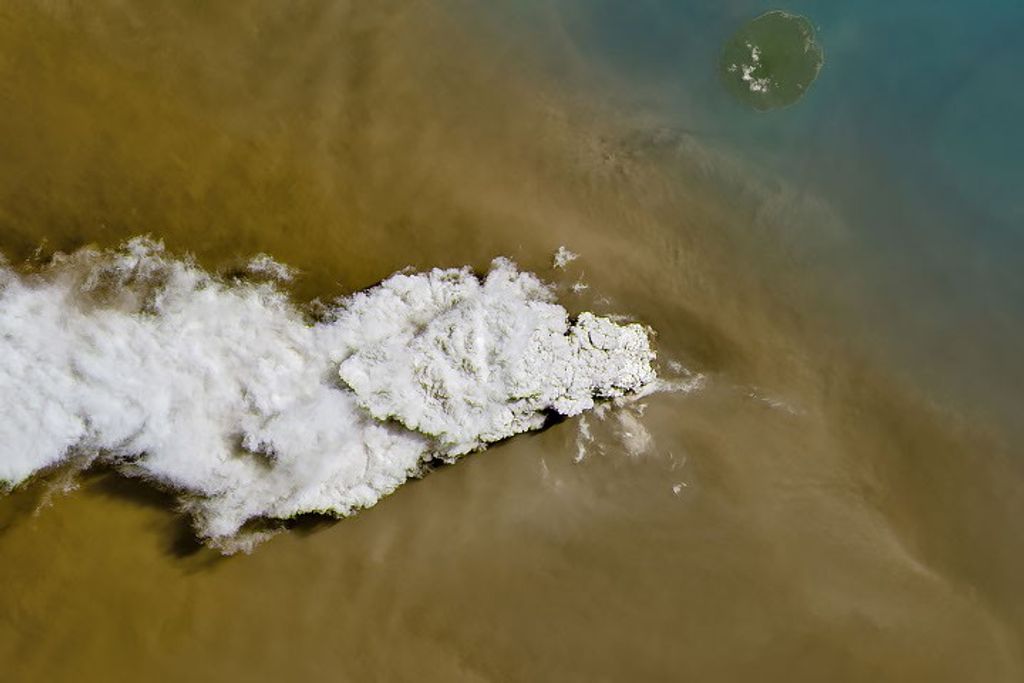











Taken from the International Space Station (ISS) by the EarthKAM camera, this nadir (straight-down) photograph shows Australia’s famed Eighty Mile Beach. Despite its name, the beach is 140 miles long (220 kilometers). It is a well-known recreational site for fishing and boating.
The waters off Eighty Mile Beach are inhabited by whales, dolphins, and dugongs within the Eighty Mile Beach Marine Park. The beach is a source for wild pearl oysters including Pinctada maxima, which produces the largest pearl shell on Earth.
Along its sandy coastline, Eighty Mile Beach is also one of Australia’s most important environments for migratory shorebirds. The area is recognized as a wetland of major importance that is now registered with the Ramsar Convention on Wetlands.
Inland from the beach, sets of linear dunes of the Great Sandy Desert can be seen in several places, especially along the light-toned course of an ancient river, now known as the Mandora Salt Marsh. The marsh is an oasis of permanent moisture within the Great Sandy Desert. It draws a wide variety of birds and other animals such as feral camels. Surrounding desert landscapes are the Nyangumarta Warrarn and Karajarri Indigenous Protected Areas.
The most visible human feature is the Great Northern Highway, a faint line that cuts across the image; a network of straight lines of unpaved roads mark the southern end of the beach.
From space, recent fire scars appear as lighter-toned areas with sharp margins. The Great Northern Highway has acted as a firebreak for fire events—with burned vegetation on one side of the highway and unburnt on the other—as seen near the upper and lower margins of the image.
References & Resources
EarthKAM photograph 309003 was acquired on November 10, 2020, with a Nikon D2Xs Digital SLR camera using a 50 millimeter lens. The photo in this article has been enhanced to improve contrast. It is provided by the Sally Ride EarthKAM@Space Camp on the International Space Station. The caption is provided by the Earth Science and Remote Sensing Unit, NASA Johnson Space Center. EarthKAM (Earth Knowledge Acquired by Middle school students) is a NASA educational outreach program that enables students, teachers, and the public to learn about Earth from the unique perspective of space. During Sally Ride EarthKAM missions, middle school students around the world request images of specific locations on Earth. Caption by M. Justin Wilkinson, Texas State University, JETS Contract at NASA-JSC.