










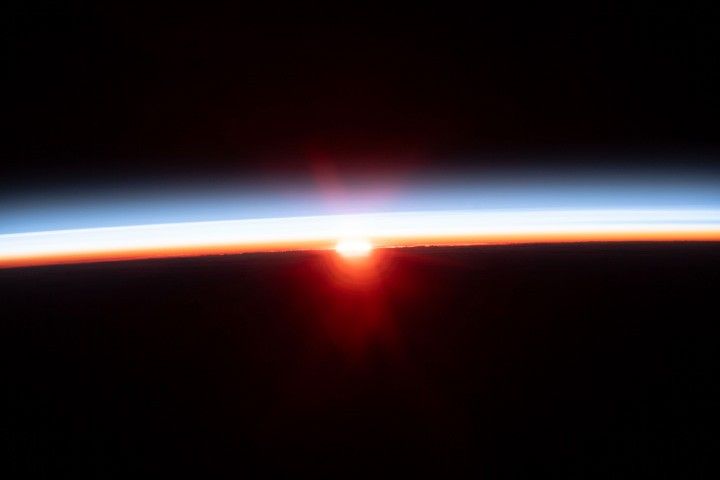
As the International Space Station orbited over the southern Indian Ocean, an astronaut looked eastward and captured this photo of the Sun rising above Earth’s horizon.
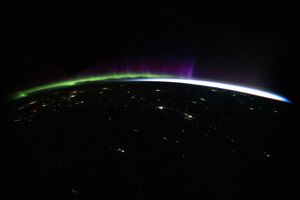
This edge-on photo of Earth’s limb reveals several atmospheric layers. The lowest layer, known as the troposphere, appears orange and red as these wavelengths of light are scattered by particles of dust, smoke, and smog. Directly above the troposphere is the stratosphere. This blue layer is usually cloud-free and extends as much as 50 kilometers (30 miles) above Earth’s surface. The region directly above the stratosphere is known as the mesosphere.
The Sun—the focal point in this image—is front and center in NASA’s Heliophysics Big Year. This “big year” celebration began with the annular solar eclipse in October 2023 and continues with a total solar eclipse in April 2024. It concludes with the Parker Solar Probe’s closest approach to the Sun in December 2024.
The total solar eclipse in April 2024 will pass over Mexico, the United States, and Canada. In addition to putting on an impressive show, the eclipse offers research opportunities including the chance for scientists to study the Sun’s effect on Earth’s ionosphere. This is the region spanning from about 80–600 kilometers (50–400 miles) above Earth’s surface, overlapping with the top of the atmosphere and the beginning of space. It is where the space station and other satellites in low Earth orbit hang out, and where radio and GPS signals bounce around.
During a solar eclipse, astronauts on the space station can sometimes see the Moon’s shadow passing over Earth. Views of sunrises are much more common, with astronauts witnessing as many as 16 sunrises every 24 hours.
References & Resources
Astronaut photograph ISS070-E-1178 was acquired on September 29, 2023, with a Nikon D5 digital camera using a focal length of 170 millimeters. The image was provided by the ISS Crew Earth Observations Facility and the Earth Science and Remote Sensing Unit at Johnson Space Center. The image was taken by a member of the Expedition 70 crew . It has been cropped and enhanced to improve contrast, and lens artifacts have been removed. The International Space Station Program supports the laboratory as part of the ISS National Lab to help astronauts take pictures of Earth that will be of the greatest value to scientists and the public and to make those images freely available on the Internet. Additional images taken by astronauts and cosmonauts can be viewed at the NASA/JSC Gateway to Astronaut Photography of Earth . Caption by Kathryn Hansen .