


















Pluto Moons: Facts
Introduction
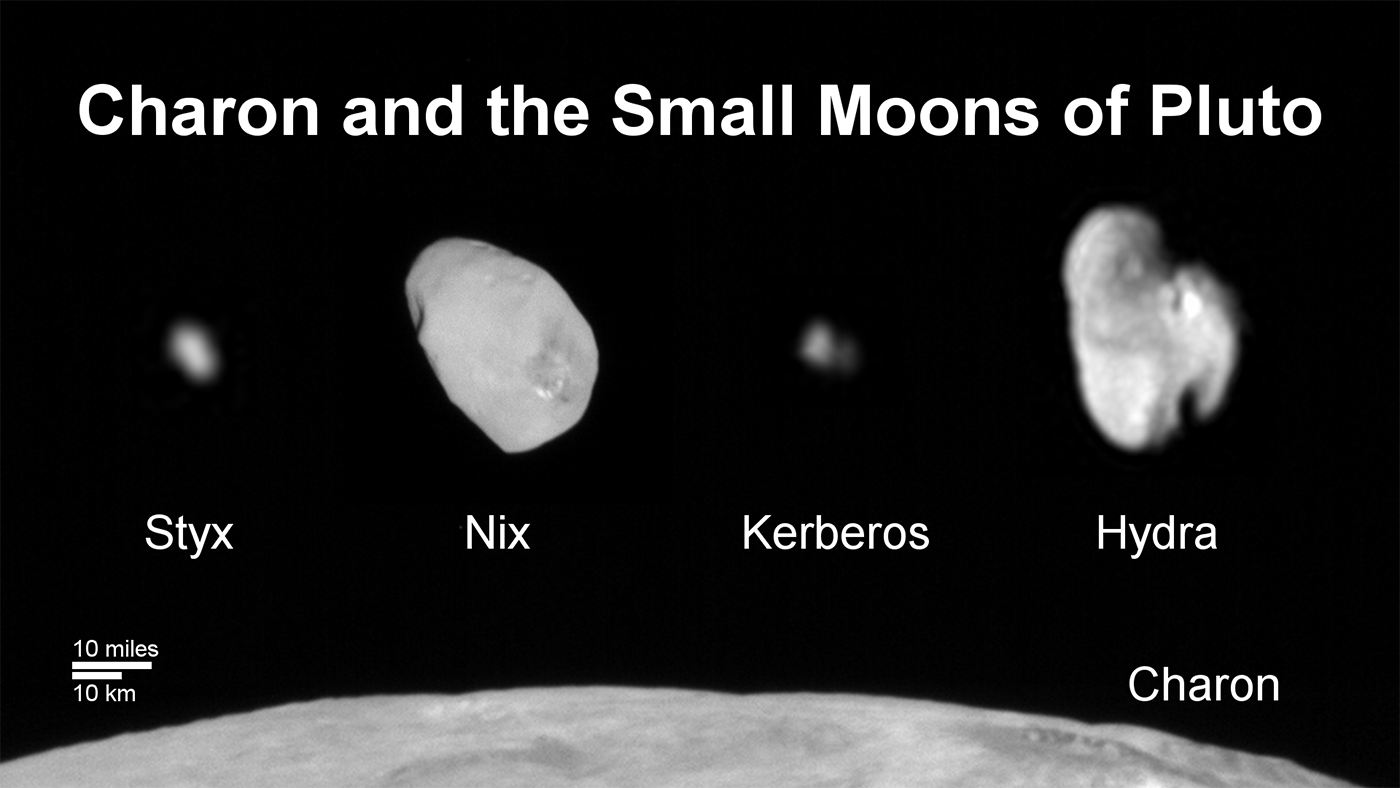
Pluto's moons to scale. The largest, Charon, is displayed along the bottom.
NASA/JHUAPL
Pluto's moon system – Charon, Nix, Hydra, Styx, and Kerberos – is believed to have formed after a collision between Pluto, and another Kuiper Belt Object early in the history of the solar system. The smashup flung material that coalesced into the family of satellites observed around Pluto.
Discovery Circumstances
| I | Charon | S/1978 P1 | 1978 | J.W. Christy | IAU WGPSN |
| II | Nix | S/2005 P2 | 2005 | H.A. Weaver, S.A. Stern, M.J. Mutchler, A.J. Steffl, M.W. Buie, W.J. Merline, J.R. Spencer, E.F. Young, L.A. Young | IAUC 8625 |
| III | Hydra | S/2005 P1 | 2005 | H.A. Weaver, S.A. Stern, M.J. Mutchler, A.J. Steffl, M.W. Buie, W.J. Merline, J.R. Spencer, E.F. Young, L.A. Young | IAUC 8625 |
| IV | Kerberos | S/2011 (134340) 1 | 2011 | M.R. Showalter, D.P. Hamilton, S.A. Stern, H.A. Weaver, A.J. Steffl, L.A. Young | IAUC 9221 |
| V | Styx | S/2012 (134340) 1 | 2012 | M.R. Showalter, H.A. Weaver, S.A. Stern, A.J. Steffl, M.W. Buie, W.J. Merline, M.J. Mutchler, R. Soummer, H.B. Throop | IAUC 9253 |
How Pluto's Moons Were Named
All of Pluto's moons are named for mythological figures associated with the underworld, a naming convention that started when 11-year-old Venetia Burney named Pluto in 1930.