

















While the Arabian Peninsula is known for its vast deserts of sand, the area also contains extensive fields of lava. The western half of the peninsula contains at least 12 volcanic fields known as harrats. One such field is the 14,000-square-kilometer (5,400-square-mile) Harrat Khaybar, one of the largest in Saudi Arabia.
Harrat Khaybar was formed by eruptions over the past 5 million years along a 100-kilometer vent system that runs north-south. According to the Smithsonian’s Global Volcanism Program, the volcanic field is still active, and eight lava flows are less than 1,500 years old. The last known eruption was reported in Harrat Khaybar in the 7th century.
Three of the youngest volcanic vents in Harrat Khaybar can be seen in this image, acquired by the OLI-2 (Operational Land Imager-2) on Landsat 9. These volcanoes resulted from different eruptive styles: Jabal Qidr is a stratovolcano (or composite cone); Jabal Abyad is a felsic dome; and Jabal Bayda is a tuff cone.
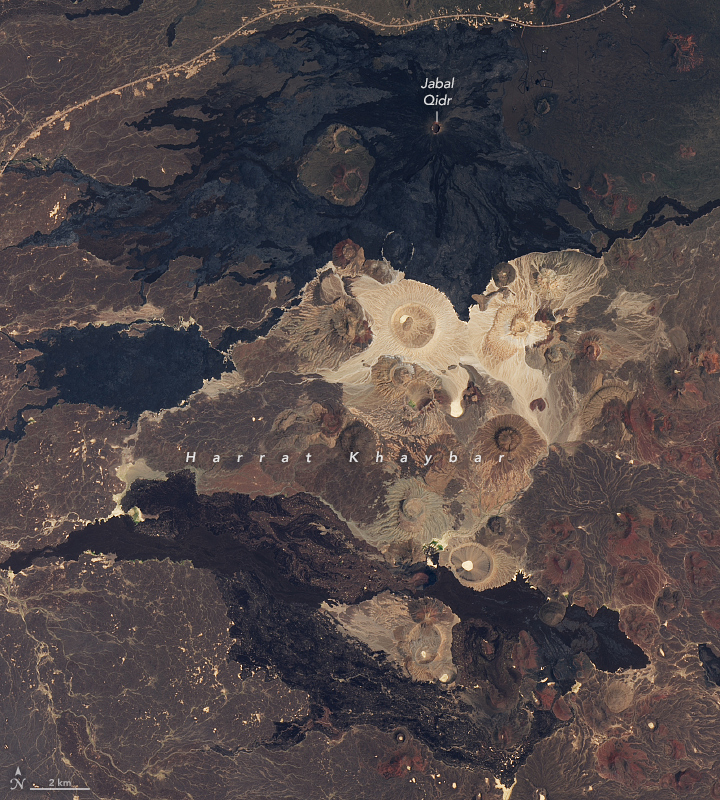
Jabal Qidr, in the northern part of the volcanic field, is built from several generations of dark, basaltic lava flows. Qidr has a 400-meter-diameter summit crater and exhibits the textbook cone shape of a stratovolcano. This is the only stratovolcano in the harrats of western Saudi Arabia.
Jabal Abyad, in the center of the image, was formed from a more viscous, silica-rich lava classified as rhyolite. While Jabal Qidr exhibits the cone shape of a stratovolcano, Jabal Abyad is a lava dome—a rounded mass of thicker, more solidified lava flows. Abyad’s dome reaches over 2,090 meters above sea level, the highest elevation amongst all the surrounding harrats.
To the west of Jabal Abyad is Jabal Bayda, a tuff cone volcano with a much larger summit crater measuring 1,400 meters in diameter. Tuff cones form from the interaction of rising magma with water. When heated rapidly by lava, water turns to steam and expands violently, fragmenting the lava into plumes of very fine grains of ash.
Abyad and bayda are the masculine and feminine words for “white” in Arabic. The lighter color of these mountains comes from the ash of comenditic lavas that are rich with silica. The white and beige colors stand out against the darker basaltic lava of Qidr.
References & Resources
- Alohali, A., et al. (2022)Spatio-temporal forecasting of future volcanism at Harrat Khaybar, Saudi Arabia. Journal of Applied Volcanology, 11 (12).
- Moufti, M. R., et al. (2014)The White Mountains of Harrat Khaybar, Kingdom of Saudi Arabia. International Journal of Earth Sciences, 103, 1641-1643.
- NASA Earth Observatory (2008, April 14) Harrat Khaybar Volcanic Field. Accessed May 21, 2024.
- Németh, K., et al. (2014)Maars over cones: repeated volcanism in the same location along fissures in western Saudi Arabian volcanic fields. 5th International Maar Conference, Abstracts Volume:Juriquilla, Qro., México, Universidad Nacional Autónoma de México, Centro de Geociencias.
- Smithsonian Institution, Global Volcanism Program Harrat Khaybar. Accessed May 21, 2024.
NASA Earth Observatory images by Lauren Dauphin, using Landsat data from the U.S. Geological Survey . Story by Emily Cassidy .