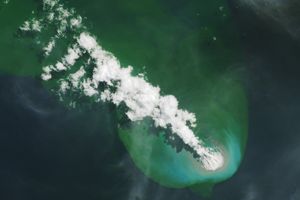

























Alaska’s Augustine Volcano continued erupting in late January 2006. According to the Alaska Volcano Observatory (AVO), the volcano entered a state of continuos eruption on January 28. On January 30, a flight over the volcano showed a volcanic plume reaching approximately 4,900 meters (16,000 feet) above sea level and extending 150 kilometers (90 miles) to the north. The Moderate Resolution Imaging Spectroradiometer (MODIS) flying onboard the Terra satellite captured this image on January 30, 2006. Although clouds cover much of the region, the volcano’s plume can still be seen billowing away toward the northeast.
Considered the most active volcano in the eastern Aleutian arc, Augustine experienced its largest historical eruption in 1883 when the volcano’s dome collapsed. It erupted again in 1986, producing an avalanche of ash, rock fragments, and gas. Augustine’s oldest dated volcanic rocks are more than 40,000 years old.
References & Resources
NASA image courtesy Jeff Schmaltz, MODIS Rapid Response Team at NASA GSFC