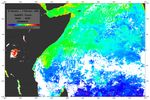


















This false-color image shows concentrations of chlorophyll in the western Indian Ocean and the southern portion of the Persian Gulf on February 1, 2002. Chlorophyll is the primary pigment found in phytoplankton, the microscopic marine plant that comprises the foundation of the ocean food chain.
Red and yellow pixels show the highest concentrations of chlorophyll in the water (ranging from about 30 to 3 milligrams per cubic meter, respectively), green is an intermediate value (1 milligram per cubic meter), while light blues and dark blues show the lowest concentrations (ranging from about 0.5 to 0.05 milligram per cubic meter). Dark grey areas represent land; white areas show where no data were collected due to cloud cover. These data were acquired by the Sea-viewing Wide Field-of-view Sensor (SeaWiFS), flying aboard the OrbView-2 satellite.
References & Resources
SeaWiFS image courtesy the SeaWiFS Project , NASA’s Goddard Space Flight Center, and ORBIMAGE