





















Like migratory birds and many retired couples, monarch butterflies head southfor warmer weather in the wintertime. During the summer hundreds of millions ofmonarchs live and breed throughout the eastern United States and southernCanada. As the fall equinox approaches and temperatures begin to drop, they flysouthwest through Texas and into central Mexico. Here they congregate by themillions at high altitude in fir forests on 12 separate mountain ranges untilthe spring Equinox. They then reverse the course of their migration and travelnorth again.
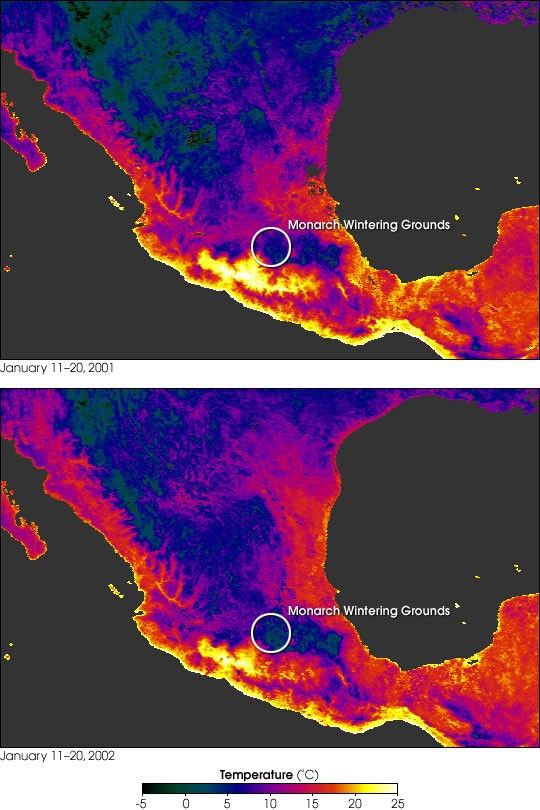
This winter, however, the monarch migration ended in disaster. On January 12,2002, a winter storm blew in over central Mexico. The cold temperatures and rainwiped out up to 250 million (80 percent) of the monarch butterflies nesting inMexico. These false color images taken by the Moderate-resolution ImagingSpectroradiometer (MODIS) aboard NASA’s Terra satellite show the average landsurface temperatures across Mexico from January 11-20 for 2001 and 2002. As isindicated by the increase in the green and dark green pixels, much more of the land’ssurface was freezing in the monarch’s habitat this year than in the last.
The freezing temperatures may have not been the sole reason for the monarch’sdemise. Intense logging in the mountains of Mexico have degraded the fir forestby 44 percent over the past 28 years. The monarchs cluster in the branches ofmature trees and shelter themselves from the elements. With the forestssubstantially thinned and reduced, the monarchs were more exposed to the harshwinds and rains of the winter storm that hit on January 12th. Were the forestsleft intact, a higher percentage of the monarchs may have lived. But given themillions of monarchs that did survive, scientists predict that the insectsshould pull through despite the storm and return again to Mexico next year.
References:
Anderson, J. B., and L. P. Brower. 1996. Freeze-protection of overwinteringmonarch butterflies in Mexico: critical role of the forest as a blanket andan umbrella. Ecological Entomology 21:107-116.
Calvert, W. H., W. Zuchowski, and L. P. Brower. 1983. The effect of rain,snow, and freezing temperatures on overwintering monarch butterflies inMexico. Biotropica 15:42-47.
Brower, L. P., G. Castilleja, A. Peralta, J. Lopez-Garcia, L.Bojorquez-Tapia, S. Diaz, D. Melgarejo, and M. Missrie. 2002. Quantitativechanges in forest quality in a principal overwintering area of the monarchbutterfly in Mexico: 1971 to 1999. Conservation Biology 16:1-15.
References & Resources
Image by Robert Simmon, based on the data sets prepared by the MODIS Land Surface Temperature Group , University of California at Santa Barbara
None