






















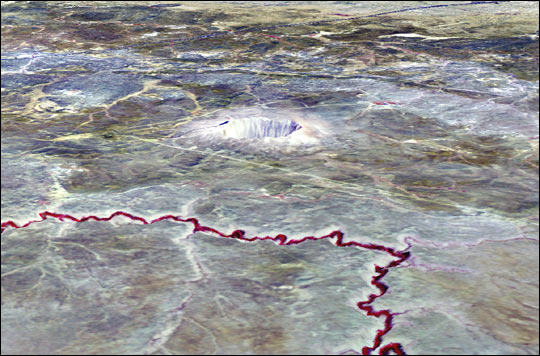
The Barringer Meteorite Crater (also known as “Meteor Crater”) is a gigantichole in the middle of the arid sandstone of the Arizona desert. A rim of smashedand jumbled boulders, some of them the size of small houses, rises 50 meters above the surrounding plain. The crater itself is nearly a 1500 meters wide and 180 meters deep. When Europeans first discovered the crater, the plain around itwas covered with chunks of meteoritic iron—over 30 tons of it—scattered overan area 12 kilometers to 15 kilometers in diameter. Scientists now believe that the crater wascreated approximately 50,000 years ago. The meteorite itself was composedalmost entirely of nickel-iron, suggesting that it may have originated in theinterior of a small planet. It was 50 meters across, weighed roughly 300,000 tons,and traveled at a speed of 65,000 kilometers per hour. This Advanced Spaceborne ThermalEmission and Reflection Radiometer (ASTER) 3-D perspectiveview was created by draping a false-color image (near infrared=red, red=green, green=blue) over a digital elevation model made by the US Geological Survey National Elevation Dataset.
This image was acquired on May 17, 2001 by ASTER aboard NASA’s Terra satellite.
Size: 15 kilometers x 30 kilometers (9 miles x 18 miles)
Location: 35.1 degrees north latitude, 111.0 degrees west longitude
Orientation: Northeast at top
Image Data: ASTER bands 1,2, and 3.
Original Data Resolution: 15 meters
Date Acquired: May 17, 2001
References & Resources
Image courtesy NASA/GSFC/MITI/ERSDAC/JAROS, and U.S./Japan ASTER Science Team