



















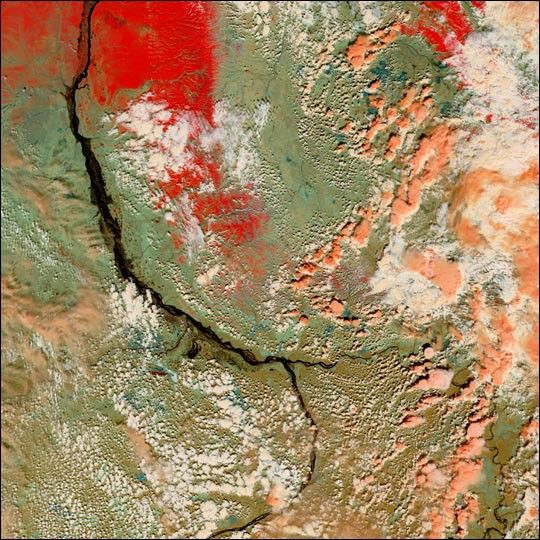
Nearly every year in the late spring, ice blocks the flow of water at the mouthof the Lena River in northeastern Russia and gives rise to floods across theSiberian plains. This year’s floods can be seen in this image taken on June 2,2002, by the MODIS (Moderate Resolution Imaging Spectroradiometer) instrumentaboard the Terra satellite. The river runs down the left side of the image, andits delta is shrouded in ice (red) at the top of the image. Normally, the river would resemble a thin black line in MODIS imagery.
The river, which is Russia’s longest, flows 2,641 miles (4,250 kilometers) southto north through Siberia and into the Laptev Sea. In the winter, the riverbecomes nearly frozen. In the spring, however, water upstream thaws earlierthan water at the mouth of the river. As the southern end of theriver begins to melt, blocks of ice travel downstream to the still frozen delta,pile up, and often obstruct the flow of water. Flooding doesn’t always occur on the same parts of the river. The floods hit further south last year. If the flooding grows severe enough, explosive chargesare typically used to break up the ice jams.
In these false-color images land areas are a dull, light green or tan, and wateris black. Clouds appear pink, and ice comes across as bright red.
References & Resources
Image courtesy Jacques Descloitres, MODIS Land Rapid Response Team at NASA GSFC