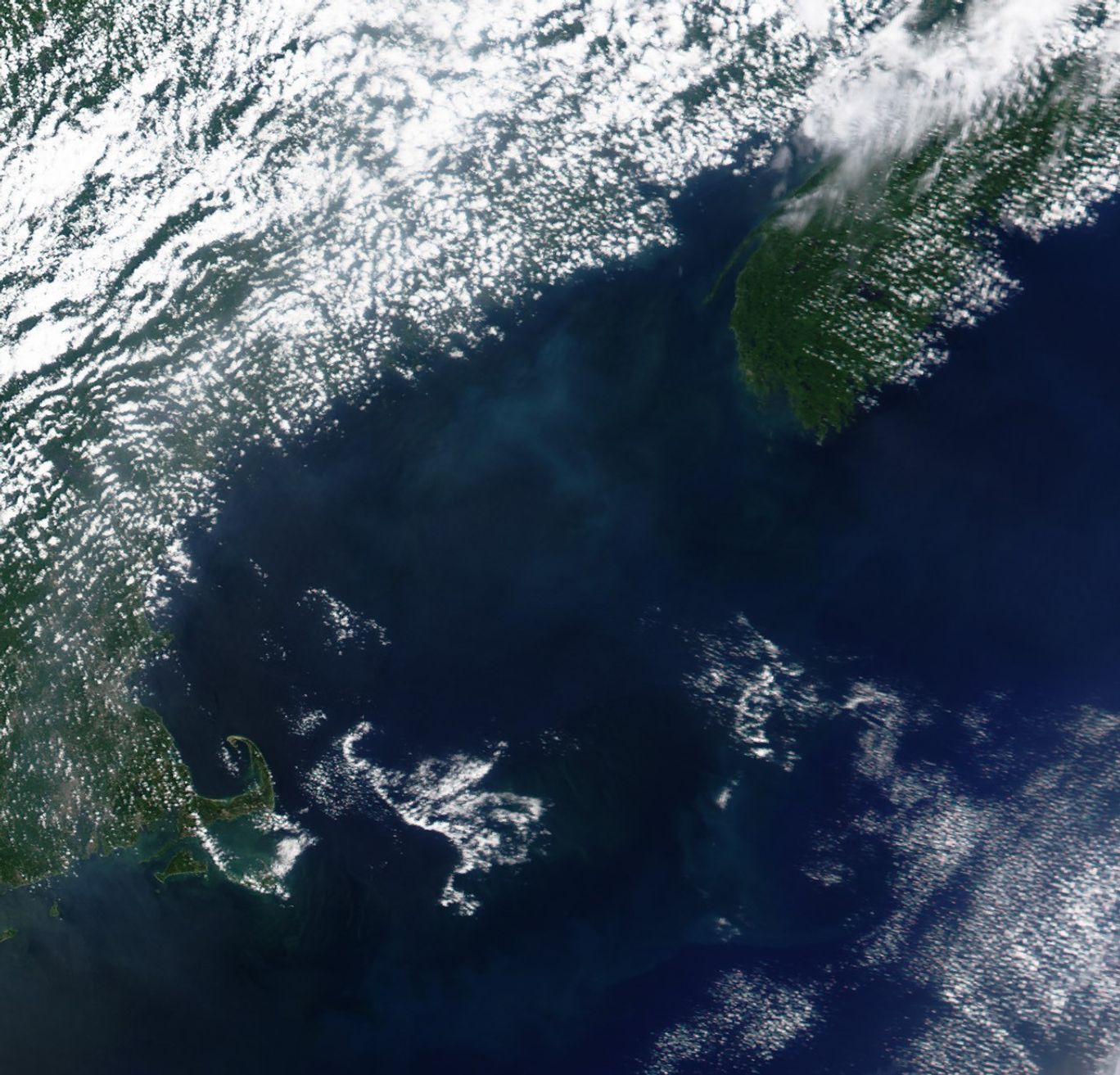
























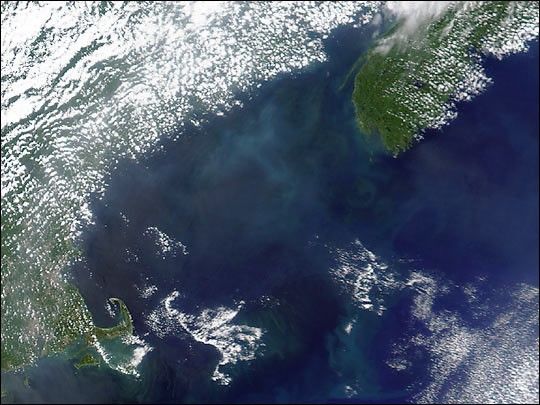
Earlier this summer, trillions of calcite (limestone) coated phytoplankton,known as coccolithophores, appeared in the waters off the coast of Maine. Thistrue color image of the coccolithophore bloom was acquired on July 11, 2002, bythe Moderate-resolution Imaging Spectroradiometer (MODIS), flying aboard NASA’sTerra spacecraft. The bloom is the large bluish-green patch in the center of theimage in the Gulf of Maine.
Unlike any other plant in the ocean, coccolithophores surround themselveswith microscopic plating made of calcite. These scales, known as coccoliths, areshaped like hubcaps and are only three one-thousandths of a millimeter indiameter. What coccoliths lack in size, they make up in volume. At any one timea single coccolithophore is attached to or surrounded by at least 30 scales.Additional coccoliths are dumped into the water when the coccolithophoresmultiply asexually, die or simply make too many scales. In areas with trillionsof coccolithophores, the waters will turn an opaque turquoise from the densecloud of coccoliths. (Click to read more about coccolithophores.)
Though there are always coccoliths in the Gulf of Maine, the area hasn’t seena bloom like this one since 1989. Currently, NASA researchers are studying thebloom aboard a ferry in the gulf in an attempt to measure the bloom’s densityand depth. So far the bloom appears to be about 20 to 25 meters thick andcontains nearly half a million tons of calcite.
References & Resources
Image by Jesse Allen, NASA Earth Observatory; Data courtesy MODIS Land Rapid Response Team