
















![Request for Information – Potential [Placeholder for Prize]](https://assets.science.nasa.gov/dynamicimage/assets/science/psd/solar/2023/09/s/solarsystem_0.jpg?w=1024)









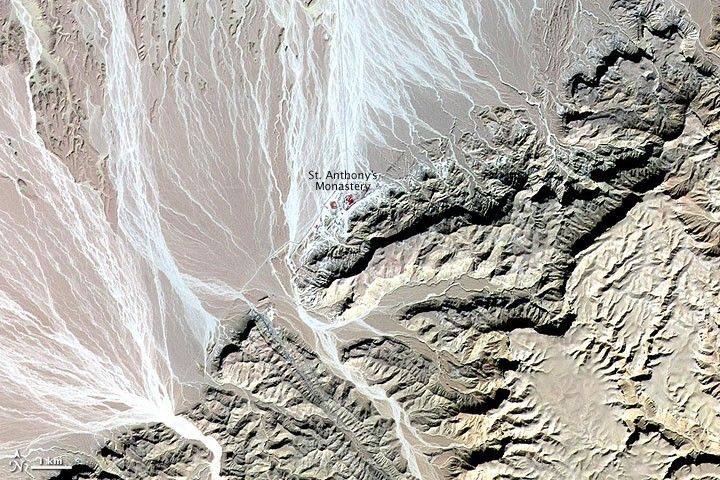
In northeastern Egypt, roughly 33 kilometers (20 miles) west of the Gulf of Suez, rugged hills give way to flat terrain. This abrupt landscape transition is obvious from the perspective of a satellite, thanks in part to an arid environment that minimizes plant cover that might blur the transition. The Advanced Spaceborne Thermal Emission and Reflection Radiometer (ASTER) on NASA’s Terra satellite captured this false-color image of the region on November 13, 2009.
Bare rock ranges in color from pink-beige to tan. Vegetation appears red. The Sun’s relatively low angle in this autumn image leaves the north-facing slopes in shadow. Immediately northwest of the hills are a collection of alluvial fans. When fast-moving rivers exit steep terrain, the water often fans out over flat land. Wavy lines of blue-gray and white show where rivulets once ran through mountains and spread out over flat land.
Although little plant life thrives in this region, underwater springs give rise to isolated oases, and one such oasis became the site of one of Egypt’s oldest Coptic Christian monasteries, that of St. Anthony. Two dots of bright red near the base of the hills indicate vegetation associated with the monastery.
References & Resources
- Byrnes, A. (2007). Geography and Geology of the Eastern Desert. Accessed February 12, 2010.
- Dunn, J. (2005). St. Anthony’s Monastery. Accessed February 12, 2010.
NASA image courtesy ASTER Science Team and Jet Propulsion Laboratory Photojournal. Caption by Michon Scott.