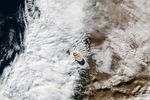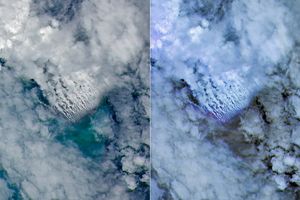






















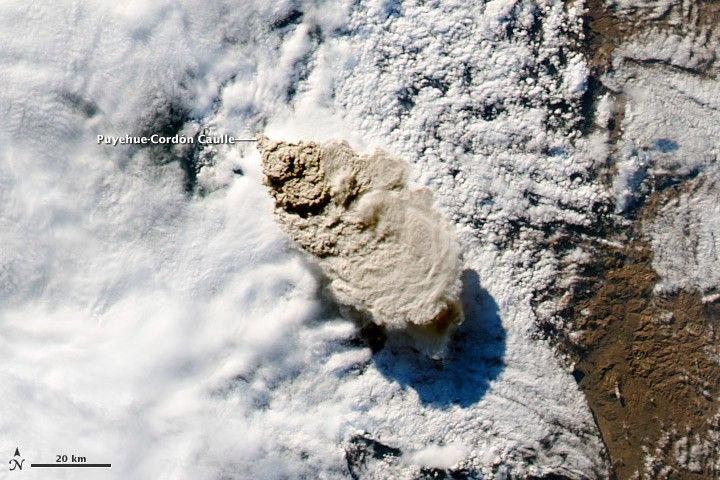
On June 4, 2011, a fissure opened in Chile’s Puyehue-Cordón Caulle Volcanic Complex, sending ash 45,000 feet (14,000 meters) into the air. The Moderate Resolution Imaging Spectroradiometer (MODIS) on the Aqua satellite captured this natural-color image shortly after the eruption began.
The brown ash plume reaches high above the clouds, covering much of the scene, and casts a shadow towards the southeast. Along the leading edge of the plume, it appears that heavier material is falling out of the ash cloud, while finer particles remain suspended in the atmosphere.
After this image was taken, the ash quickly blew eastward towards Argentina. Over the border, near the town of Bariloc, a layer of ash at least 30 centimeters (12 inches) deep covered the ground, the Buenos Aires Herald reported. Argentinian police collected golfball-sized pumice near the border, which is at least 21 kilometers (13 miles) from the eruption.
As the eruption continued, the plume blew north and then east over the Atlantic Ocean, reaching some 3,300 kilometers in length. The cloud of airborne ash forced flight cancellations at several airports in Argentina, including the two airports in Buenos Aires, reported the Buenos Aires Herald.
The Puyehue-Cordón Caulle Volcanic Complex is a chain of formations that includes the Puyehue volcano, the Cordillera Nevada caldera, and the Cordón Caulle rift zone. The complex is active, with the last eruption occurring as recently as 1990 and the last major eruption in 1960, both in the Cordón Caulle rift zone. The 2011 eruption appears to be coming from an area northeast of the vents that erupted in 1960, says volcanologist Eric Klemetti.
As of the afternoon of June 6, the eruption had started to diminish in intensity, said SERNOGEOMIN, Chile’s geology and mineral agency. The MODIS image from June 7 shows the eruption continuing.
References & Resources
- Buenos Aires Herald. (2011, June 6). State of emergency remains in Bariloche, schools, public buildings to stay closed. Accessed June 6, 2011.
- Buenos Aires Herald. (2011, June 7). Aeroparque flights back to normal; Ezeiza awaits committee decision. Accessed June 7, 2011.
- Global Volcanism Program. (n.d.) Payehue-Cordón Caulle. Smithsonian National Museum of Natural History. Accessed June 7, 2011.
- Harrington, R. (2011, June 6). Puyehue-Cordón Caulle update, 6 June 2011. (The Volcanism Blog)
- Klemetti, E. (2011, June 6). Spectacular Images and Video of the Puyehue-Cordón Caulle Eruption in Chile. (Eruptions.)
- NOAA Satellite and Information Service. (2011, June 4). Buenos Aires, Argentina-Volcanic Ash Advisories. Accessed June 6, 2011.
- Servicio Nacional de Geología y Minería. (2011, June 6). Reporte especial de actividad volcánica no 31 región de Los Ríos complejo Volcánico Puyehue-Cordón. (Spanish) Accessed June 7, 2011.
NASA image by Jeff Schmaltz MODIS Rapid Response Team , NASA-GSFC. Caption by Rob Simmon and Holli Riebeek.