












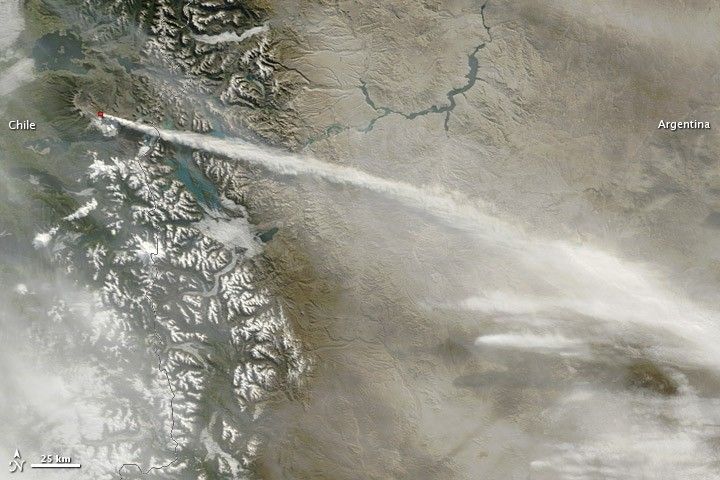
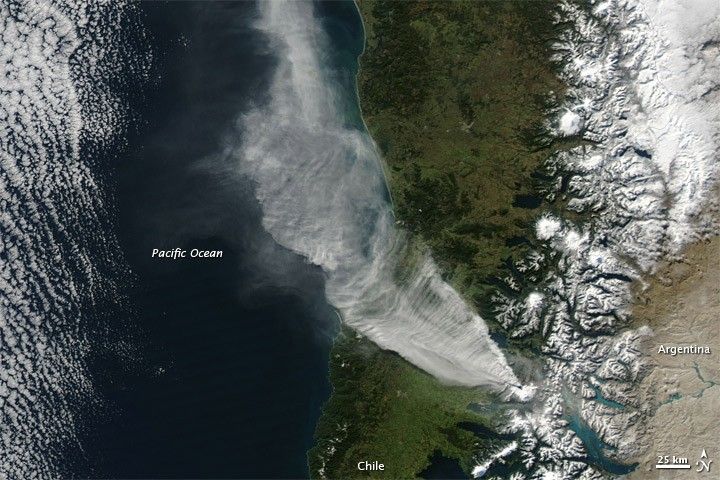
Though less dramatic than the initial eruption in June, Chile’s Puyehue-Cordón Volcano Complex continued releasing ash and steam in early July 2011. Shifting winds moved the plume in different directions, sometimes over the Pacific and sometimes over South America, where ash interfered with air traffic.
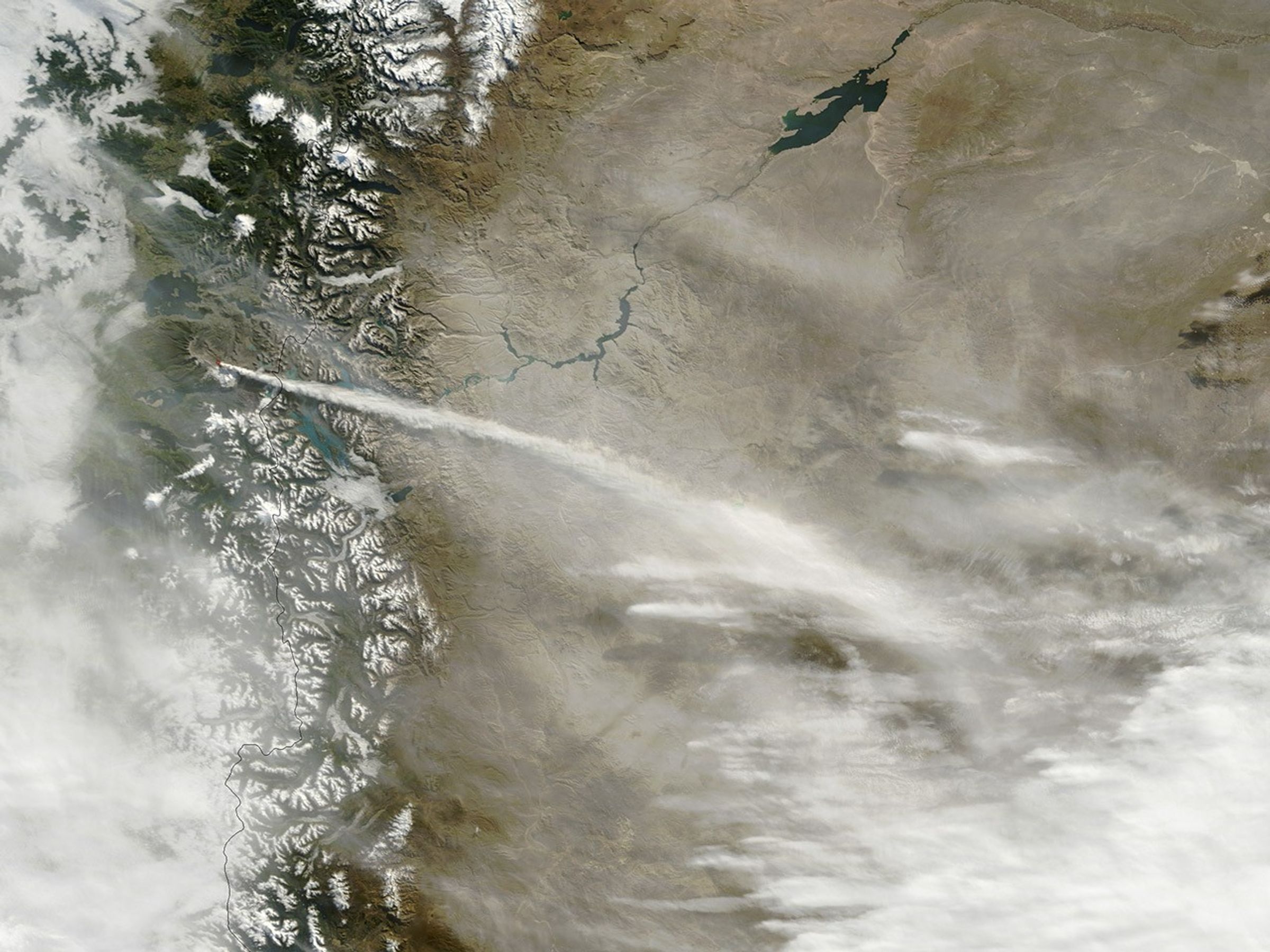
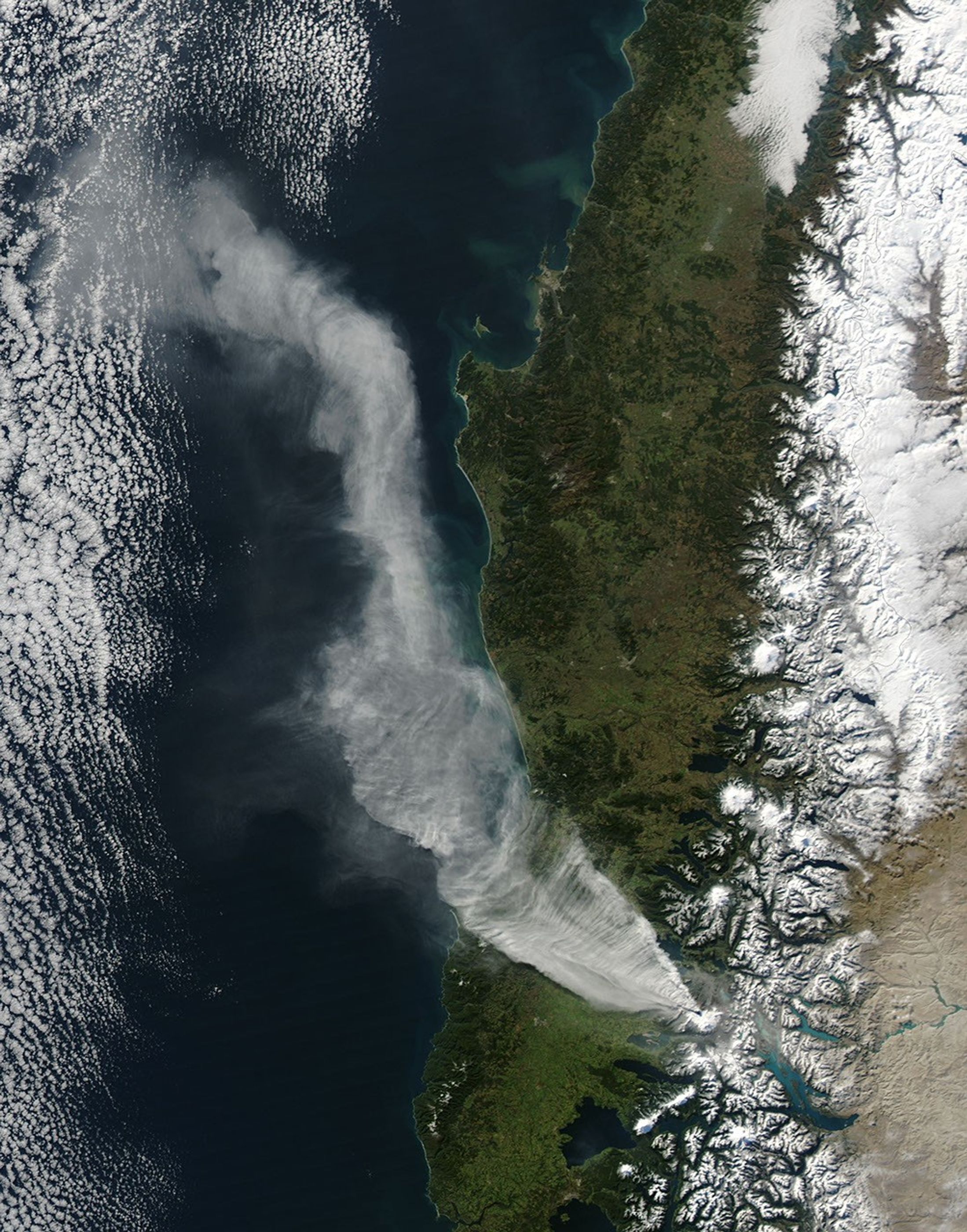
On July 8, 2011, the Moderate Resolution Imaging Spectroradiometer (MODIS) on NASA’s Terra satellite observed the plume blowing toward the east-southeast (top). On July 2, 2011, MODIS on NASA’s Aqua satellite observed the plume blowing toward the northwest (bottom).
Volcanic plumes can contain a combination of ash, steam, and gases invisible to the human eye. The light color of the plumes in these images suggests that the visible components in the plumes are a mixture of water vapor and some ash. Ash already deposited by this eruption coats the landscape east of Puyehue-Cordón in beige.
Unlike the soft ash from wildfires, volcanic ash consists of jagged particles of rock and glass. Abrasive, slightly corrosive, and capable of conducting electricity when wet, volcanic ash can complicate breathing, coat vegetation and leave it inedible, and even destroy machinery. Planes flying into volcanic ash clouds can experience rapid engine failure.
Volcanic ash released by Puyehue-Cordón continued to cause difficulty in South America in early July. Agence France-Presse reported that the plume disrupted air travel in parts of Argentina, Brazil, and Uruguay. Meanwhile, provinces in southwestern Argentina were in a state of emergency because of widespread damage from the ash layer.
SERNOGEOMIN, Chile’s geology and mineral agency, reported that although ash and steam emissions continued, activity had decreased significantly and lava flows had apparently stopped. The agency did not rule out a future explosive eruption, although it reported such an event would be unlikely to equal the magnitude of the June event.
References & Resources
- Agence France-Presse. (2011, July 9). Chile volcano grounds flights in Argentina, Uruguay. Accessed July 11, 2011.
- Agence France-Presse. (2011, July 11). Chile volcano grounds flights. Sydney Morning Herlad. Accessed July 11, 2011.
- Global Volcanism Program. Puyehue-Cordón Volcano Complex. Smithsonian Institution. Accessed July 11, 2011.
- Holmes, H. (2001). The Secret Life of Dust. John Wiley and Sons, Inc., Hoboken, New Jersey.
- Servicio Nacional de Geología y Minería. (2011, July 10). Reporte especial de actividad volcánica no 68 región de Los Ríos complejo Volcánico Puyehue-Cordón. (Spanish) Accessed July 11, 2011.
NASA images courtesy Jeff Schmaltz, MODIS Rapid Response Team, Goddard Space Flight Center. Caption by Michon Scott.