




















Each day, a blanket of tiny particles drifting through the Earth’s atmosphere filters out some of the sunlight headed for the planet’s surface. These aerosols, including dust, smoke, and human-produced pollution, can reflect incoming light or absorb it, directly affecting the Earth's energy balance and climate. Aerosols also influence the climate indirectly, by affecting the brightness and amount of clouds.
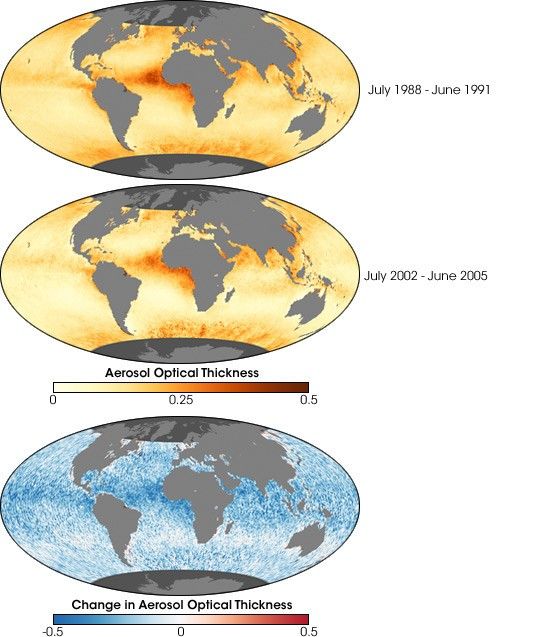
Research by NASA scientists on global aerosol patterns since the 1990s indicate the global aerosol blanket has likely thinned, allowing more sunlight to reach the Earth’s surface over the past decade. The thinning of the blanket is shown by this trio of images based on satellite observations of aerosol optical thickness, a measurement that scientists use to describe how much the aerosols filter the incoming sunlight. Higher optical thickness (orange and red) means more sunlight blocking. The globes show average aerosol optical thickness for 1988-1991 (top), 2002-2005 (middle), and the change between the two time periods (bottom). Overall, the 1988-1991 image appears redder, a sign that aerosols were blocking more incoming sunlight; the 2002-2005 image has more light yellow areas. In the bottom image, small pockets of red (increased aerosol optical thickness), mostly near land masses in the Northern Hemisphere, are far outnumbered by blue areas (decreased aerosol optical thickness).
Because they block incoming sunlight from reaching Earth’s surface, aerosols may counterbalance greenhouse gas warming. The decline in the dimming power of aerosols over the past decade may have made the greenhouse warming trend more evident in the past decade than in previous decades. The scientists describe their results as a “likely” trend because the National Oceanic and Atmospheric Administration satellite sensors they used in their analysis were not specifically designed to observe aerosols, and may contain some errors. However, specific, major aerosol events, such as large volcanic eruptions, show up in the right place at the right time in the observations, and the data also agree with available ground-based observations. Ongoing NASA missions such as the Terra, Aqua, Aura, and Cloudsat/CALIPSO, as well as upcoming missions such as Glory, will provide the data scientists need to monitor aerosol trends over time.
References & Resources
- Global ‘Sunscreen’ Has Likely Thinned, Report NASA Scientists
- Mishchenko, M., Geogdzhayev, I., Rossow, W., Cairns, B., Carlson, B., Lacis, A., Liu, L., and Travis, L. (2007). Long-Term Satellite Record Reveals Likely Recent Aerosol Trend. Science, 315, 1543.
NASA image created by Jesse Allen, using data provided courtesy of Michael Mishchenko and Igor Geogdzhayev, NASA Goddard Institute of Space Studies,
None