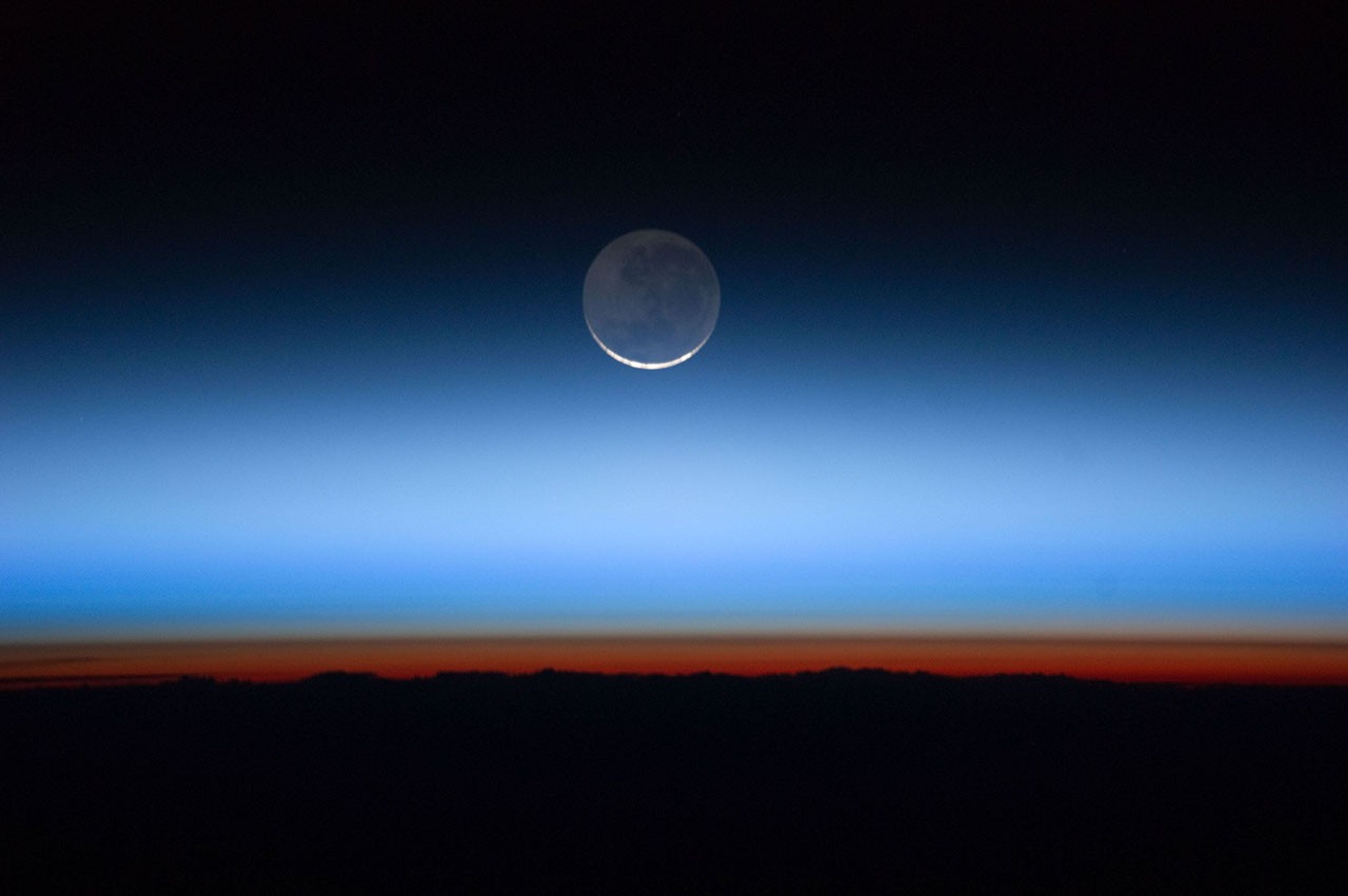



















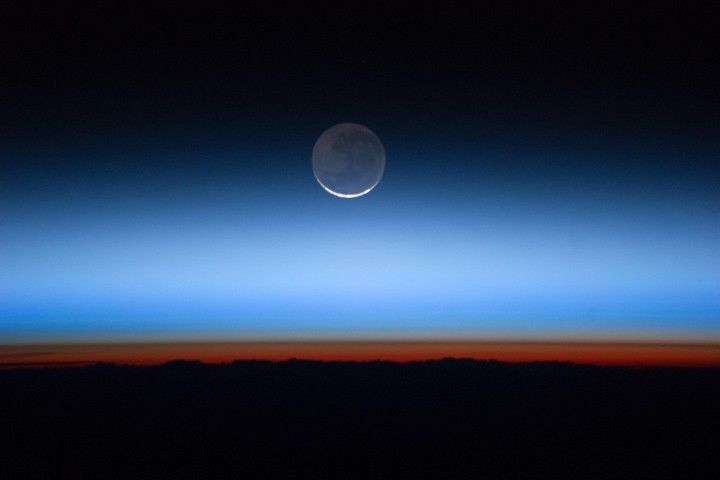
The limb of the Earth is a work of beauty and a gift to science. When observed from space, the layers of the atmosphere remind us of the fragility of the cocoon that shelters life. That same view also allows scientists to detect the gases and particles that make up the different layers of our atmosphere. Astronauts aboard the International Space Station captured a bit of both in this digital photograph from July 31, 2011. They threw in the Moon as an extra gift.
Closest to Earth’s surface, the orange-red glow reveals the troposphere—the lowest, densest layer of atmosphere, and the one we live within. A brown transitional layer marks the upper edge of the troposphere, known as the tropopause. A milky white and gray layer rests above that, likely a slice of the stratosphere with perhaps some noctilucent clouds in the mix. The upper reaches of the atmosphere—the mesosphere, thermosphere, and exosphere—fade from shades of blue to the blackness of space.
The different colors occur because the dominant gases and particles in each layer act as prisms, filtering out certain colors of light. Instruments carried on satellites and on craft such as the space shuttle have allowed scientists to decipher characteristics of the ozone layer and the climate-altering effects of aerosols.
A thin crescent of the Moon is illuminated by the Sun from below the horizon of the Earth. Though the Moon is more than 384,400 kilometers (238,855 miles) away, the perspective from the camera makes it appear to be part of our atmosphere.
References & Resources
Astronaut photograph ISS028-E-020072 was acquired on July 31, 2011, with a Nikon D3S digital camera using a 400 mm lens, and is provided by the ISS Crew Earth Observations experiment and Image Science & Analysis Laboratory, Johnson Space Center. The image was taken by the Expedition 28 crew. The image has been cropped and enhanced to improve contrast. Lens artifacts have been removed. The International Space Station Program supports the laboratory as part of the ISS National Lab to help astronauts take pictures of Earth that will be of the greatest value to scientists and the public, and to make those images freely available on the Internet. Additional images taken by astronauts and cosmonauts can be viewed at the NASA/JSC Gateway to Astronaut Photography of Earth. Caption by Mike Carlowicz.