



















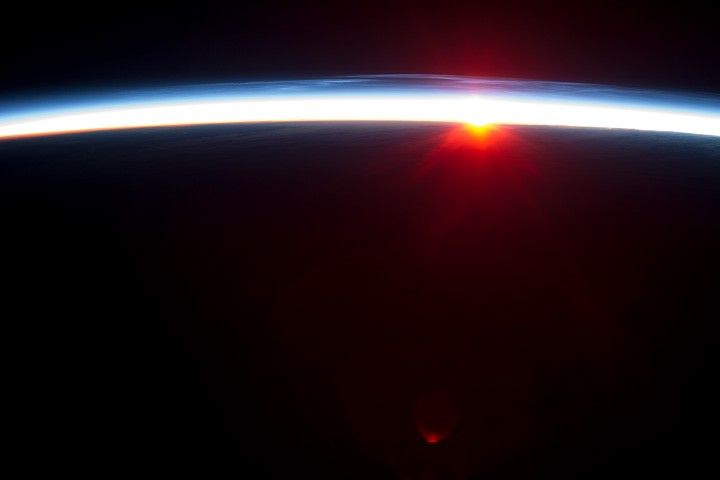
Astronauts on the International Space Station (ISS) took this panoramic photo looking northeast from a point half-way along the Aleutian Island chain. They were flying east at “the top of the orbit”—the northernmost latitude reached by the ISS (51.6 degrees north). If the Sun had been higher, western Alaska would have been visible in the foreground; instead, it lies on the dark side of the day-night line.
This image was taken about 15 minutes after local midnight in early August 2013. From their vantage point at 222 kilometers altitude, the astronauts were able to look northeast and see a near-midnight sunrise (when it was approaching noon in England). The rising Sun makes a red, teardrop-shaped reflection in the lower center of the image—perhaps a reflection within the camera lens, from the window frame, or from some item inside the spacecraft.
Long, blue-white ripples appear in the atmosphere above the midnight sun. These are noctilucent or “night-shining” clouds. Some astronauts say these wispy, iridescent clouds are the most beautiful phenomena they see from orbit. Noctilucent clouds are best seen after sunset, when the viewer is on the night side of the day-night line and these high clouds are still lit by the Sun. Crews are trained in this somewhat complicated geometry of clouds being lit from beneath, the spacecraft in sunlight, and the ground below in darkness.
Noctilucent clouds are also known as polar mesospheric clouds (PMCs), as they appear in the summer hemisphere over polar latitudes. Some data suggest that these clouds are becoming brighter and appearing at lower latitudes, perhaps as an effect of global warming. A comparison of noctilucent cloud formation from 2012 and 2013 has been compiled using data from NASA’s Aeronomy of Ice in the Mesosphere (AIM) spacecraft. You can see the sequence here.
Polar mesospheric clouds are interesting because they form much higher in the atmosphere (75 to 90 kilometers) than the normal rainclouds that form in the lowest, densest, “weather-layer” below 15 kilometers. The weather layer, or troposphere, appears in this image as a thin, orange line along the left horizon.
Other astronaut images of PMCs:
- NASA Earth Observatory (2010, July 5) Polar Mesospheric Clouds Illuminated by Orbital Sunrise.
- NASA Earth Observatory (2010, February 22) Polar Mesospheric Clouds, Southern Hemisphere.
- NASA Earth Observatory (2003, August 10) Noctilucent Clouds.
References & Resources
Astronaut photograph ISS036-E-28913 was acquired on August 4, 2013, with a Nikon D3S digital camera using a 50 millimeter lens, and is provided by the ISS Crew Earth Observations experiment and Image Science & Analysis Laboratory, Johnson Space Center. The image was taken by the Expedition 36 crew. It has been cropped and enhanced to improve contrast, and lens artifacts have been removed. The International Space Station Program supports the laboratory as part of the ISS National Lab to help astronauts take pictures of Earth that will be of the greatest value to scientists and the public, and to make those images freely available on the Internet. Additional images taken by astronauts and cosmonauts can be viewed at the NASA/JSC Gateway to Astronaut Photography of Earth. Caption by M. Justin Wilkinson, Jacobs at NASA-JSC.