













CloudSat samples the atmosphere, taking the tiniest vertical slices of clouds and haze and dust and smoke and creating a profile of all that stands between us and space. This vertical sampling is possible because the satellite carries a radar instrument similar to those used to track storms on the ground, but more than 1,000 times more sensitive. The profiles reveal the hidden structure of clouds and their distribution and abundance.
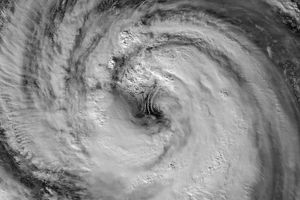
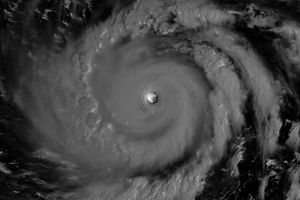
It is rare, however, for the satellite to fly directly over the center of a tropical cyclone. On August 11, 2013, CloudSat did exactly that, capturing a perfect profile of the category 4 Super Typhoon Utor approaching the Philippines. Since its launch in April 2006, CloudSat has directly intersected the eye of a storm of this intensity and size only a handful of times.
The view of the storm at the top of this page comes from the Moderate Resolution Imaging Spectroradiometer (MODIS) on NASA’s Aqua satellite, which flies in formation with CloudSat and acquired this image a few minutes before the CloudSat overpass. The red line shows the footprint of the CloudSat radar observation displayed in the lower image. The CloudSat observation is about 10 kilometers east of the center of the storm, taking in the structure of the eye and eye wall. At the time, Utor had winds estimated at 115 knots (132 mph) and a minimum pressure of 937 millibars.
This overpass reveals many unique features of a well-defined and intense typhoon, including a distinct eye, bands of rain separated by cloud-free areas, and extremely heavy rain. The dip in the center of the profile shows an outward sloping eye and strong eyewall. The lack of a data signal below five kilometers (ten kilometers close to the eye) is due to heavy precipitation, since the radar pulse loses power traveling through intense rain. The strong signal elsewhere points to large amounts of ice and liquid water spread throughout the storm. Dark stripes are rain bands, and these are separated by moats (cloud-free areas) beneath the cirrus canopy.
References & Resources
NASA Earth Observatory image by Jesse Allen, using CloudSat FirstLook data provided courtesy of the CloudSat team at Colorado State University. Caption by Natalie D. Tourville and Holli Riebeek.