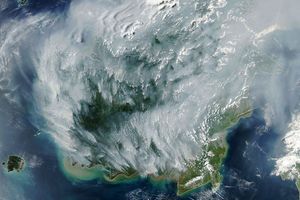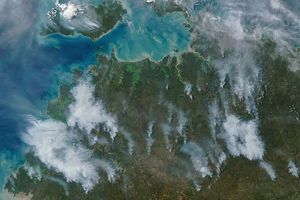













These images of northeastern South Africa, near Kruger National Park,were acquired on September 7, 2000 by the Mulit-angle Imaging Spectroradiometer(MISR). The left image shows an 85-kilometerwide x 200-kilometer long area captured by MISR's aftward- viewing45-degree camera. At lower left are the Drakensberg Mountains; to theeast of this range a large burn scar with thin smoke plumes fromstill-smoldering fires is visible. Near the top of the image anotherlarge burn scar with an open-pit mine at its western edge can be seen.Other burn scars are scattered throughout the image.
Just above the center of the lefthand image is a polygonal burn scarwith a set of smoke plumes from actively burning fires at itssouthwestern tip. The righthand image, which is a “zoomed-in” view ofthe area, was acquired almost simultaneously by MISR's airbornecounterpart, AirMISR, aboard a NASA ER-2 high-altitude aircraft. AirMISRcontains a single camera that rotates to different view angles; whenthis image was acquired the camera was pointed straight downward.Because the ER-2 aircraft flies at an altitude of 20 kilometers, whereasthe Terra spacecraft orbits the Earth 700 kilometers above the ground,the AirMISR image has 35 times finer spatial resolution. The AirMISRimage covers about 9 kilometers x 9 kilometers. Unlike the MISR view,the AirMISR data are in “raw” form and processing to remove radiometricand geometric distortions has not yet been performed.
Fires such as those shown in the images are deliberately set to burn offdry vegetation, and constitute a widespread agricultural practice inmany parts of Africa. These MISR and AirMISR images are part of aninternational field, aircraft, and satellite data collection andanalysis campaign known as SAFARI-2000, the Southern Africa RegionalScience Intitiative. SAFARI-2000 is designed, in part, to study theeffects of large-scale human activities on the regional climate,meteorology, and ecosystems.
References & Resources
Image courtesy NASA/GSFC/JPL, MISR and AirMISR Teams.