






















There’s more than one way to feed a phytoplankton bloom in the Gulf of Alaska. Iron, a key nutrient for the growth of these tiny plant-like organisms, can enter the gulf waters from the air—via volcanic eruptions or airborne dust from dry lakebeds and streams. Other times, the nutrient stays closer to the ground, catching a ride to the gulf with the meltwater of thawing glaciers.
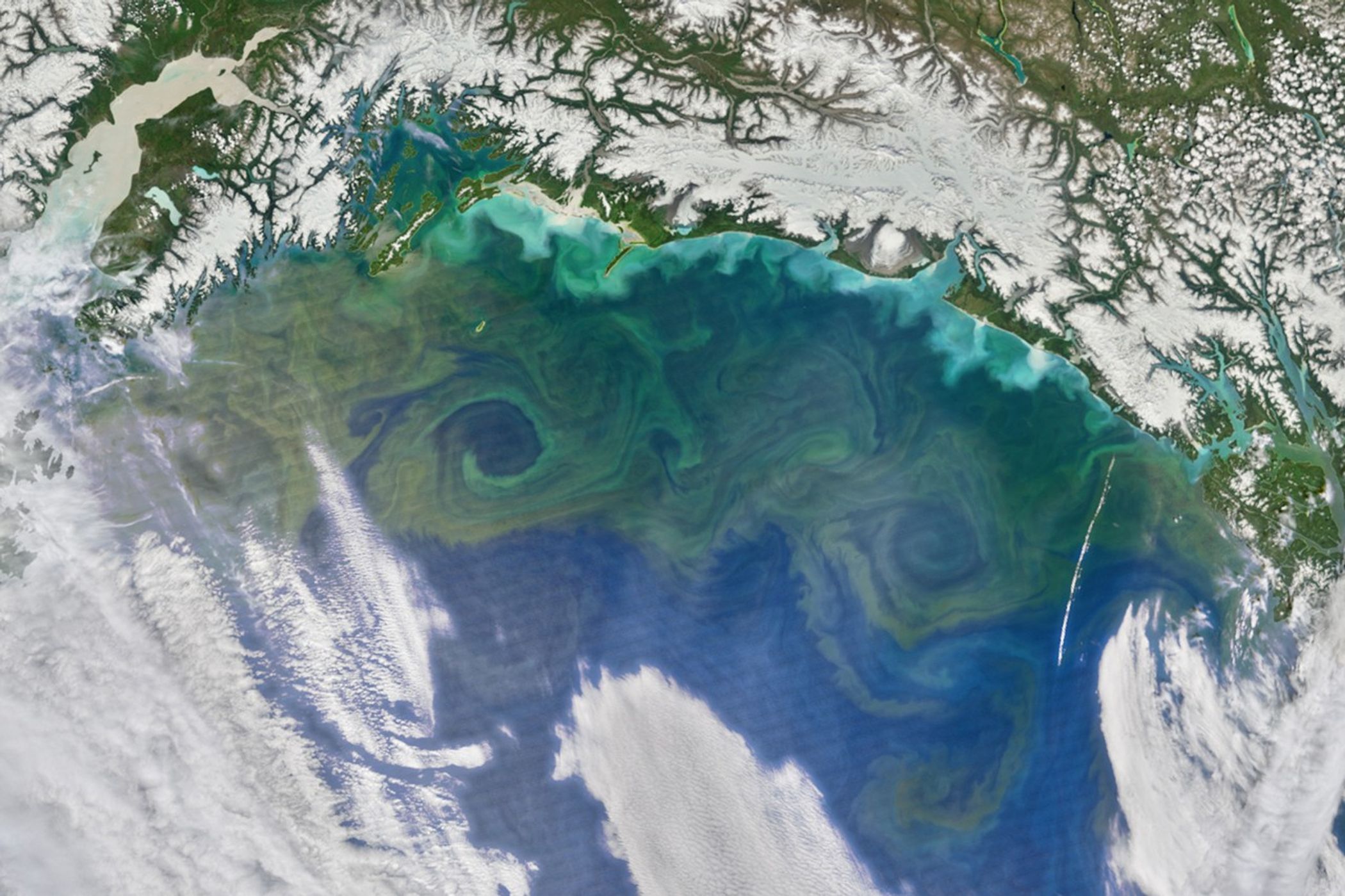
The Visible Infrared Imaging Radiometer Suite (VIIRS) on the Suomi-NPP satellite captured this image of the Gulf of Alaska on June 9, 2016. NASA scientists noted that this is the time of year when melt water from Alaska’s glaciers flows through rivers and out into the Gulf of Alaska. The meltwater carries a supply of “rock flour,” or “glacial flour”—the dusty remains of bedrock ground up by a glacier. Where it reaches the Gulf of Alaska, this rock flour imparts a milky turquoise color to the water.
The rock flour also supplies the gulf with the iron, a nutrient that promotes phytoplankton growth by helping the organisms to process nitrate. Eddies such as the ones visible in this image help distribute the iron offshore, where it mixes with nitrate-rich waters. As a result, conditions are just right for an offshore bloom of phytoplankton. The bloom is visible here as swirls of green.
Runoff is highest from June through September. By fall, iron still makes its way into Gulf of Alaska, but it takes a different path. Low river levels in the fall mean that more riverbed sediments are exposed to winds. Winds can loft huge plumes of riverbed dust into the air, some of which settles back down on gulf waters and fertilizes blooms.
References & Resources
- Aguilar-Islas, A.M. et al. (2015) Temporal variability of reactive iron over the Gulf of Alaska shelf. Deep-Sea Res. II.
- Crusius, J. et al. (2011, March) Glacial flour dust storms in the Gulf of Alaska: Hydrologic and meteorological controls and their importance as a source of bioavailable iron. Geophysical Research Letters, 38 (6).
- NASA’s OceanColor Web (2016, June) Ocean Color Feature: Gulf of Alaska. Accessed June 21, 2016.
- NASA Earth Observatory (2012, October 31) Dust Storm Off Alaska.
NASA image by Norman Kuring, NASA’s Ocean Color web. Caption by Kathryn Hansen.