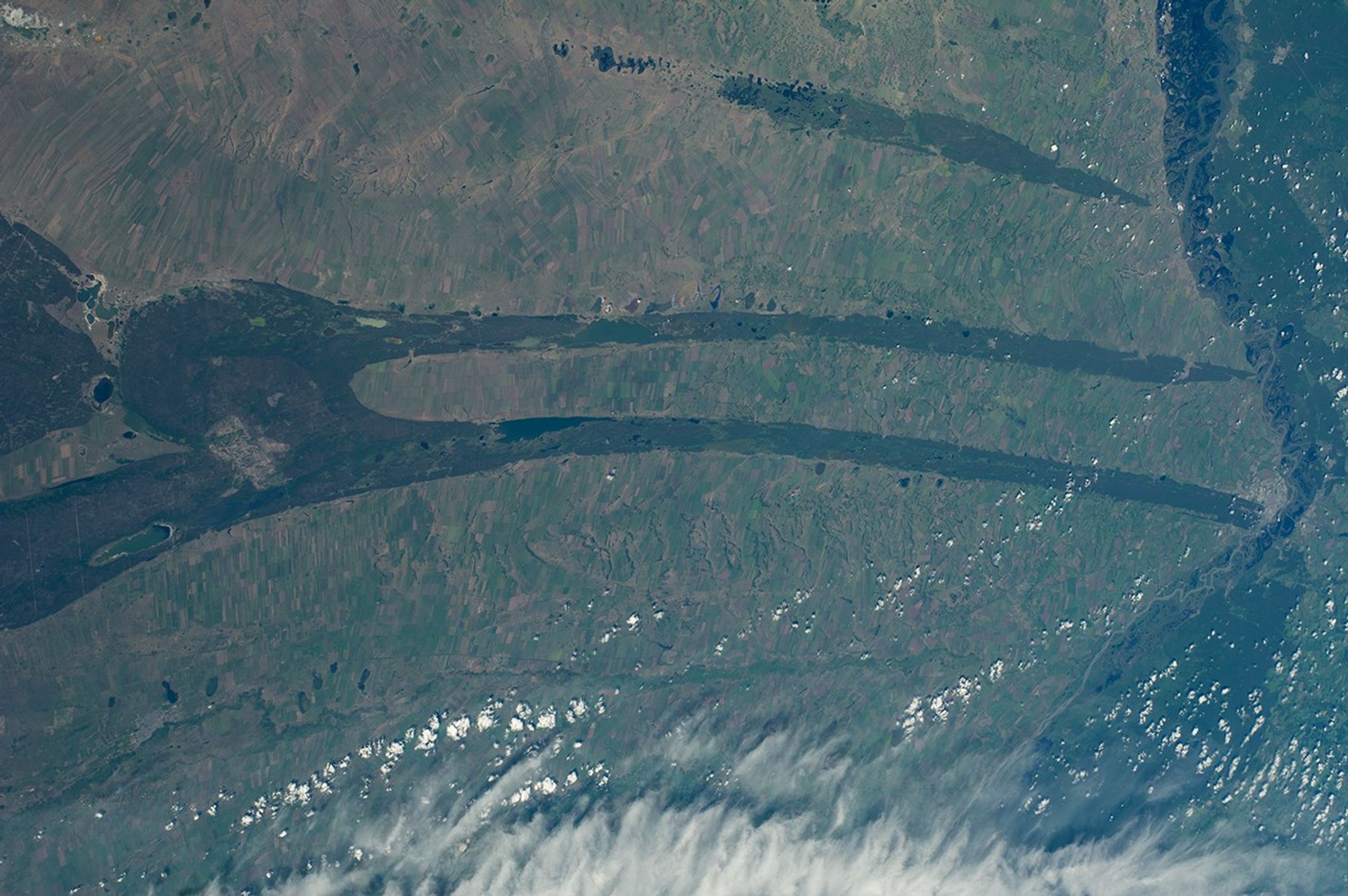




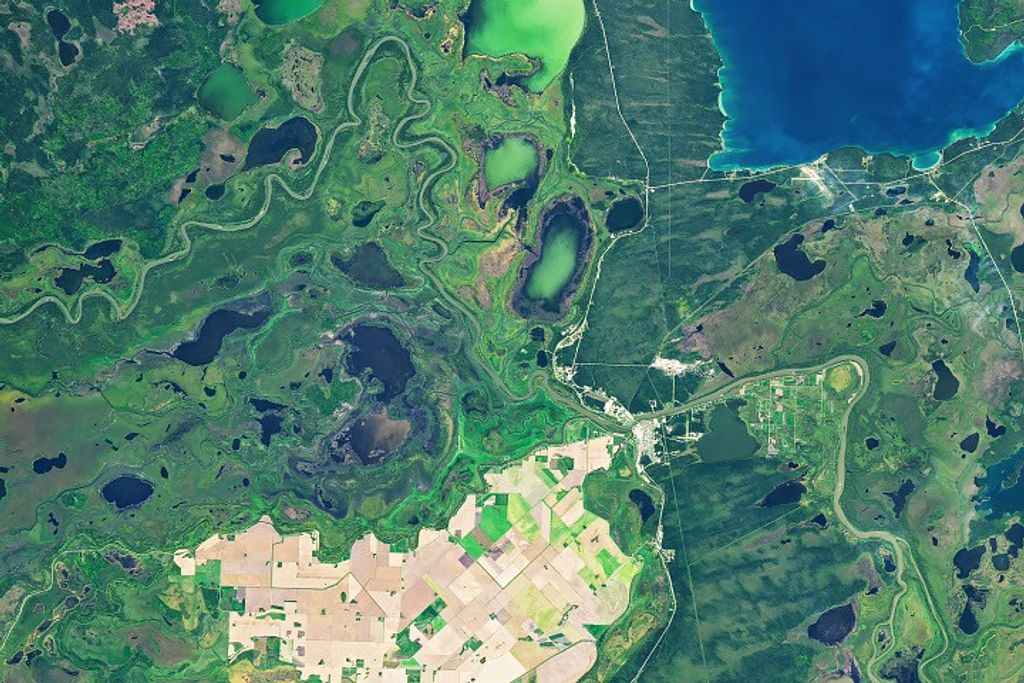











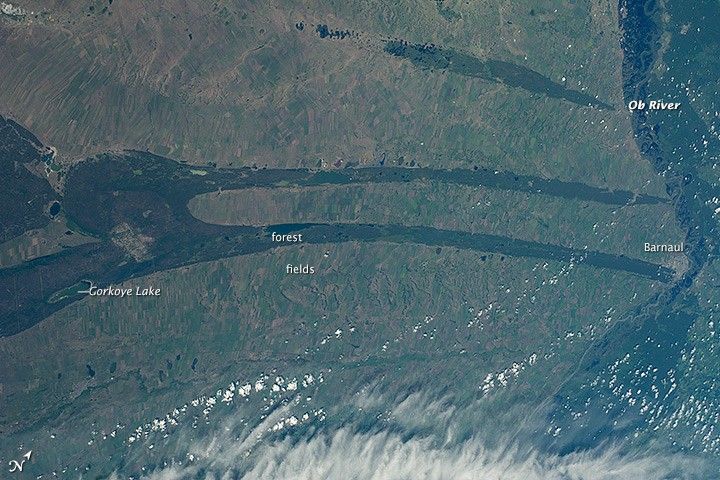
In June 2014, the crew aboard the International Space Station (ISS) called down to Houston to ask for an explanation of this strange pattern of spikes crossing the Kulunda Steppe in central Russia. The “spikes” are a prominent visual feature when the ISS is at the top of its orbit (52 degrees north, the highest latitude flown over by the spacecraft). Scientists at NASA’s Johnson Space Center were able to provide an answer.
The linear zones in the image are gentle folds in the surface rocks of the area; they lie slightly lower than the surrounding, lighter-toned agricultural lands. The dark zones are forested with pines and dotted with salt-rich lakes. The image shows a distance of a little more than 300 kilometers (200 miles) from left to right, and the forested spikes are nearly that length.
The green floodplain on the right includes the famous Ob River, the westernmost of Siberia’s three great rivers (the others being the Yenisei and Lena). The Ob flows north for another 2,000 kilometers (1,200 miles) to the Arctic Ocean.
The city of Barnaul lies on the banks of the river, with riverboat, air, and rail links to the rest of the country. With a population of 612,000 people, Barnaul is a major center of industry, trade, and culture in Siberia. A broader image of the Kulunda geology and the Ob River in winter can be seen here.
References & Resources
Astronaut photograph ISS040-E-27042 was acquired on June 30, 2014, with a Nikon D3S digital camera using an 80 millimeter lens, and is provided by the ISS Crew Earth Observations Facility and the Earth Science and Remote Sensing Unit, Johnson Space Center. The image was taken by the Expedition 40 crew. It has been cropped and enhanced to improve contrast, and lens artifacts have been removed. The International Space Station Program supports the laboratory as part of the ISS National Lab to help astronauts take pictures of Earth that will be of the greatest value to scientists and the public, and to make those images freely available on the Internet. Additional images taken by astronauts and cosmonauts can be viewed at the NASA/JSC Gateway to Astronaut Photography of Earth. Caption by M. Justin Wilkinson, Jacobs at NASA-JSC.