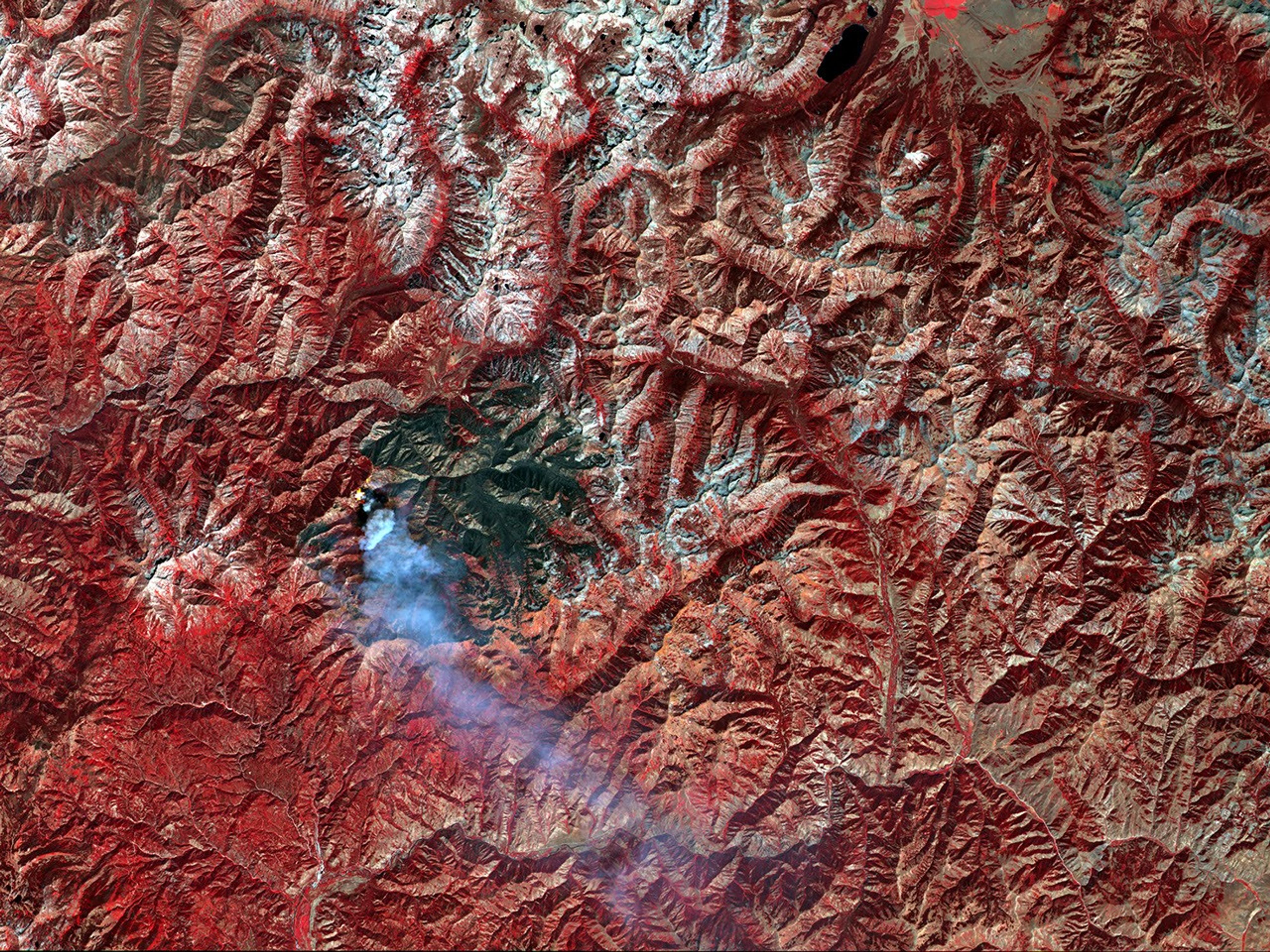

















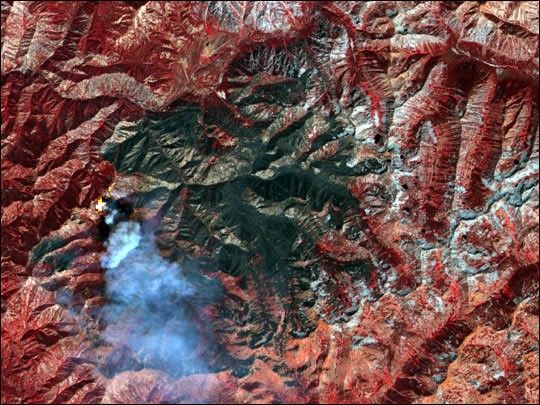
This image shows the Clear Creek fire in Idaho on the morning ofAugust 30, 2000, as seen by the Advanced Spaceborne Thermal Emission andReflection Radiometer (ASTER), flying aboard NASA’s Terra spacecraft. The United States Forest Service firstdetected the Clear Creek fire on July 10, 2000, and deployed a handful of firefightersand a helicopter to fight the fire. By the end of the day, the fire hadconsumed 12 hectares (30 acres) of forest. Later in July, strong winds causedthe fire to jump firebreaks, increasing the burned area from 21,260 hectares (52,500 acres)on the 26th to 24,300 hectares (60,000 acres) on the 27th. On August30, 1787 people, 16 helicopters, 47 fire engines, and 20 bulldozers werefighting the fire, which had consumed 80,990 hectares (199,973 acres).In the following days, rain and cool temperatures slowed the growth ofthe fire. Although the fire stopped spreading in the first week ofSeptember, it was not declared contained until October 14th, havingburned 83,580 hectares (206,379 acres).
ASTER views the Earth in wavelengths of light ranging from 0.56micro;m (green) to 11.3 µm (thermal infrared ). The image abovecombines a color composite of near-infrared, red, and green light at 15-meter(49-foot) resolution with thermal infrared data at 90-meter (295-foot) resolution.Red indicates vegetation, light gray corresponds tobarren areas, dark gray to recently burned areas, and blue-black to water,while light blue is smoke. Flaming areas show up as orange, yellow, andwhite.
References & Resources
Image by Robert Simmon, based on data from NASA/GSFC/MITI/ERSDAC/JAROS, and U.S./Japan ASTER Science Team