









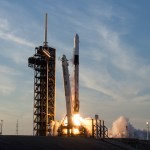







After several launch attempts since May that were often scrubbed because of weather, the skies were finally clear enough for a NASA Terrier-Improved Malemute sounding rocket to blast off at 4:25 a.m. Eastern Time on June 29, 2017.
Soon after the launch from Wallops Flight Facility (Virginia), puffs of color emerged high in the night sky over the Mid-Atlantic coast. These artificial clouds glowed momentarily red-green and then faded into blue and violet as they drifted in the ionosphere. This upper layer of Earth’s atmosphere extends from 80 to 600 kilometers (50 to 360 miles) above the surface, and it is full of charged particles that get bombarded by solar and cosmic radiation.
In the course of the eight-minute flight, the sounding rocket ejected ten canisters about the size of a soft drink can as part of a test of a new multi-canister ejection system. Once separated from the sounding rocket by several miles, the canisters released blue-green and red vapor that formed the aurora-like clouds seen in the photograph above. Interactions between barium, strontium, and cupric-oxide gave the clouds their color.
The second image is a time-lapse photograph that shows the fire trail from the rocket pushing upward into the night sky. The smaller streak of light is the second stage of the rocket falling back toward the ocean.
Sounding rockets have been used since the 1950s to study the upper atmosphere and ionosphere and to aid in understanding the Earth’s near-space environment. The rockets follow parabolic or “U-shaped” trajectories. In this case, the sounding rocket flew to an altitude of about 118 miles (190 kilometers).
NASA Wallops received nearly 2,000 reports and photos of cloud sightings from areas as far as New York and North Carolina, and inland across Virginia, Maryland, and Pennsylvania. Photos submitted by the public can be viewed on the Wallops facebook page.
References & Resources
- NASA About Vapor Trails. Accessed June 29, 2017.
- NASA Wallops Flight Facility NASA Wallops Rocket Launch Lights up the Mid-Atlantic Coast. Accessed June 29, 2017.
- NASA Wallops Flight Facility (Facebook) Submitted Photos. Accessed June 29, 2017.
Photographs by Terry Zaperach for NASA. Story by Adam Voiland, based on a release from NASA Wallops Flight Facility.