









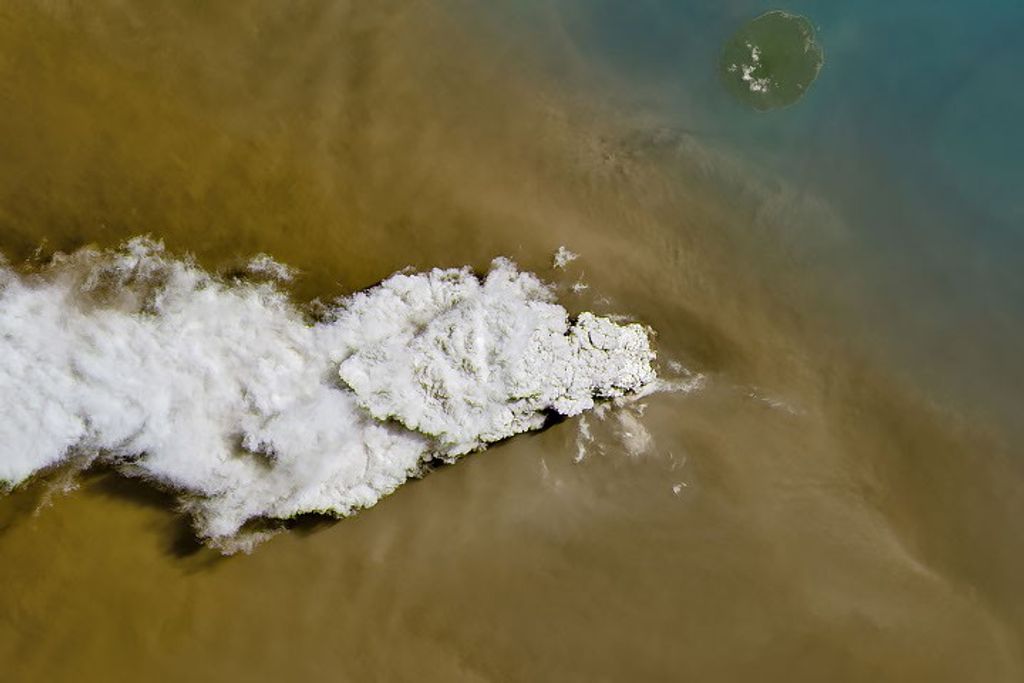








In July 2017, sweltering temperatures and strong winds fueled intense wildfires in southern California. The fires forced thousands of people to flee their homes, charred dozens of structures, closed roads, and darkened skies throughout the region with thick smoke.
On July 8, 2017, the Moderate Resolution Imaging Spectroradiometer (MODIS) on NASA’s Aqua satellite captured this image of smoke streaming from the Alamo fire. Actively burning areas, detected by MODIS’s thermal bands, are outlined in red. Through July 10, 2017, the fire had charred roughly 30,000 acres (100 square kilometers) in San Luis Obispo County, California. Meanwhile, the Whittier fire, near Cachuma Lake (Santa Barbara County) had scorched 10,000 acres.
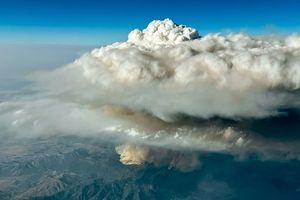
Countervailing winds at different levels of the atmosphere pushed smoke plumes from the Alamo fire in opposing directions. As meteorologist John Lindsey noted, surface level winds were blowing out of the northwest and mid-level winds were out the southwest on July 8. As the fire grew in intensity, more smoke billowed higher into the atmosphere, where the mid-levels winds began to push it northward. The University of Wisconsin-Madison CIMSS satellite blog has posted a clip from the GOES-16 satellite showing this process unfolding throughout the day. Though the Whittier fire appears small in the MODIS image, it grew quite intense later in the day.
Surface features like buildings, trees, and mountains create friction and turbulence that contribute to differences in wind speeds at the surface and higher levels of the atmosphere. As Lindsey pointed out in a column for the San Luis Observer, it is common for cold fronts along California’s Central Coast to move in from the northwest despite the surface winds coming out of the south.
According to National Interagency Fire Center statistics, 3.1 million acres of wildfires have burned in the United States between January 1 and July 7, 2017. That is above the average of 2.4 million acres for the past ten years.
References & Resources
- Cal Fire (2017, July 10) Alamo Fire. Accessed July 10, 2017.
- InciWeb (2017, July 10) Whittier Fire. Accessed July 10, 2017.
- Los Angeles Times (2017, July 10) Wildfires across California destroy more than two dozen homes. Accessed July 10, 2017.
- National Interagency Fire Center (2017, July 7) Daily Statistics. Accessed July 10, 2017.
- The Tribune (2017, July 8) Wondering which way Alamo Fire smoke will blow? The answer may not be so simple. Accessed July 10, 2017.
- University of Wisconsin-Madison CIMSS Satellite Blog (2017, July 8) GOES-16: wildfires in southern California. Accessed July 10, 2017.
NASA image by Jeff Schmaltz, LANCE/EOSDIS Rapid Response . Story by Adam Voiland, with information from Colin Seftor (SSAI) and Mike Fromm (U.S. Naval Research Laboratory).