












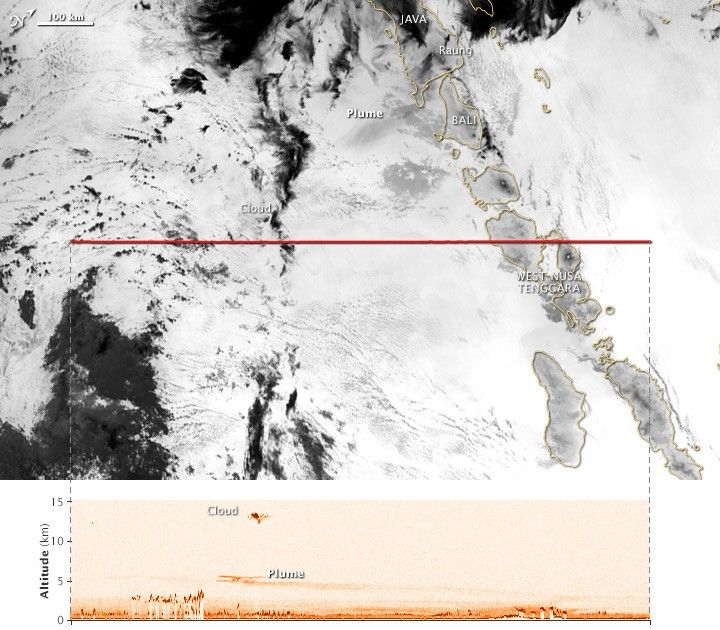
When it comes to seeing what’s going on in the atmosphere after dark, CATS has an advantage. From a perch on the outside of the International Space Station, the Cloud-Aerosol Transport System (CATS) recently observed part of a plume streaming from Raung Volcano, even though the plume was not apparent in imagery from other spaceborne instruments.
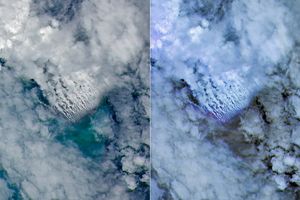
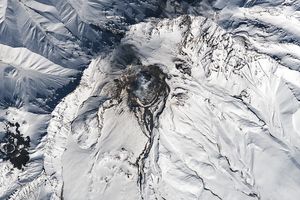
Mount Raung, a stratovolcano on the Indonesian island of Java, has erupted at least 13 times in the past 25 years, according to the Smithsonian Global Volcanism program. The most recent bout of activity began in June 2015 and prompted authorities to temporarily close airports in neighboring Bali due to concerns about volcanic ash. In the daytime, Raung’s ash plume is clearly visible in natural-color imagery acquired on July 14, 2015, and again on July 21. Viewing the plume at night, however, poses a bigger challenge.
Shortly after midnight (Java time) on July 12, part of the plume could be detected by satellite sensors observing in the longwave infrared (thermal) portion of the electromagnetic spectrum. The top image was acquired with the Visible Infrared Imaging Radiometer Suite (VIIRS) on the Suomi NPP satellite. Warmer areas appear light grey and white (mostly land and ocean), while cooler areas appear dark (high clouds and the volcanic plume). The plume spreads toward the south and cools high in the atmosphere, which is why it appears dark. But eventually the aerosols composing the plume are too diffuse to be visible even in the thermal image.
The red line shows where, less than an hour after Suomi NPP passed over, CATS scanned a vertical slice through the atmosphere (bottom image). The instrument sends pulses of laser light down through the atmosphere and measures the light scattered back up to the instrument. Even though the volcanic aerosols were relatively diffuse in the area, even that faint puff of ash showed up at altitudes of 5 kilometers (16,000 feet) and below. Darker red areas on the CATS image depict where the atmosphere reflects more light—areas where the plume is optically thicker.
References & Resources
- NASA Earth Observatory (2015) Natural Hazards: Activity at Raung Volcano.
- NASA Goddard Space Flight Center (2015) Cloud-Aerosol Transport System (CATS).
- Smithsonian Global Volcanism Program (2015) Raung. Accessed July 24, 2015.
NASA Earth Observatory image by Jesse Allen, using data provided by John Yorks and Matthew McGill of the Cloud-Aerosol Transport System (CATS) team. Caption by Kathryn Hansen.
None