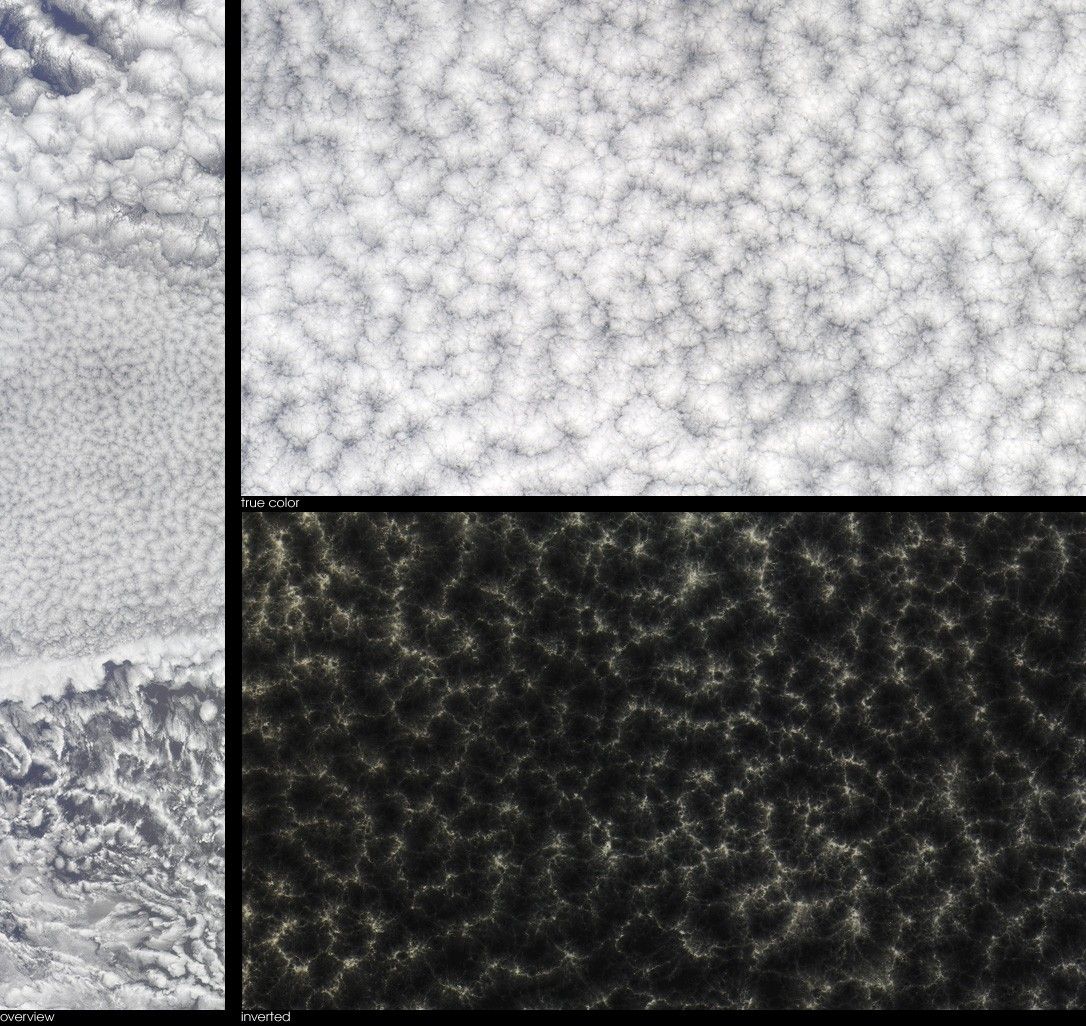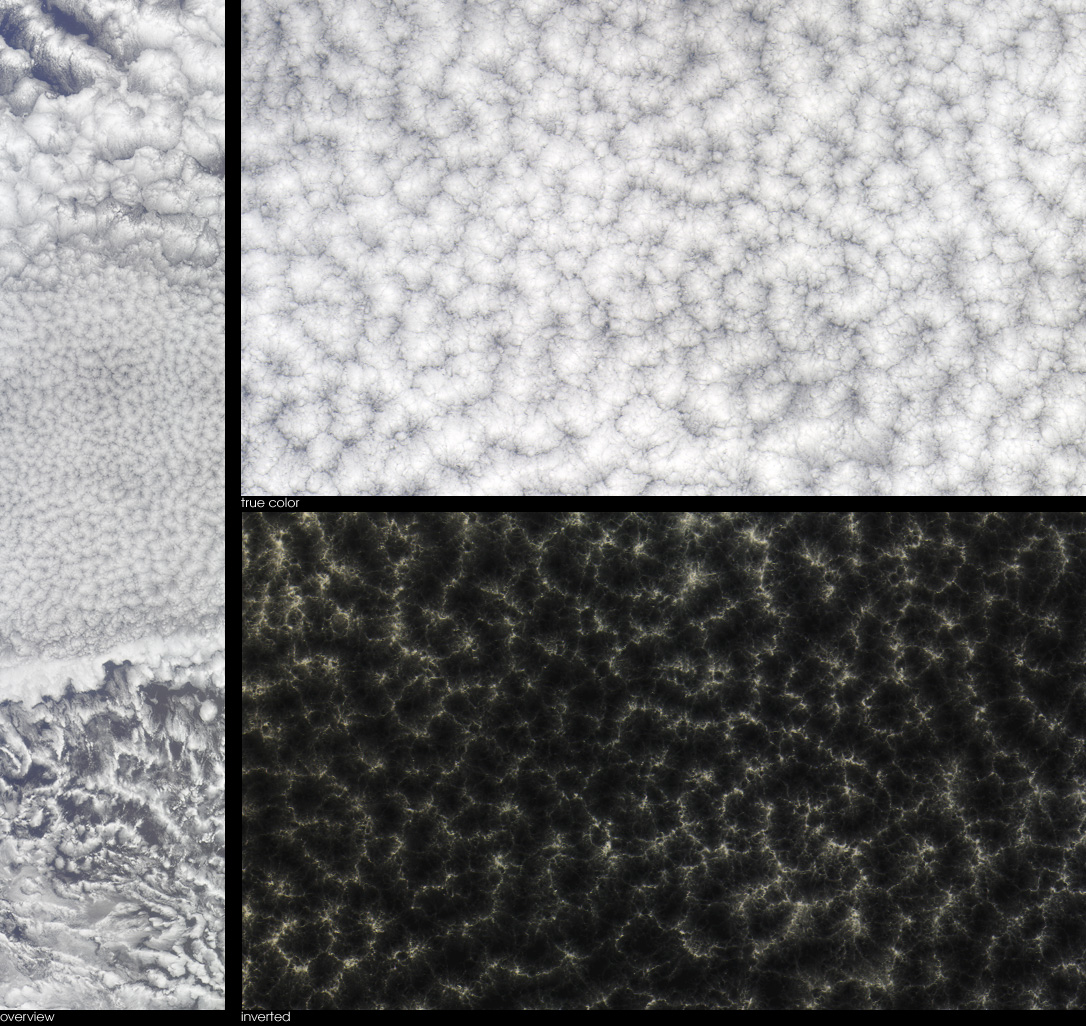













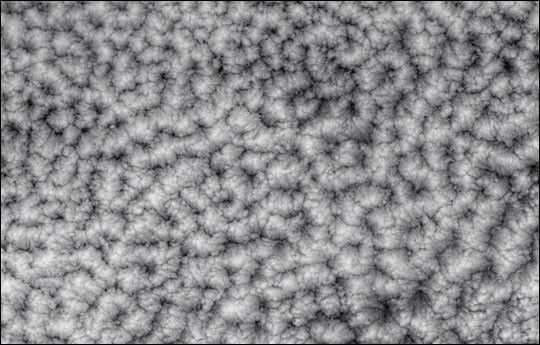
The structure of tightly packed ‘closed cells’ in a layer of marinestratocumulus over the southeastern Pacific Ocean are highlighted in these viewsfrom the Multi-angle Imaging SpectroRadiometer (MISR). Closed cell clouds are formedunder conditions of widespread sinking of the air above. As heat is radiated tothe atmosphere, the top of the cloud cools. The cool air sinks along the cellboundaries and this sinking motion perturbs the shallow cloud layer intointeresting structures such as those shown here. These cells are notably small,with diameters ranging from 10-15 kilometers, instead of the 15-45 kilometerstypically noted in satellite observations. The dark areas along the cellboundaries are also cloudy and do not indicate clear sky. Closed cell clouds arefound in high pressure systems characterized by weak winds, and are thought tooccur preferentially over cold ocean waters. The image covers an area of about280 kilometers x 227 kilometers.
An overview image showing some of the meteorological context, and anatural-color and inverted image pair are also provided. The cell structure andthe distinctive radial patterns indicative of the sinking air motions are easierto see clearly in the inverted view. The area covered by the overview on theleft is 274 kilometers x 463 kilometers, while the right-hand images each cover278 kilometers x 62 kilometers. All of the images were created with data fromMISR’s vertical-viewing (nadir) camera, and were acquired on November 19, 2001(during Terra orbit 10228). The scenes are centered roughly at 38 degrees southlatitude and 118 degrees west longitude.
Low-lying marine stratocumulus clouds are important components in the Earth’senergy budget because they are bright and abundant, and reflect a large amountof solar energy toward space. They are difficult to represent in climate modelshowever, due to their variable structure and rapid changes in reflectivity overshort distances.
References & Resources
Image courtesy NASA/GSFC/LaRC/JPL, MISR Team.