





















Veil Nebula
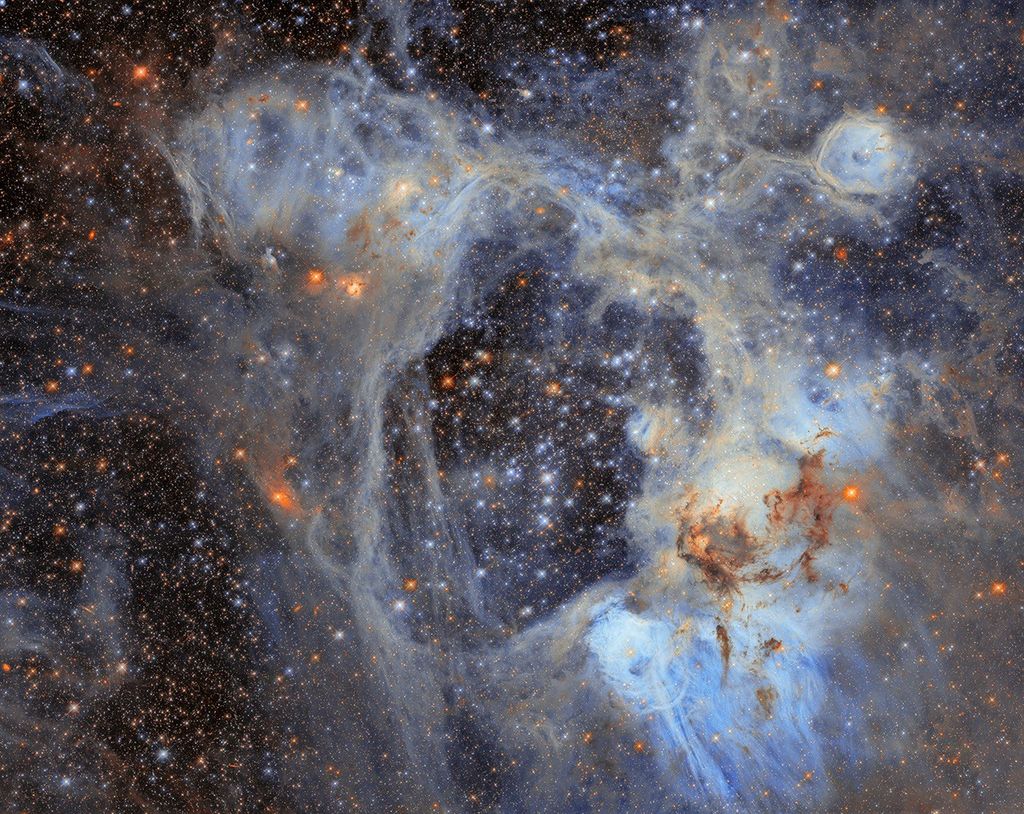
This image shows in stunning detail a small section of the expanding remains of a massive star that exploded about 8,000 years ago, called the Veil Nebula. The debris is one of the best-known supernova remnants, deriving its name from its delicate, draped filamentary structures. The entire nebula is 110 light-years across, covering six full moons on the sky as seen from Earth, and resides about 2,100 light-years away in the constellation Cygnus, the Swan. This view is a mosaic of six pictures of a small area roughly two light-years across, covering only a tiny fraction of the nebula's vast structure. This close-up look unveils wisps of gas, which are all that remain of what was once a star 20 times more massive than our Sun. The fast-moving blast wave from the ancient explosion is plowing into a wall of cool, denser interstellar gas, emitting light. The nebula lies along the edge of a large bubble of low-density gas that was blown into space by the dying star prior to its self-detonation. The nebula resembles a crumpled bed sheet viewed from the side. The bright regions are where the shock wave is encountering relatively dense material or where the "bed sheet" ripples are viewed edge on.
Image Credit: NASA, ESA, and the Hubble Heritage Team (STScI/AURA)
- X
https://science.nasa.gov/image-detail/veil-nebula/
Image CreditNASA, ESA, and the Hubble Heritage Team (STScI/AURA)
Size10681x7121px