

























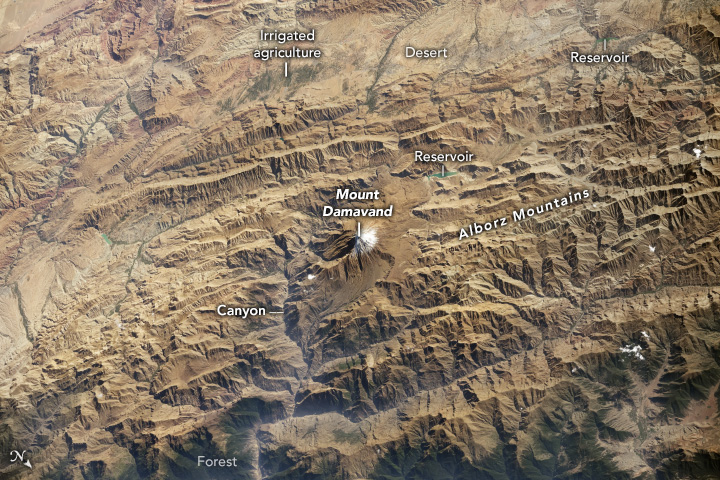
An astronaut aboard the International Space Station took this photo of Mount Damavand (also spelled Demavend) in the Alborz Mountains of northern Iran. Damavand is a dormant volcano with a cone much larger than the white snow-clad summit pictured here in early autumn 2024.
The Alborz Mountains are comprised of folded and faulted rock strata. These strata occupy most of the area shown in the photograph, appearing as prominent linear structures with a marked east-west orientation. Note that the photo has been rotated (north is down) to minimize an optical illusion known as relief inversion.
Mount Damavand, which last erupted about 7,300 years ago, is the highest mountain in Iran, standing about 5,600 meters (18,000 feet) above sea level. A prominent canyon that cuts across the Alborz range carries meltwater from the snowcap to the Caspian Sea, which lies just outside the bottom of the image. A detailed astronaut image of the cone in winter can be seen here.
The Alborz Mountains separate the wetter coastal lowlands of the Caspian Sea area from the deserts of central Iran. This photo shows the arid, tan-hued desert south of the mountains, which contrasts with the dark-green forested slopes to the north.
The strata forming the Alborz Mountains are layered sedimentary rocks deposited in the ancient Tethys Sea. They were subsequently folded when this sea was “closed” during the geological period in which the Africa-Arabian tectonic plate moved northeast and the Iranian plate moved south. This kind of rock folding is a typical part of the geological processes that occur when oceans close. The Appalachian Mountains of North America were formed in a similar process.
Two small reservoirs are visible west of Mount Damavand. Both feed water to the irrigated agriculture of the desert country. The Latyan Reservoir also delivers water to Iran’s capital city, Tehran, which lies just outside the upper right corner of the image.
References & Resources
Astronaut photograph ISS072-E-265 was acquired on September 23, 2024, with a Nikon Z9 digital camera using a focal length of 200 millimeters. It was provided by the ISS Crew Earth Observations Facility and the Earth Science and Remote Sensing Unit, Johnson Space Center. The image was taken by a member of the Expedition 72 crew . The image has been cropped and enhanced to improve contrast, and lens artifacts have been removed. The International Space Station Program supports the laboratory as part of the ISS National Lab to help astronauts take pictures of Earth that will be of the greatest value to scientists and the public, and to make those images freely available on the Internet. Additional images taken by astronauts and cosmonauts can be viewed at the NASA/JSC Gateway to Astronaut Photography of Earth . Caption by Justin Wilkinson, Texas State University, Amentum JETS II Contract at NASA-JSC.