













Career Path Suggestions
Astrobiology is the study of the origins, evolution, distribution, and future of life in the universe. This interdisciplinary field requires a comprehensive, integrated understanding of biological, planetary, and cosmic phenomena. Astrobiology encompasses many topics including the search for habitable environments in our solar system and on planets around other stars; the search for evidence of prebiotic chemistry or life on solar system bodies like Mars, Jupiter’s moon Europa, and Saturn’s moon Titan; and research into the origins, early evolution, and diversity of life on Earth.
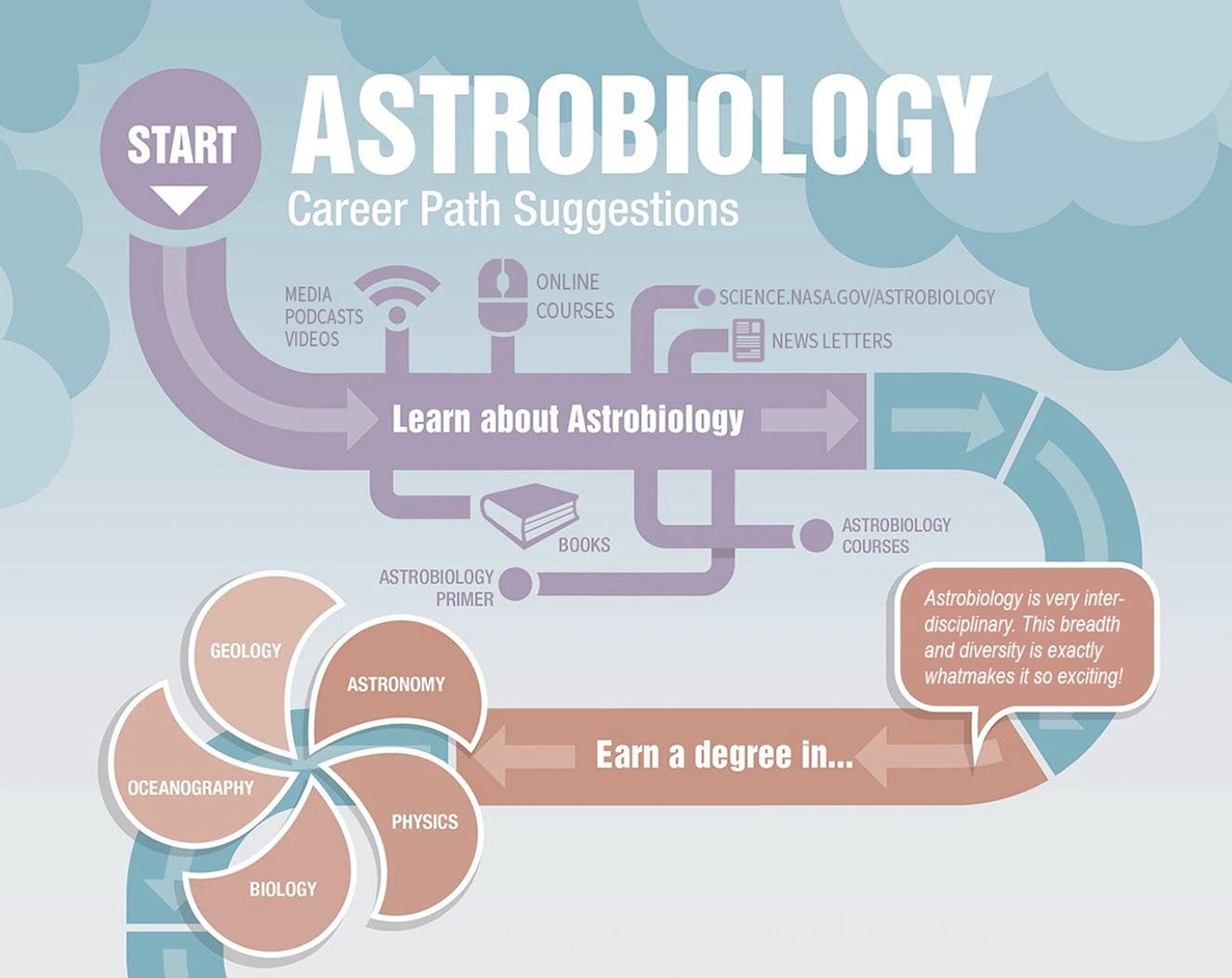
The field of astrobiology is relatively new when compared to the long established fields of astronomy, biology, physics, geology, planetary science, etc. There are dedicated graduate degree programs in astrobiology and even some undergraduate programs. However, the typical pathway for a student interested in pursuing astrobiology studies is to specialize in a single scientific discipline. You should choose a field that really excites you. This discipline will be the base of knowledge that you will build upon, so make it one you are passionate about.
Undergraduate Studies
As you work on building a foundation in your field of interest, educate yourself about astrobiology. Seek out online courses from established organizations. The Astrobiology Primer is a good reference tool to understand, at least at a fundamental level, the field of astrobiology. You can browse this NASA Astrobiology Program website for the latest information on astrobiology at NASA, including careers, learning resources, funded research, news, and publications. You should subscribe to the Astrobiology Program Mailing List to keep current on astrobiology happenings.
Undergraduate Opportunities: Check out NASA summer programs, internships, and special programs, many of which have opportunities available to undergraduates.

Graduate Studies
When looking for graduate schools, look at research topics of individual scientists involved in the part of astrobiology you are interested in, and focus your graduate applications towards working with those individuals.
A good place to start your search is by looking at the research projects within the NASA Research Coordination Networks (RCNs) and NASA Research Opportunities in Space and Earth Science (ROSES) supported by the NASA Astrobiology Program.
You should also be networking and engaging with your astrobiology community. Attend events like the Astrobiology Graduate Conference (AbGradCon) and participate in astrobiology summer schools.
Graduate Opportunities: There are many NASA summer programs, internships, and special programs available to graduate level students.
Postdoctoral Work
As you look towards your postdoctoral work you will want to identify a research group involved in the research you are interested in, whether that’s searching for exoplanets or understanding microbes in extreme environments. You should read recently published papers from research groups supported by the NASA Astrobiology Program you’re interested in and visit their website to gain an appreciation for what they do and how that fits with your interests. Then contact the Principal Investigator (PI) to see if they have Ph.D. or postdoctoral positions available.
You should seek out job boards or newsletters beyond NASA in your field that post postdoctoral opportunities. You can also look for opportunities at NASA, including fellowships and internships. Be sure to sign up to the Astrobiology Program Mailing List.

Now You’re An Astrobiologist!
There is a wide range of jobs available to astrobiologists besides doing research in a lab or lecturing at a university. You can work in the press office informing the media on the latest happenings; or as a science journalist writing about the latest discoveries in websites, magazines, newspapers, or books. Are you also an artist? You can develop educational materials like the Astrobiology Graphic Histories. You could get into science policy to help the government make well-informed decisions about new laws or funding; or work in project management or administration. Where do you want to contribute? What’s your path?
For more information about finding a career in astrobiology, check out the Astrobiology Graphic History Issue #9: Becoming an Astrobiologist (full resolution; mobile)!