
























NASA’s Dragonfly Rotorcraft Gets Decked Out, Tested
NASA’s Dragonfly rotorcraft is beginning to take shape – literally – with the delivery of the panels that make up the rotorcraft lander’s body. Built from ultra‑lightweight honeycomb panels designed at the Johns Hopkins Applied Physics Laboratory (APL) in Laurel, Maryland, and manufactured by Lockheed Martin Space in Denver, the primary structure is specially designed for the challenges of flight on Saturn’s largest moon Titan.
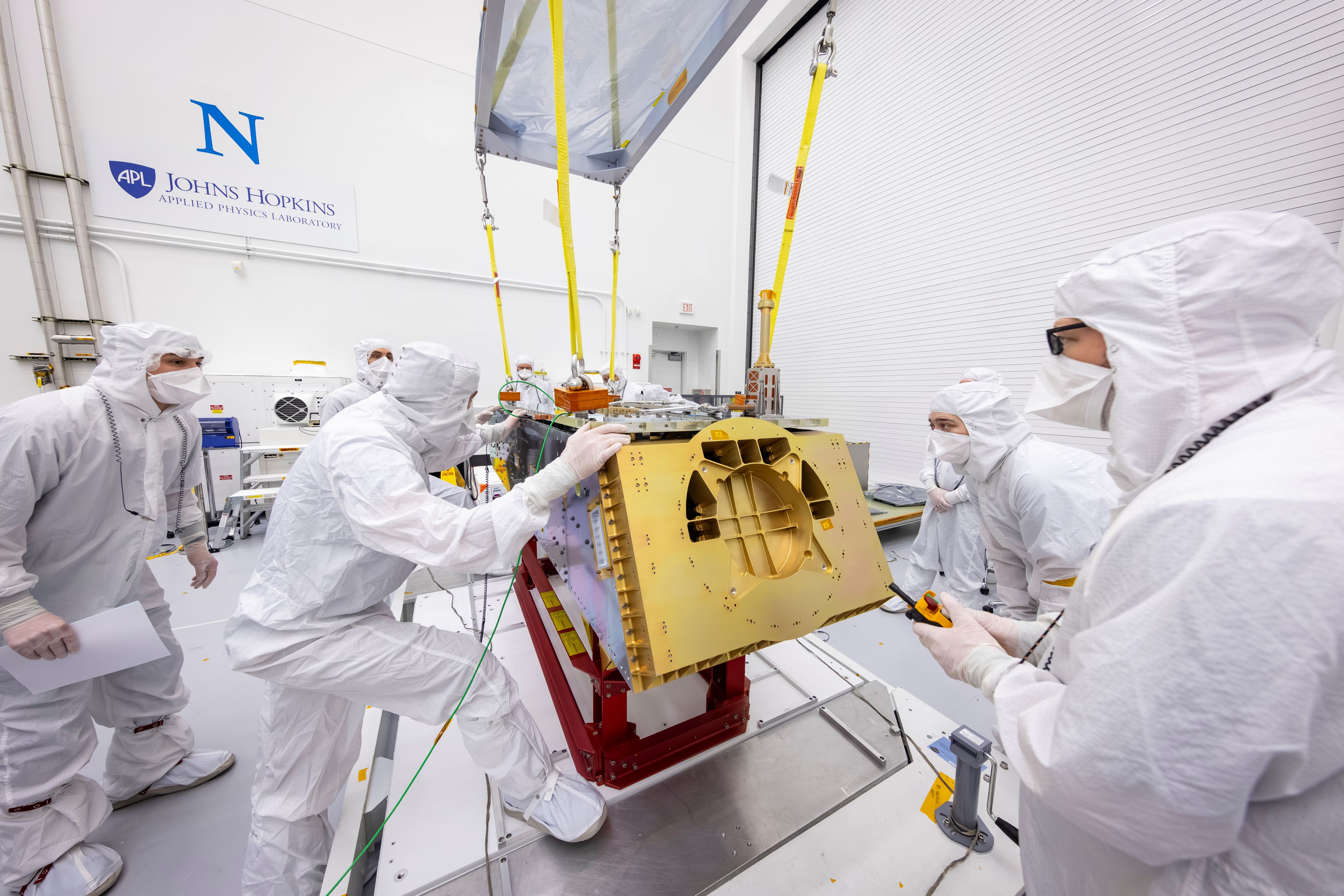
Each panel uses aluminum face sheets only 0.01 inches thick — much thinner than typically used on spacecraft — to meet the strict mass limits required for powered flight through Titan’s atmosphere. But while the entire frame weighs just 230 pounds, it’s also durable. “The structure is remarkably light and yet strong enough to withstand the intense forces of launch and the entry into Titan’s atmosphere,” said Gordon Maahs, the Dragonfly mechanical systems engineer from APL. “We’ve never built anything like it.”
In early April, the APL team began assembling the fuselage and integrating key structural elements, including the mounting plate and cover for Dragonfly’s power source, a multi-mission radioisotope thermoelectric generator, which will be installed just before launch. Engineers also performed a fit check of the top deck, which carries components of Dragonfly’s telecommunications system.
In May, vibration and static-load tests will be performed on the structure to measure Dragonfly’s response to the dynamic forces of launch (from Earth) and atmospheric entry and landing (on Titan). “The lander is starting to look like Dragonfly,” said Hunter Reeling, Dragonfly’s thermal mechanical integration and test lead from APL. “We’re excited to see the designs coming to life.”
Parachute passes test
In February, the mission achieved a significant milestone with the successful completion of another series of parachute drop tests, key to the development of the parachute decelerator elements of the entry, descent and landing (EDL) system that will decelerate the Dragonfly lander as it descends into Titan’s atmosphere.
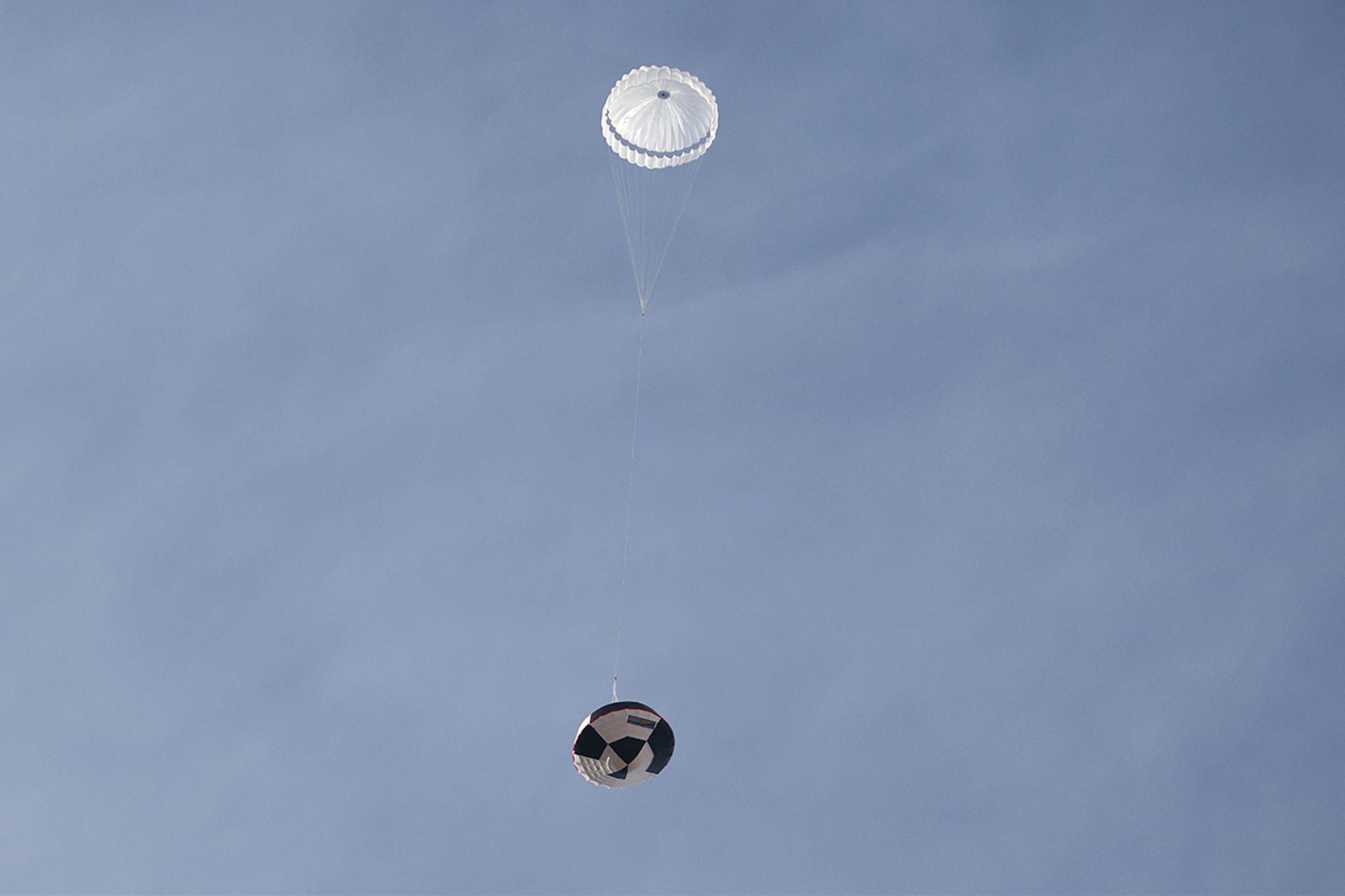
Led by Airborne Systems of Santa Ana, California, in coordination with NASA’s Langley Research Center in Hampton, Virginia, and NASA’s Ames Research Center in California’s Silicon Valley, and conducted in Eloy, Arizona, the test marked the first trials of a full-scale parachute system, including both the drogue and main parachutes. These tests on Earth are designed to closely replicate the environment Dragonfly will encounter within Titan’s atmosphere.
The team plans to conduct another series of similar design-qualification tests in October before building the flight systems.
Preparing to sample Titan’s surface
Dragonfly’s portable chemistry lab, which will study Titan’s surface composition, is in the final stages of integration and testing at NASA’s Goddard Space Flight Center in Greenbelt, Maryland. This payload, called the Dragonfly Mass Spectrometer (DraMS), includes two systems for releasing molecules from samples that Dragonfly will collect: laser desorption and gas chromatography. Once released, the molecules will flow to a mass spectrometer, which will identify them by their masses.
On April 15, engineers completed testing of the laser system, which was integrated within DraMS in February. Using a sample with known compounds, the team confirmed that the laser and mass spectrometer can identify the chemicals in a relevant sample, even in very small amounts.
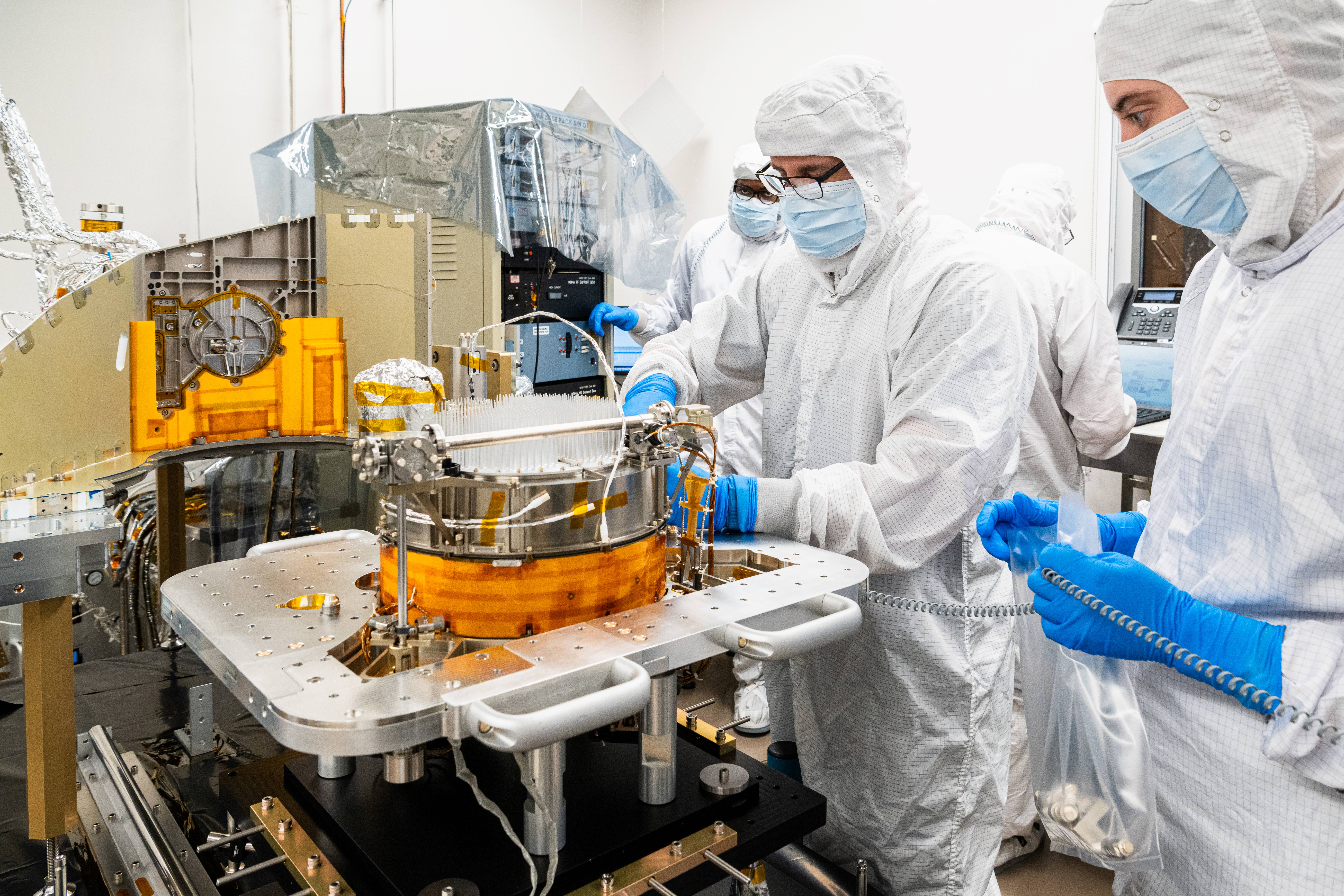
Over the next few weeks, engineers will install the gas chromatography system into DraMS and carry out similar tests. The gas chromatography system, provided by CNES (Centre National d’Etudes Spatiales), works by heating a sample, releasing molecules, and separating them before analysis. Together, the laser- and gas-analysis systems will help Dragonfly detect compounds across a wide range of sizes.
Dragonfly is scheduled to launch no earlier than 2028 for a six-year voyage to Saturn’s moon Titan, where it will spend three years flying from location to location to explore a range of sites to study the chemistry, geology, and atmosphere of the Earthlike moon and ultimately advance our understanding of life’s chemical origins.
