





















NASA Predicts Swift Spacecraft’s Location for Boost Mission
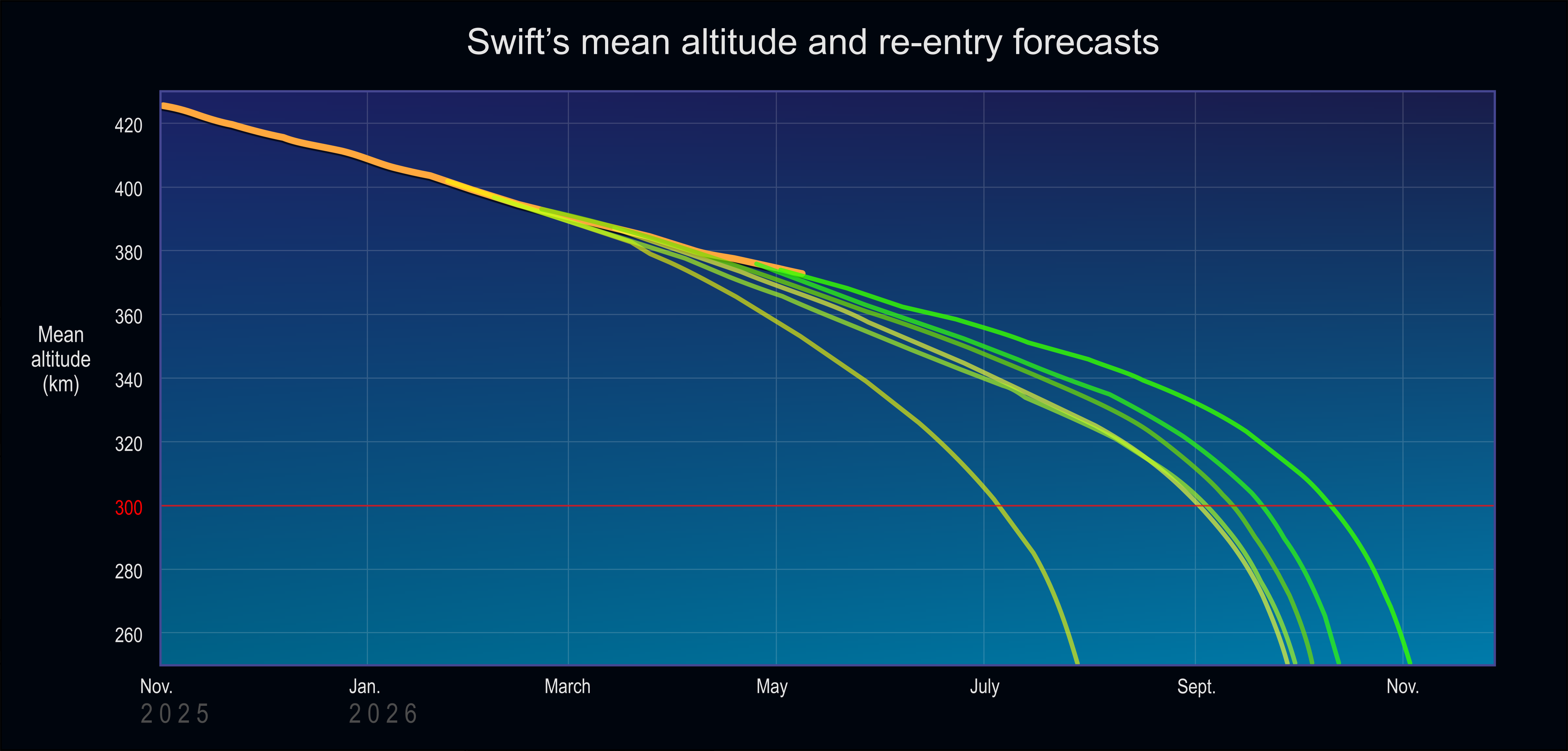
Editor’s note: This post was updated with a new version of the graph on Tuesday, May 26. The label on the x-axis that says “July” previously said “June.”
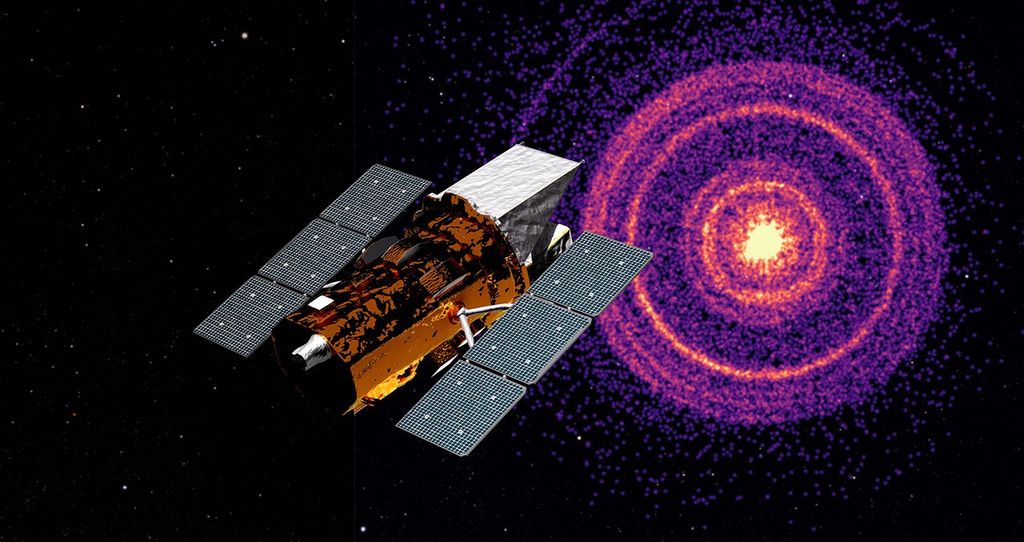
NASA analysts and engineers have been closely tracking the agency’s sinking Neil Gehrel’s Swift Observatory as part of a fast-paced plan to raise it to a higher orbit.
Teams have been generating models to forecast the spacecraft’s altitude in the coming weeks and months, as Katalyst Space readies its LINK robotic servicing satellite to launch and rendezvous for the lift maneuver.
“These predictions evolve over time, based on space weather forecasts and other factors like Swift’s current height and orientation,” said Michael Shoemaker, deputy flight dynamics lead in SSMO (Space Science Missions Operations) at NASA’s Goddard Space Flight Center in Greenbelt, Maryland. “It’s also an iterative process with members of Swift’s operations team. They determine new ways to point the spacecraft to reduce drag, and we do some new computations to see how much extra time that buys them.”
All spacecraft in low Earth orbit experience drag caused by our planet’s atmosphere, which solar storms can magnify. Many satellites, like Swift, don’t have propulsion systems to maintain their orbits, so the drag gradually reduces their altitudes.
Shoemaker and his colleagues create annual predictions for dozens of spacecraft in this situation, some that are still active and others that have been decommissioned.
They use orbital data from the U.S. Space Force, solar activity research from NASA and the National Oceanic and Atmospheric Administration’s Space Weather Prediction Center, and operational details from each satellite team.
After most models forecast that a mission will re-enter Earth’s atmosphere within two years, the team generates altitude predictions more frequently.
Swift’s November 2023 yearly model showed a split in the possibilities, with some potential re-entries falling within the two-year window, but a similar number stretched far beyond it, into the 2030s.
In 2024, the Sun reached its solar maximum phase, triggering intense space weather that was more active than expected. The activity caused Earth’s atmosphere to expand slightly and increased its drag on Swift. By early 2025, almost all the models had Swift re-entering by the summer of 2026.

NASA awarded Katalyst, based in Flagstaff, Arizona, a contract to attempt to boost Swift to a higher altitude in September 2025. The Swift team started looking for ways to slow Swift’s orbital decay to give Katalyst as much time as possible to complete the lift maneuver. For the best chance of success, Swift needs to be at least 185 miles (300 kilometers) above Earth.
Shoemaker and his colleagues started generating weekly orbital predictions, which the Swift team used to make decisions about when to halt science observations and how to steer the spacecraft to reduce drag as much as possible. This innovative new approach to operating Swift has allowed them to successfully slow its orbital decay.
According to the most recent predictions, the Swift team’s actions will likely keep the spacecraft above the critical altitude into early fall.
“We’re also working on predictions for where Swift will be when LINK is set to launch in June aboard a Northrop Grumman Pegasus rocket,” said Russell Carpenter, the deputy project manager in SSMO. “The project to re-boost Swift has generated intense interest across the flight dynamics community. The Swift team is grateful that so many people have been willing to pitch in to help with refining these predictions.”
Learn more about the Swift mission at:
https://science.nasa.gov/mission/swift/
By Jeanette Kazmierczak
Goddard Space Flight Center, Greenbelt, Md.
Media contacts:
Alise Fisher
Headquarters, Washington
202-358-2546
Claire Andreoli
Goddard Space Flight Center, Greenbelt, Md.
301-286-1940
