






















APOD
Astronomy Picture of the Day
Discover the cosmos! Each day a different image or photograph of our fascinating universe is featured, along with a brief explanation written by a professional astronomer.
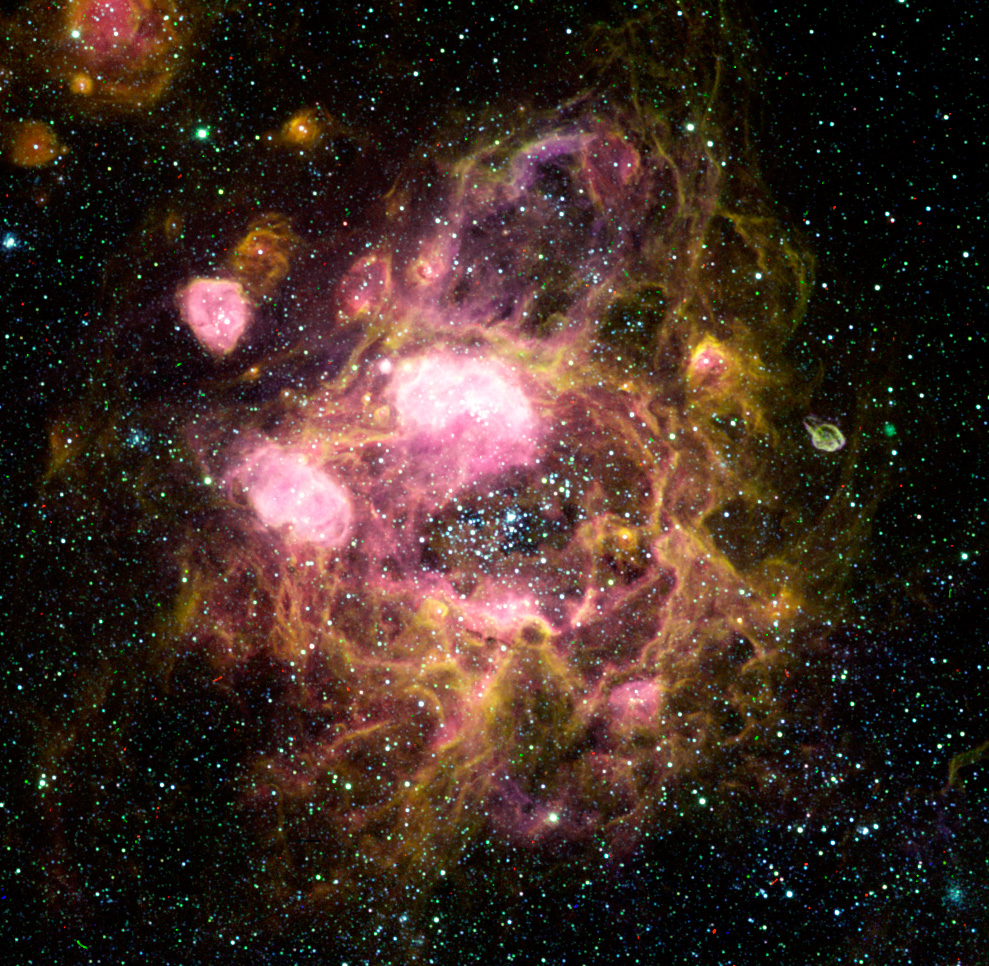
N11: A Giant Ring of Emission Nebulas
Explanation: How did this unusually large nebula form? One of the largest nebulas yet detected is actually a complex ring of emission nebulas connected by glowing filaments. The unusual network , known as N11, spans over 1000 light years and is a prominent structure of the Large Magellanic Cloud , the largest satellite galaxy of our Milky Way Galaxy . In the center of the above image is open star cluster LH9, also known as NGC 1760, composed of about 50 bright blue stars that emit radiation that has eroded a hole in their surroundings. A leading hypothesis for the formation of N11 is shells of successive generations of stars being formed further out from the center. The bright region just above center is N11B , an explosive domain where stars are being formed even today.
| Date | October 6, 2004 |
|---|---|
| Credit | Credit & Copyright: C. Smith & S. Points , CTIO , AURA , NOAO , NSF |
| Authors & editors: | Robert Nemiroff (MTU) & Jerry Bonnell (UMCP) |
| A service of: |
ASD at NASA / GSFC, NASA Science Activation & Michigan Tech. U. |