

















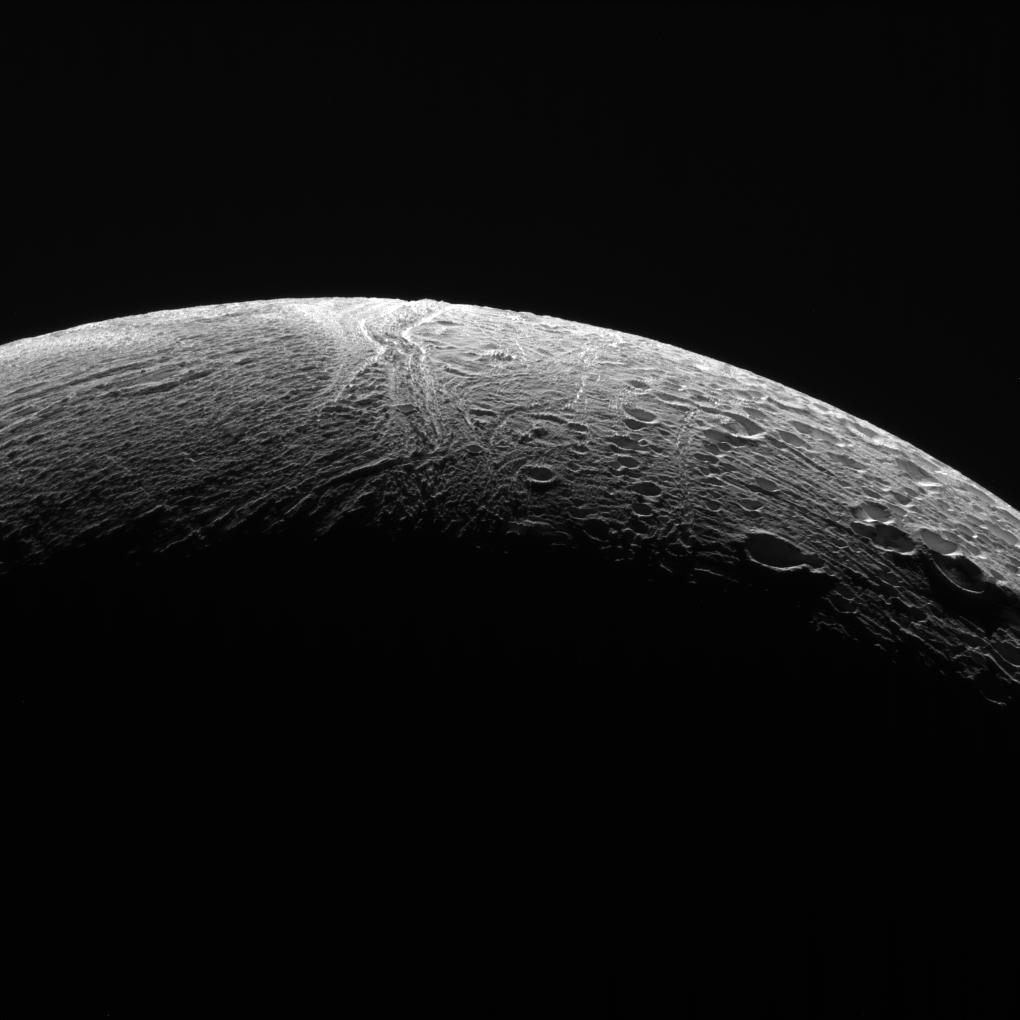
After revealing Enceladus' surprising geologic activity in 2005, Cassini made a series of discoveries about the material gushing from warm fractures near its south pole. Scientists announced strong evidence for a regional subsurface sea in 2014, revising their understanding in 2015 to confirm that the moon hosts a global ocean beneath its icy crust.
In addition to the processed images, unprocessed, or "raw," images appear on the Cassini mission website at: https://science.nasa.gov/mission/cassini/multimedia/featured-raw-images/
Additional information and multimedia products for Cassini's final Enceladus flybys are available at:
https://science.nasa.gov/toolkit/enceladus-final-flybys/
The Cassini-Huygens mission is a cooperative project of NASA, ESA (European Space Agency) and the Italian Space Agency. NASA's Jet Propulsion Laboratory in Pasadena, California, manages the mission for the agency's Science Mission Directorate in Washington. The Cassini imaging operations center is based at the Space Science Institute in Boulder, Colorado.
For more information about Cassini, visit: https://science.nasa.gov/mission/cassini/
Preston Dyches
Jet Propulsion Laboratory, Pasadena, Calif.
818-354-7013
preston.dyches@jpl.nasa.gov