






















Science Interest Group
Active Galactic Nuclei
The Active Galactic Nuclei Science Interest Group (AGN SIG) offers an opportunity for researchers across all career stages studying AGN.
About AGN SIG
Exploring the Active Galactic Nuclei
The Active Galactic Nuclei Science Interest Group (AGN SIG) offers an opportunity for researchers across all career stages studying AGN to come together in a series of inspiring and focused talks given by leaders in the field, followed by informal discussions that can potentially lead to future collaborations
In addition, the AGN SIG organizes workshops and other collaborative activities aimed at advancing AGN science in alignment with NASA missions.
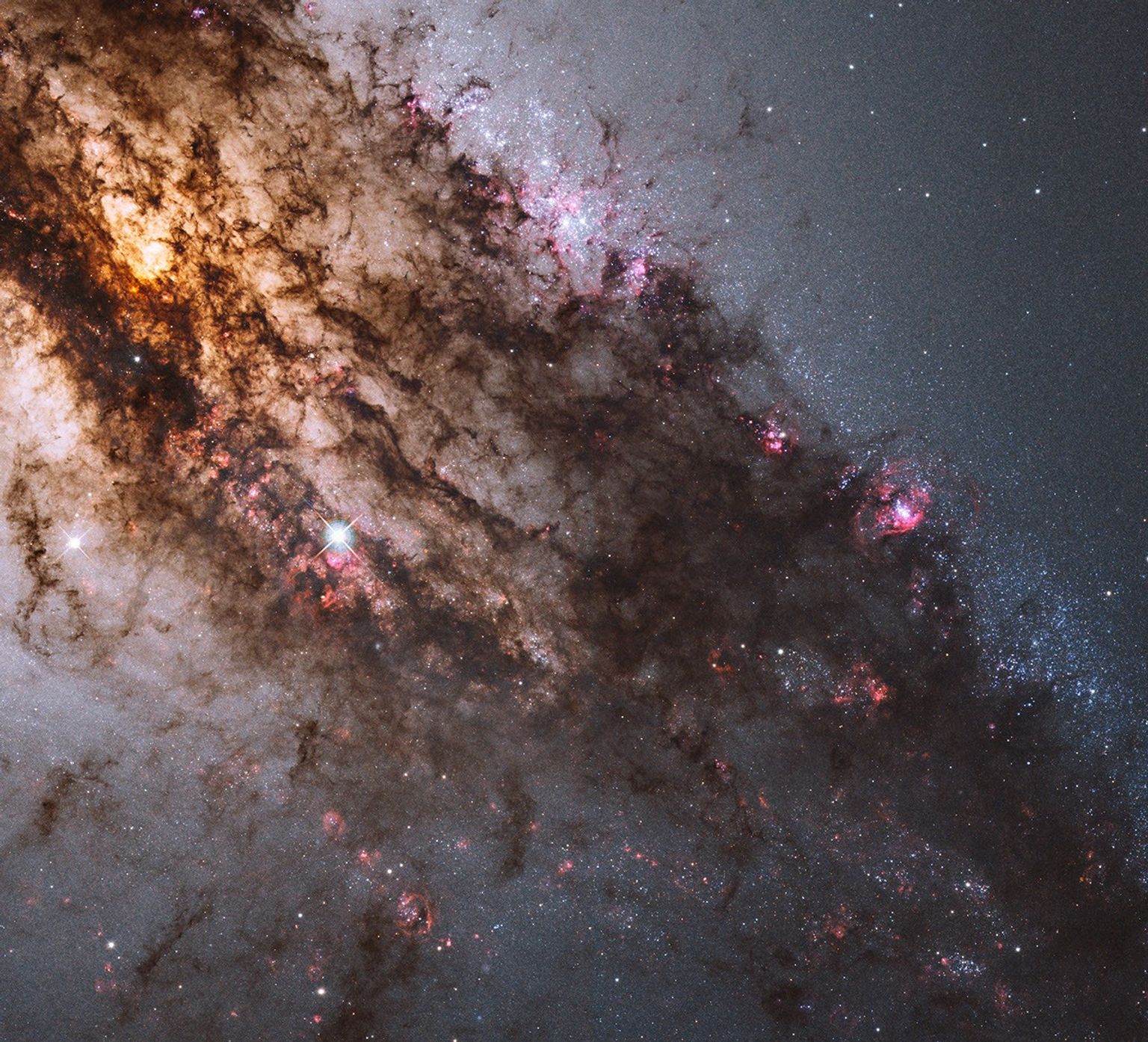
The warped shape of Centaurus A's disk of gas and dust is evidence for a past collision and merger with another galaxy. The resulting shockwaves cause hydrogen gas clouds to compress, triggering a firestorm of new star formation. These are visible in the red patches in this Hubble close-up.
At a distance of just over 11 million light-years, Centaurus A contains the closest active galactic nucleus to Earth. The center is home for a supermassive black hole that ejects jets of high-speed gas into space, but neither the supermassive black hole or the jets are visible in this image.
This image was taken in July 2010 with Hubble's Wide Field Camera 3.
Acknowledgment: R. O'Connell (University of Virginia) and the WFC3 Scientific Oversight Committee
Subscribe to the AGN SIG Email List
To join the list, send an email to AGN-SIG-join@lists.nasa.gov with Subject="join"
To unsubscribe, send an email to AGN-SIG-leave@lists.nasa.gov with Subject="leave"
Your email address will be used only for the purpose of subscription to the selected email distribution list. For further information, read the NASA Web Privacy Policy.
News & Events

AGN Science with the Roman EXtreme Deep Field (RXDF) and Other Large Surveys in the Roman Era. Speaker: Dr. Anton Koekemoer (STScI)
AGN Coffee is designed to be a monthly, low-pressure, informal environment where early-career astronomers can discuss recent AGN papers, research ideas, and broader developments in the field.
Unveiling the Role of Multi-Phase AGN Outflows with MIRACLE. Speaker: Dr. Matteo Ceci (Università di Firenze) and Disk Reflection as the Origin of the X-ray Polarization of NGC 4151 with IXPE. Speaker: Dr. Elias Kammoun (California Institute of Technology)
AGN SIG Spotlight Series. Speakers: Dr. Xiaojing Lin (Tsinghua University) and Dr. Pallavi Patil (National Radio Astronomy Observatory)
We invite everyone to join us for the next AGN Coffee on August 6th at 1 pm ET/10 am PT.
Our Spotlight Series highlights recent advances in AGN science, with a strong emphasis on participation from early-career researchers, and includes plenty of time for community discussion following the presentations.
Leadership Council
| Name | Affiliation |
|---|---|
| Erin Hicks, Chair | University of Alaska Anchorage |
| Travis Fischer, Co-Chair | STScI |
| Anika Goel | Indiana University Bloomington |
| Pallavi Patil | Johns Hopkins University |
| Peter Maksym | NASA/MSFC |
| Ming-yi Lin | University of Toledo |
News Straight to Your Inbox
Subscribe to your community email news list
We will never share your email address.
