





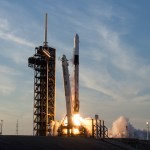



Cosmic Origins at AAS 235
The Cosmic Origins (COR) Program's presented activities at the 235th Meeting of the American Astronomical Society (AAS). The COR program's topic areas include galactic and stellar evolution, dark matter, and the origins and effects of supermassive black holes.
Location
Honolulu, Hawaii
DATE
4 – 8 January 2020
COMMUNITY
Cosmic Origins
TYPE
Meeting
Saturday January 4, 2020
COPAG Technology Interest Group (TIG) with UV-Vis Science Interest Group (UVSIG)
This splinter features a joint session of the UV Science Interest group, led by Jason Tumlinson, and the technology interest group (TIG), led by Sarah Tuttle. The session will include a review of the Astro2020 Decadal white papers relevant to UV science and technology areas. There will be a discussion of technology advancement needs for all astrophysics missions. It will end with a discussion of future directions for UV science.
Joint Program Analysis Group Meeting
Paul Hertz : NASA Astrophysics Division [PDF]
Cosmic Origins Program Analysis Group (COPAG) Meeting
Margaret Meixner, Chair of COPAG Executive Committee, Splinter Chair
Cosmic Origins Opportunities with the James Webb Space Telescope [PDF]
| Topic | Speaker | Presentation |
|---|---|---|
| COPAG and COPAG Activities | Margaret Meixner | [PDF] |
| Applying for Time in JWST's Cycle 1 | Possible speaker: Klaus Pontoppidan (JWST Project Scientist at STScI) | [PDF] |
| JWST Instrument Capabilities | Stephanie LaMassa | [PDF] |
| The Cosmic Evolution Early Release Science (CEERS) Survey | Steve Finkelstein | [PDF] |
| Star Formation at Low Metallcity: Studies with JWST | Margaret Meixner | [PDF] |
| Establishing Extreme Dynamic Range with JWST: Decoding Smoke Signals in the Glare of a Wolf-Rayet Binary | Ryan Lau | [PDF] |
| Star and Planet Formation with JWST: NIRCam and NIRISS GTO Science Programs | Michael Meyer | [PDF] |
| The JWST NIRCam and MIRI GTO Debris Disk Programs | Andras Gaspar | [PDF] |
| Thermal Emission Spectroscopy of Beta Pictoris' Prototypical Debris Disk | Christine Chen | [PDF] |
Sunday January 5, 2020
Special Session on Report by NASA Great Observatories Science Analysis Group (SAG 10) Session
NASA's Great Observatories (Hubble, Compton, Chandra, and Spitzer) opened up the electromagnetic spectrum from space, providing the scientific community with a flexible and powerful suite of telescopes with which to attack a broad range of scientific questions and react to a rapidly changing scientific landscape. As the existing Great Observatories age, or are decommissioned, access to the electromagnetic spectrum from space is diminishing, with an accompanying loss of scientific capability. This not only has the potential to significantly impede progress in astrophysics, but may also erode technical and scientific expertise in key wavelength regimes. To analyze the impact of losing wavelength coverage, the Great Observatories Science Analysis Group (SAG-10) was organized by NASA's Cosmic Origins Program Analysis Group, with support from the Physics and Exoplanet Program Analysis Groups. This session will review the analysis and conclusions reached by this group, in particular the importance of panchromatic coverage, basic lessons from the Great Observatories, and possible strategies for maintaining coverage into the forthcoming decades.
Final report is available online [PDF].
| Topic | Speaker |
|---|---|
| Introduction to Great Observatories SAG | Lee Armus |
| Origin of Life and Planets | Michael Meyer |
| Galactic Processes | Massimo Marengo |
| Galaxy Evolution | Lee Armus |
| Fundamental Physics | Ralph Kraft & Suvi Gezari |
| Capabilities, Facilities, and Options | StephanMcCandliss & Martin Elvis |
Tuesday January 7, 2020
IR SIG Splinter Session: The Role of Infrared Astronomy in NASA's Strategic Vision to 2030
All are welcome to join the IR SIG splinter session to hear talks on current and future missions under the IR SIG purview as well as a panel discussion focussed on the role of infrared observations over the coming decade. Confirmed invited speakers include Phil Korngut (SPHEREx), Paul Goldsmith (ASTHROS), Tiffany Kataria (Origins), Hal Yorke (SOFIA) and Matt Bradford (SPICA).
Cosmic Dawn, SAG-11
The NASA COPAG is soliciting involvement in a Cosmic Dawn Science Analysis Group (SAG #11). This SAG will assess what questions relating to reionization and galaxy evolution in the very early universe will remain after the JWST mission, and will i) assess the potential for future NASA flagship missions or proposed probe-class missions to answer these questions, ii) explore what investigations can be done with current telescopes and archives, and iii) identify the need for coordinated multi-observatory programs and/or simulation efforts towards these goals. The goal of SAG11 is to analyze the above questions and compose and publish a report, delivered to NASA HQ, by the end of 2020.
SAG 11 will kick off with a discussion session at the January 2020 AAS on Tuesday, 7 January, at 2:00 – 3:00pm, and we are now soliciting members of the astronomy community for this SAG. If interested, please fill out the form, linked below, by 31 January 2020. We encourage applicants at all career stages.
235th Meeting of the American Astronomical Society
Learn More
News Straight to Your Inbox
Subscribe to your community email news list
We will never share your email address.