


















Infrared Science and Technology Interest Group Seminar | February 5, 3pm ET / 12pm PT
5 February 2024
Ex-MORA + COSMOS-Web: Gas, Dust, and Stars in Massive Dusty Galaxies at z > 3
Date: February 5th at 3pm Eastern / 12pm Pacific
Speaker: Arianna Long (University of Texas Austin)
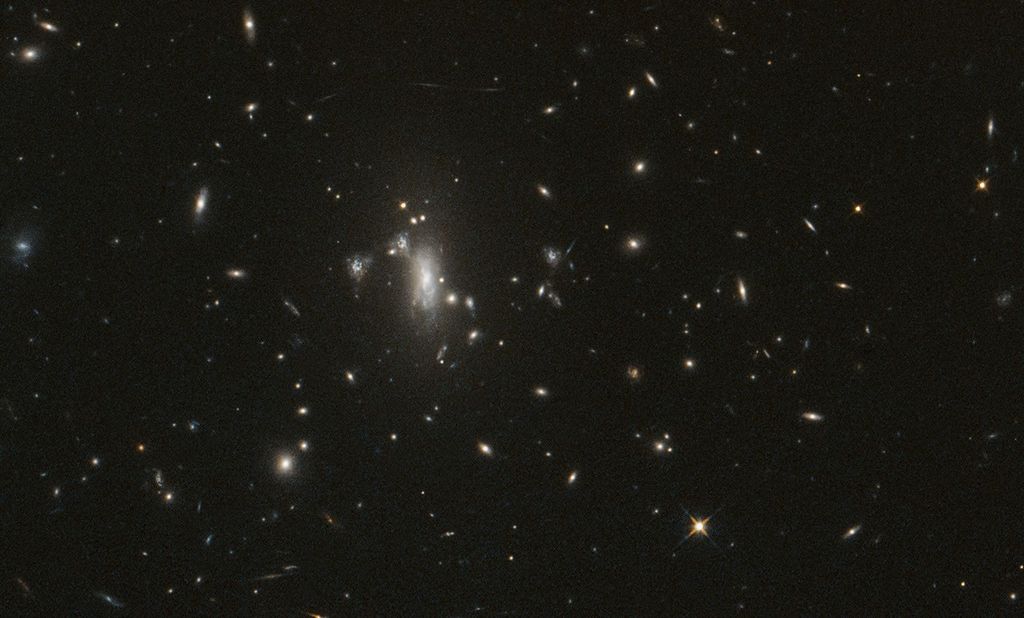
Abstract: For nearly a decade, we have hunted for the ancestors to massive quiescent galaxies in the early Universe (z > 2). Several lines of evidence suggest that heavily dust obscured star-forming galaxies (DSFGs) at z > 3 are the likely progenitor population for these giants. While DSFGs are known as the most massive, most star forming, and most dust-obscured galaxies at Cosmic Noon, their population prevalence and properties at z > 3 historically remained elusive and enigmatic. Now, with a combination of JWST and ALMA observations over large solid angles, we can finally identify and analyze statistically significant samples of z > 3 DSFG populations. In this talk, I will present new results on z > 3 DSFGs identified in the Ex-MORA survey — the largest ever ALMA blank-field survey. Ex-MORA is specifically designed to capture massive z > 3 galaxies too dust obscured to be detected in most pre-JWST UV/optical surveys. I will reveal their optical morphologies and share the significance of these objects in the context of rapid massive galaxy evolution in the first 2 Gyr of the cosmos.
The Quantum Capacitance Detector – Counting Single Photons in the Far-Infrared
Date: February 5th at 3pm Eastern / 12pm Pacific
Speaker: Pierre Echternach (NASA Jet Propulsion Laboratory)
Abstract: The Quantum Capacitance Detector (QCD) is a high-sensitivity direct detector under development for low background applications such as far-infrared spectroscopy from a cold space telescope. The QCD has demonstrated an optically-measured noise equivalent power of 2⋅10-20 W⋅Hz-1/2 at 1.5 THz, making it among the most sensitive far-infrared (IR) detectors systems ever demonstrated, and meeting the requirements for spaceborne spectroscopy. The device is also intrinsically fast, and thus able to count individual far-IR photons. Here we report a new 2-D array yielding 291 QCDs out of 441 pixels patterned, demonstrating photon-counting in a large scale. A readout technique was developed to reveal the presence or absence of a photon within a frame by a single number, providing a way to scale up to even larger arrays while maintaining a modest data rate need.
Zoom link for IR STIG seminars
For connection information, see here: IR STIG Seminar | Feb 5th
Please join the IR STIG Email List
News Straight to Your Inbox
Subscribe to your community email news list
We will never share your email address.