


















Science Analysis Group
O VI
O VI refers to Oxygen that has been five-times ionized, and has a doublet spectral feature at approximately 103 nm. The Cosmic Origins Program Office has initiated the O VI Science Analysis Group (SAG) to consider important science that can be done with UV sensitivity to the O VI lines.
About O VI SAG
The Ultraviolet Waveband Will be Key to Addressing Astro2020 Decadal Survey Science Goals
The Habitable Worlds Observatory (HWO) will be the next flagship mission of NASA Astrophysics capable of addressing fundamental questions concerning galaxy growth, cosmology, the evolution of elements, planetary systems, and more.
The O VI Science Analysis Group (SAG) will consider important science that can be done with UV sensitivity to the O VI lines and what these lines can do for understanding the circumgalactic medium of galaxies, and galaxy evolution more broadly.
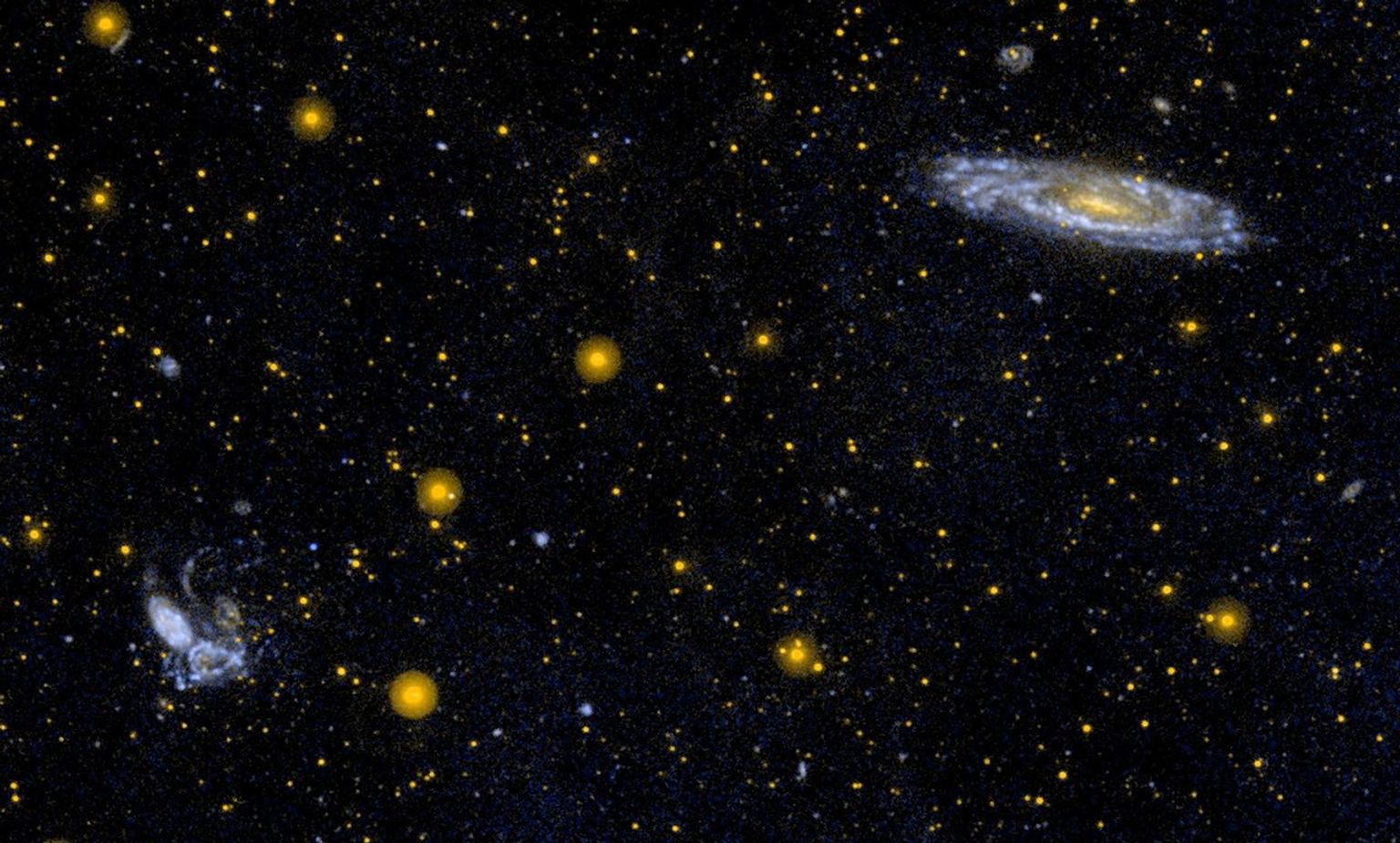
The goals of this SAG are to analyze the status of theoretical predictions for far-UV spectral line diagnostics in simulations of galaxy evolution, and particularly the circumgalactic medium of galaxies. O VI is featured specifically because of its proximity to the far UV wavelength limit for practical UV coatings that may be considered for HWO. The SAG will synthesize the science goals and objectives that may be attained if HWO has sensitivity to this far-UV end of the wavelength spectrum and clearly articulate the science that would be lost if this wavelength were not accessible due to design trades in HWO that forfeited this spectral wavelength range from approximately 100 - 120 nm.
The outcomes of the analysis will be communicated to NASA and the astrophysics community through reports to the COPAG Executive Committee, Cosmic Origins UV Science and Technology Interest Group (UV STIG), the HWO Community Science and Instrument Team (CSIT), and the HWO Technology Maturation Project Office (HTMPO). This Science Analysis Group (SAG) will produce essential input for CSIT and HTMPO deliberations on the importance of far UV sensitivity for general astrophysics goals of Habitable Worlds Observatory.
Subscribe to the O VI SAG Email List
To join the list, send an email to O-VI-SAG-join@lists.nasa.gov with Subject="join"
To unsubscribe, Send an email to O-VI-SAG-leave@lists.nasa.gov with Subject="leave"
Your email address will be used only for the purpose of subscription to the selected email distribution list. For further information, read the NASA Web Privacy Policy.
SAG Membership
| Sanchayeeta Borthakur (lead) – Arizona State University | Haeun Chung |
| Hsiao-Wen Chen | Chris Howk |
| Romeel Dave | Andrew Fox |
| Ben Oppenheimer | Joe Burchett |
News & Events
Meeting, conferences, seminars, workshops, and other SAG news and events.
The 247th AAS meeting (joint with the Historical Astronomy Division) will be held 4-8 January in Phoenix, Arizona at the Phoenix Convention Center. Join us in the exhibit hall at the NASA booth and attend the NASA sessions.

OVI Absorption in the Halos of Local Group Galaxies Speaker Andy Fox
The goals of this SAG are to analyze the status of theoretical predictions for far-UV spectral line diagnostics in simulations of galaxy evolution, and particularly the circumgalactic medium of galaxies. O VI is featured specifically because of its proximity to…
News Straight to Your Inbox
Subscribe to your community email news list
We will never share your email address.
