












Science Analysis Group
Spatially Resolved UV Spectroscopy
This Science Analysis Group (SAG) will produce essential input for the HWO Community Science and Instrument Team (CSIT) and HWO Technology Maturation Project Office (HTMPO) deliberations on spatially resolved UV science and technology for Habitable Worlds Observatory.
About Spatially Resolved UV Spectroscopy SAG
Addressing Science Goals Defined by the 2020 Astrophysics Decadal Survey
The ultraviolet (UV) spectrograph will be key to addressing the science goals of “Cosmic Ecosystems” and “Worlds and Suns in Context.”
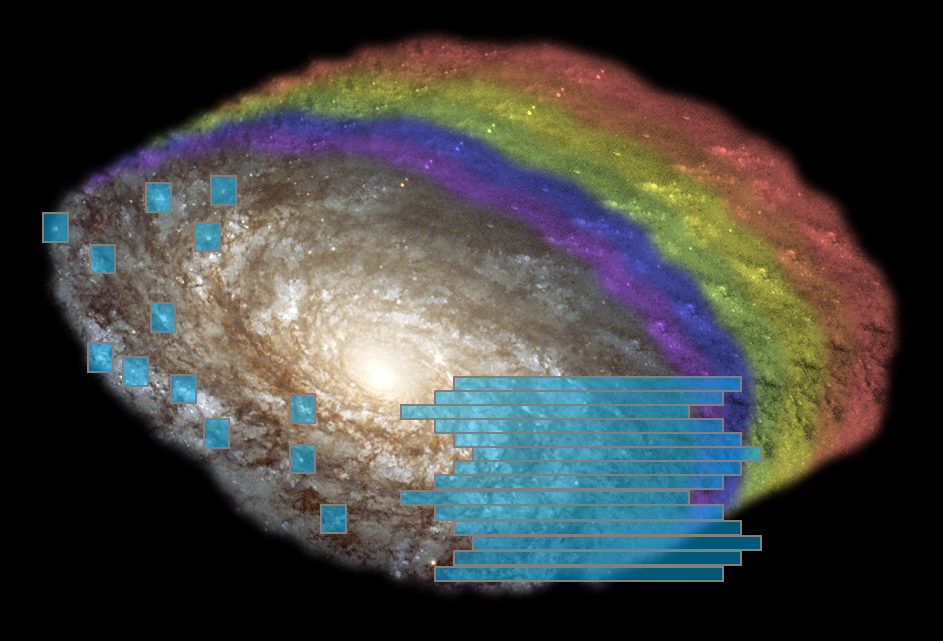
The Habitable Worlds Observatory (HWO) will be the next flagship instrument of NASA Astrophysics capable of addressing fundamental questions concerning galaxy growth, cosmology, the evolution of elements, planetary systems, and more. The ultraviolet (UV) spectrograph, capable of spatially resolved spectroscopy, will be key to addressing the science goals of “Cosmic Ecosystems” and “Worlds and Suns in Context” as defined by 2020 Astrophysics Decadal Survey. Extensive preparation regarding what UV technology will be available for use on HWO and what science cases most need to be addressed has occurred. The goal of this SAG is to build on that work and consider the parameter space that maximizes HWO science return and is also feasible with the UV spectroscopic technology that is expected to be available in the next four to five years.
The goals of this SAG are to analyze the status of UV technology development for spatially resolved spectroscopy, identify new science capabilities enabled by the performance metrics of an integral field spectrograph (IFS) beyond those made possible by a workhorse multi-object spectrograph (MOS), and review UV spectroscopy requirements for general astrophysics. The group will consolidate, build upon, and update previous work on this topic by the LUVOIR and HabEx Science and Technology Definition Teams and the UV Science and Technology Working Group in support of HWO. The outcomes of the analysis will be communicated to NASA and the astrophysics community through reports to the COPAG Executive Committee, Cosmic Origins UV Science and Technology Interest Group (UV STIG), the HWO Community Science and Instrument Team (CSIT), and the HWO Technology Maturation Project Office (HTMPO). This Science Analysis Group (SAG) will produce essential input for CSIT and HTMPO deliberations on spatially resolved UV science and technology for Habitable Worlds Observatory.
Subscribe to the SRUVS SAG Email List
To join the list, send an email to SRUVS-SAG-join@lists.nasa.gov with Subject="join"
To unsubscribe, send an email to SRUVS-SAG-leave@lists.nasa.gov with Subject="leave"
Your email address will be used only for the purpose of subscription to the selected email distribution list. For further information, read the NASA Web Privacy Policy.
SAG Membership
| Name | Institution |
|---|---|
| Emily Witt, Lead | Johns Hopkins University |
| Brian Fleming | University of Colorado |
| Paul Scowen | HWO, NASA GSFC |
| Erika Hamden | University of Arizona |
| Stephan McCandliss | Johns Hopkins University |
| Susan Kassin | Space Telescope Science Institute |
| David Schiminovich | Columbia University |
| Sanchayeeta Borthakur | Arizona State Universit |
| Hsiao-wen Chen | University of Chicago |
| Anne Jaskot | Williams College |
| Claudia Scarlata | University of Minnesota |
| Bethan James | Space Telescope Science Institute |
| Christi Erba | Space Telescope Science Institute |
| David Rupke | Rhodes College |
| Peter Senchyna | Carnegie Observatories |
| Sarah Tuttle | University of Washington |
| Kevin France | University of Colorado |
| Aki Roberge | HWO, NASA GSFC |
| Shouleh Nikzad | Jet Propulsion Laboratory |
| Matthew Hayes | Stockholm University |
| Dimitry Vorobiev | University of Colorado |
| Aaron Yung | Space Telescope Science Institute |
| Arika Egan | JHU Applied Physics Laboratory |
| Drew Miles | California Institute of Technology |
| Massimo Robberto | Space Telescope Science Institute |
| Richard Cartwright | JHU Applied Physics Laboratory |
| Joe Burchett | New Mexico State University |
| Blair Russell | Chapman University |
| Nicole Melso | RIT |
Documents
News Straight to Your Inbox
Subscribe to your community email news list
We will never share your email address.