















Suggested Searches

News & Events

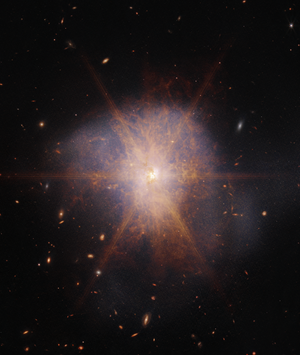
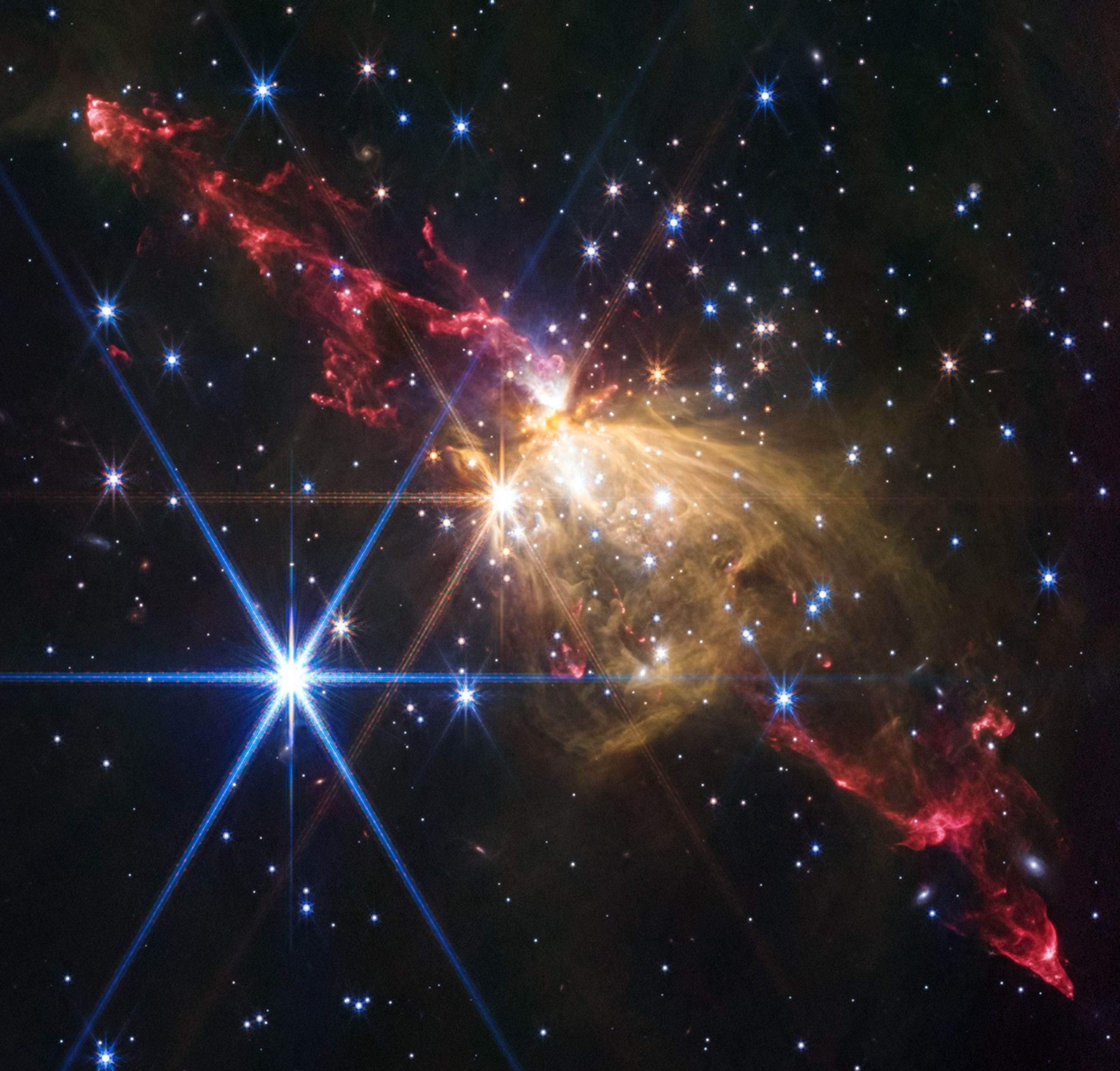
Gaseous yellow-orange filaments look like a rose seen from the side and tilted slightly from upper left to lower right, slightly higher than the center of the frame. Extending from the rose to upper left and lower right are gaseous outflows that appear as red lobes that have an overall shape of tall, narrow triangles with rounded tips. Each red triangle is made up of wavy, irregular lines. Dozens of stars are scattered across the field. One particularly bright white star with eight diffraction spikes is located at the top of the yellow rose. Another bright blue star with even more prominent diffraction spikes is to its lower left. The background of space is black.

Filters

All Science Org Terms

Date Range

Cosmic Origins at AAS 247 (Jan 2026)

The 247th AAS meeting (joint with the Historical Astronomy Division) will be held 4-8 January in Phoenix, Arizona at the Phoenix Convention Center. Join us in the exhibit hall at the NASA booth and attend the NASA sessions. Please ask…

Dec 30, 2025
AI/ML STIG Lecture Series, 22 Dec 2025

JAX Speaker Philip Cargile (Harvard CfA) Meeting Connection Join the Meeting

Dec 22, 2025
AI/ML STIG Lecture Series, 15 Dec 2025

PyTorch and Autodifferentiation Speaker Philip Cargile (Harvard CfA) Meeting Connection Join the Meeting

Dec 15, 2025
ROSES-25 Amendment 30: Updates to ROSES-25 Summary of Solicitation

ROSES-2025 is an omnibus or umbrella solicitation that contains many program element appendices (listed in Tables 2 and 3) and the ROSES-25 Summary of Solicitation (SoS) lays out the backstop rules that apply by default to those program element appendices. ROSES-2025 Amendment 30 makes a…

Dec 15, 2025
Cosmic Pathfinders Early-Career Lunch with NASA Astrophysics at AAS 247

Express your interest in joining the astrophysics program offices and the Cosmic Pathfinders program for a networking lunch event with NASA Astrophysics leadership during the upcoming 247th American Astronomical Society meeting in January.

Dec 15, 2025
AI/ML STIG Lecture Series, December 15, 2025

The next AI & ML STIG lecture will be held today, December 15th (Monday) at 4:00pm ET/1:00pm PT and will cover deep learning basics – PyTorch and auto differentiation. The presentation will be given by Phil Cargile from the Harvard-Smithsonian Center for Astrophysics. The link…

Dec 15, 2025
O VI SAG Working Group Meeting 11 Dec 2025

OVI Absorption in the Halos of Local Group Galaxies Speaker Andy Fox

Dec 11, 2025
Roman Space Telescope Cycle 1 Call for Proposals is Open!!

The Nancy Grace Roman Space Telescope Project is pleased to announce that the Cycle 1 Call for Proposals opens today.  The Cycle 1 Call for Proposals marks the first opportunity to submit proposals to conduct scientific investigations with Roman’s Wide…

Dec 10, 2025
AI/ML STIG Lecture Series, 8 Dec 2025

Model Context Protocol (MCP) Building on our last lecture about AI as a research agent, I’ll be covering something that’s been making waves lately: MCP, or Model Context Protocol. Much like HTTP did for the web, MCP is quickly becoming…

Dec 8, 2025
ROSES-25: F.10 PRISM Correction and FAQ Posted

This email is to notify potential proposers to F.10 PRISM that 1) a bullet was added to the list of information in Section 4.1 that proposers must provide if leveraging survive-the-night services, 2) the FAQ has been updated.

Dec 8, 2025
AI/ML STIG Lecture Series December 8, 2025

The next AI / ML STIG lecture will be held on December 8th (Monday) at 4:00pm ET/1:00pm PT

Dec 8, 2025
Save the Date! Cosmic Origins at AAS 247

The 247th Meeting of the American Astronomical Society (joint with the Historical Astronomy Division) will be held January 4th-8th 2026 in Phoenix, Arizona. A tentative listing of all the COPAG affiliated sessions is below.

Dec 3, 2025
ROSES-25 Amendment 26 D.2 Astrophysics Data Analysis Due Dates

To enhance the scientific return on NASA mission investments, ROSES D.2 the Astrophysics Data Analysis Program (ADAP) provides support for investigations whose focus is on the analysis of archival data from NASA space astrophysics missions. ROSES-2025 Amendment 26 announces the release of final text for…

Dec 3, 2025
NSF Astronomy and Astrophysics AC Meeting Dec 11, 2025

November 2025 Rescheduled to December 11, 2025 Time: 9:00am – 5:30pm ET About the series: Astronomy and Astrophysics AC The Astronomy and Astrophysics Advisory Committee is a federal advisory committee chartered under the Federal Advisory Committee Act at the recommendation of the…

Dec 3, 2025
Galaxies SIG Seminar 3 December 2025

Simulations Meet Space Telescopes to Understand AGN at Cosmic Dawn Speaker Sabrina Berger (University of Melbourne) Abstract For the first time, JWST lets us directly see the stellar light from galaxies hosting luminous quasars at z > 6. Early stellar…

Dec 3, 2025
HWO SIG Seminar December 3, 2025

We would like to invite you to our next virtual seminar: Wednesday, December 3rd, at 10:00 am PT / 1:00 pm ET / 6:00 pm BST / 7:00 pm CET. This is an excellent opportunity to stay informed on the…

Dec 3, 2025
IR STIG Seminar 1 December 2025

We will have two presentations this month from Ben Mazin (University of California Santa Barbara) and Lindsey Wiser (Johns Hopkins Applied Physics Laboratory).  Dr. Mazin will share MKID development progress and Dr. Wiser will discuss the study of exoplanet atmospheres through…

Nov 24, 2025
Cosmic Origins Research Opportunities Page

Additionally, check out the research opportunities page here for an exhaustive listing of other proposal and fellowship opportunities aligned with NASA astrophysics science: https://science.nasa.gov/astrophysics/programs/cosmic-origins/opportunities/ Hyperlinks on the proposal name will take you to the solicitation. Before you begin writing a…

Nov 24, 2025
NASA Postdoctoral Program Deadline Extended

If you’re an early-career or senior scientist, apply to the NASA Postdoctoral Program to help pursue NASA’s mission and experience the world’s most diverse technology and expertise. Become a part of the NPP and experience this unique educational program that…

Nov 24, 2025
IR STIG Seminar December 1, 2025

We will have two presentations this month from Ben Mazin (University of California Santa Barbara) and Lindsey Wiser (Johns Hopkins Applied Physics Laboratory).  Dr. Mazin will share MKID development progress and Dr. Wiser will discuss the study of exoplanet atmospheres through…

Nov 24, 2025
AI/ML STIG Lecture Series, 24 Nov 2025

LLM as Agent Speaker Francisco Villaescusa-Navarro, Flatiron Meeting Recording

Nov 24, 2025
ROSES-25 Amendment 14: F.9 Proposal Due Date Reset

F.9 The Citizen Science Seed Funding Program (CSSFP) aims to incubate citizen science projects as they are being conceived or during critical transitions, like the year when they are first launched or beta tested (i.e., when the first group of…

Nov 21, 2025
Submit an Abstract to AAS Splinter

AAS Splinter Session Tuesday, January 6th, 10:00am – 2:00pm Erika Hamden (University of Arizona) and the Eos Team are soliciting for 15-minute talks on the subject of: Cycles of galaxy growth and star formation in the FUV. . This session will…

Nov 21, 2025
AI/ML STIG Lecture Series Nov 24, 2025

The next AI & ML STIG lecture will be held on November 24th (Monday) at 4:00pm ET/1:00pm PT and will cover Large Language Models (LLM) as Autonomous Agents (Module 1) — LLM as Agent. The presentation will be given by Francisco Villaescusa-Navarro…

Nov 21, 2025

News Straight to Your Inbox

Subscribe to your community email news list

We will never share your email address.

Sign Up
An illustration of Sun-like star HD 181327 and its surrounding debris disk. The star is at top right. It is surrounded by a far larger debris disk that forms an incomplete ellpitical path and is cut off at right. There’s a huge cavity between the star and the disk. The debris disk is shown in shades of light gray. Toward the top and left, there are finer, more discrete points in a range of sizes. The disk appears hazier and smokier at the bottom. The star is bright white at center, with a hazy blue region around it. The background of space is black. The label Artist's Concept appears at lower left.

Submit an Announcement

Submit your Cosmic Origins news or announcement to be featured in the COR News email.

Learn More about Submit an Announcement
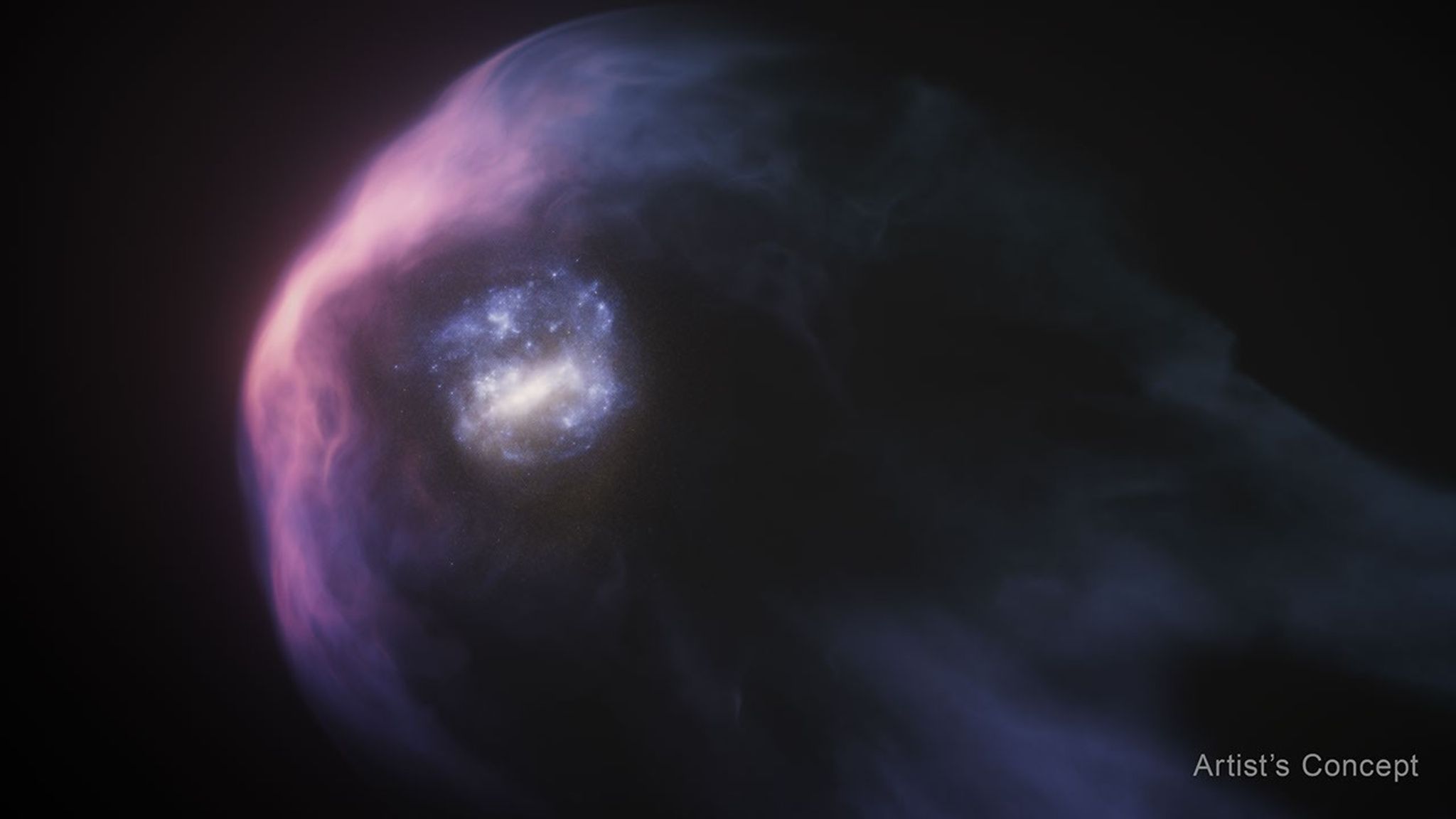
Labeled "artist’s concept" at bottom right, the graphic shows a closeup of a dwarf galaxy, which appears roughly circular with a light yellow bar in the center. Faint, blue, wispy, cloud-like features surround this yellow bar, and they are sprinkled with tiny white specks. A wide, wispy, purple arc appears to the left of the galaxy. Trailing the galaxy is a large, faint, wide, tail-like  feature.