
























NASA’s Dragonfly Clears Key Tests as Titan Rotorcraft Takes Shape
NASA’s Dragonfly is starting to look less like a collection of spacecraft parts and more like the rotorcraft that will fly across the surface of Titan, Saturn’s hazy moon.
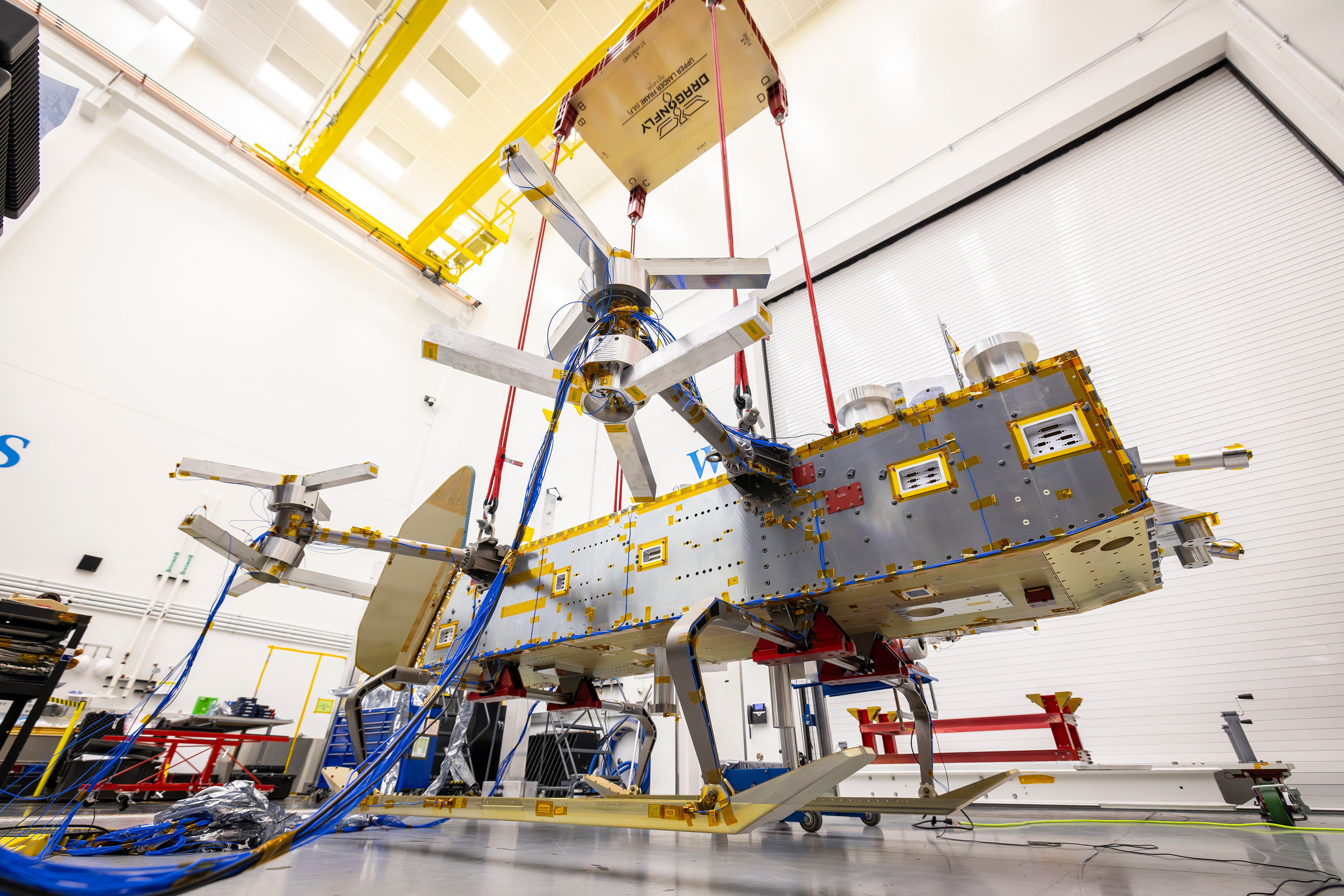
The mission reached a major milestone on June 29, when the Dragonfly team at the Johns Hopkins Applied Physics Laboratory (APL) in Laurel, Maryland, delivered the nearly 13-foot-long fuselage for the next phase of spacecraft integration ahead of schedule. The delivery followed a roughly month-long process of structural testing of the lander frame assembly, which carried many of the features that give the Dragonfly rotorcraft its unmistakable shape — including its landing skids, the cap for the spacecraft’s power source, and the arms that will eventually hold its eight sets of rotors.
“It was pretty awesome to see the lander, as we designed it, become real,” said Hunter Reeling, Dragonfly thermal-mechanical integration and test lead from APL.
With structural testing complete and the fuselage delivered, the team started integrating the mechanical, thermal and electrical systems on July 1, kicking off the process that will turn the lander into the flying science lab it’s meant to be.
Throughout the month, they’ll populate Dragonfly’s fuselage with the flight bulkheads, as well as the wiring harness, cables and connectors — the electrical “nervous system” that ties Dragonfly’s systems together. Electronics boxes, avionics and science instruments will follow as mission partners across the country complete their own assembly and test campaigns.
“From here, it’s about populating that structure with electronics boxes, instruments, wiring, insulation — everything that will enable its mission,” Reeling said. “It’s all about getting Dragonfly ready to launch.”
Link back home
One of the most visible additions came in May, when the Dragonfly team at APL integrated the mission’s high-gain antenna, the primary system that operators will use to communicate with the rotorcraft and retrieve the science data it collects on Titan.
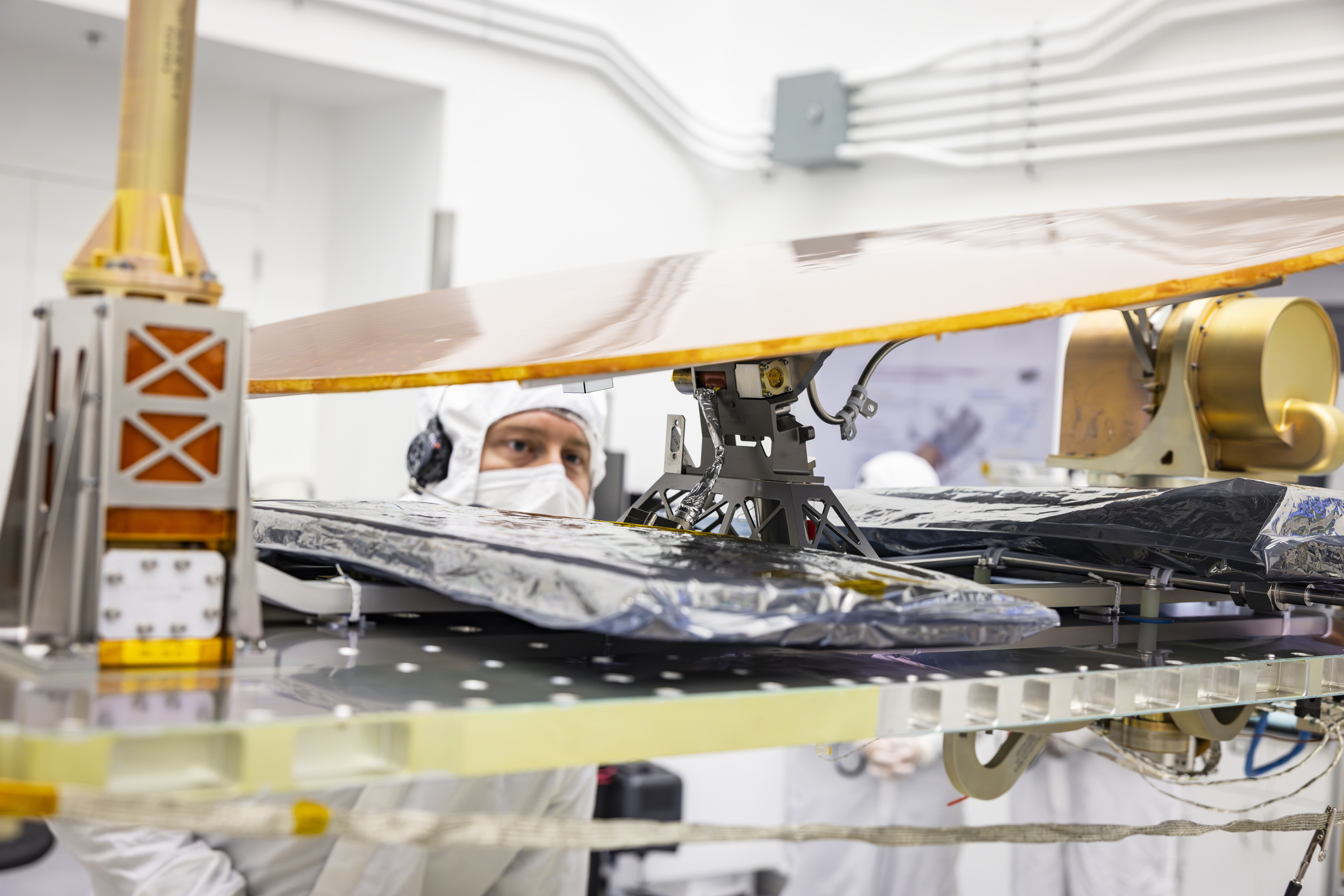
The high-gain antenna is a 34.4-inch-wide (87.4-centimeter-wide) disc made of electrically insulating foam sandwiched between two metal plates that contain hundreds of small slots. Together, these slots will narrow and focus the radio beam back to Earth. Adapted from technology originally developed for planetary defense applications, Dragonfly’s high-gain antenna, larger than previously flown systems, is attached to a motorized arm that will raise the antenna when the rotorcraft is stationary and lower it into a locking mechanism before Dragonfly takes off again.
“Every time the lander prepares to fly to another location, we store the antenna so it survives the vibrations created during flight and prevents resonance that could interfere with the rest of the lander,” said Jackson Banbury, Dragonfly telecommunications mechanical and thermal lead at APL.
The antenna and its gimbal are designed and tested to endure the rigors of Titan’s environment, including frigid temperatures averaging around minus 290 degrees Fahrenheit (minus 179 degrees Celsius), swirling dust on the surface, and potentially liquid methane rain.
Shaken, sealed, delivered
From May through early June, engineers and technicians at APL put the Dragonfly rotorcraft through vibration and sealing tests designed to show that the fuselage’s structural backbone can withstand the loads of launch, entry through Titan’s atmosphere, and landing on the surface of this ocean world.
For vibration testing, the team installed mass simulators in place of the flight instruments and electronics being built and tested elsewhere. The ground vibration test gave the team a fleeting preview of Dragonfly in the air. Engineers suspended the rotorcraft’s structure a few inches off the ground from long bungee cords, then measured how mechanical vibrations at the rotor locations traveled through the frame to key sensors on the main body.
“Suspended for a few hours during that test – even barely above the floor – was structurally akin to Dragonfly’s first flight,” said Gordon Maahs, the Dragonfly mechanical systems engineer from APL. “It gets the imagination going about what actual flight will look like.”
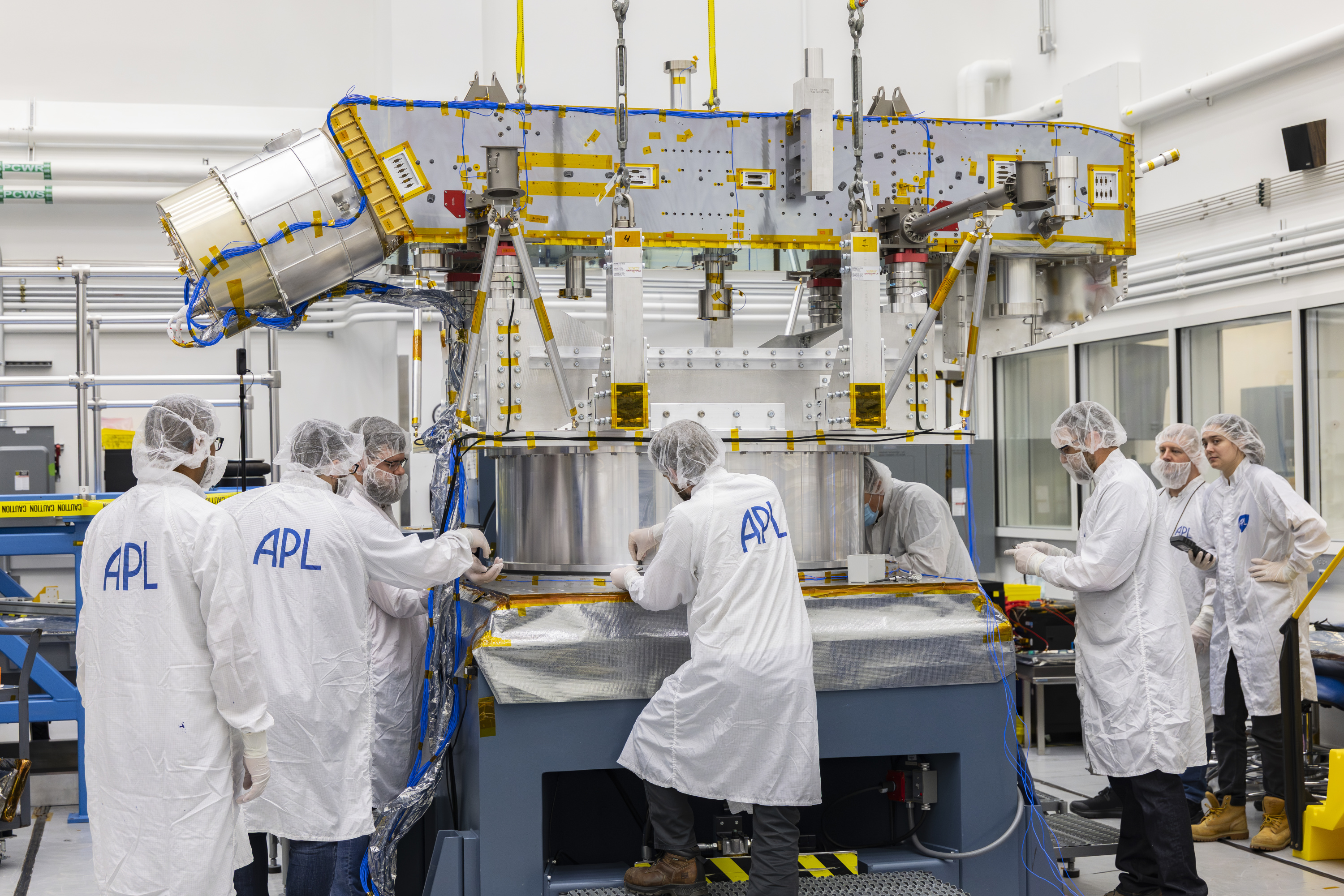
The sealing test was more unusual. Most planetary spacecraft are built for the vacuum of space or worlds with thin atmospheres. But Dragonfly is headed to Titan, where the surface atmosphere is dense, cold and about 1.5 times the pressure of Earth’s, so engineers needed to understand how well the assembled structure could keep that environment out. The solution: pressurize Dragonfly’s outer structure to identify any gaps, cracks or holes that could allow air flow in and out of the lander on Titan.
“I’ve never seen a test like it on any other spacecraft,” Maahs said. “We get a total flow rate based off of the sealing test, and that feeds our thermal analysis to determine if we’re sealed enough.”
The results, Maahs added, were “extremely good.”
Watch Eye on Dragonfly Live, an inside look at the mission’s progress, livestreamed here on July 16 at 2 p.m. ET. Hear from Dragonfly scientists and engineers, direct from the clean room, as they discuss the spacecraft’s latest milestones in integration and testing, explain how Dragonfly will explore Titan, and answer audience questions about the mission.