












Astra has completed final liquid oxygen conditioning and resumed countdown for the launch of its Rocket 3, carrying two of NASA’s TROPICS CubeSats. Liftoff currently is scheduled for today at 1:43 p.m. EDT.
Astra has paused the countdown of the launch of its Rocket 3, carrying two of NASA’s TROPICS CubeSats, to complete final liquid oxygen conditioning on the vehicle. Upon completion, the team will set a new launch time for TROPICS-1.

Each TROPICS satellite is identical – a 3U CubeSat about the size of a loaf of bread and weighing about 12 lbs. The TROPICS CubeSat payload is a spinning microwave radiometer with highly integrated, compact microwave receiver electronics. TROPICS satellite measures microwave frequencies ranging from about 90 to 205 gigahertz, which can monitor …

NASA’s TROPICS CubeSats mission is scheduled to launch today, June 12, on an Astra Rocket 3 from Space Launch Complex 46 at Cape Canaveral Space Force Station in Florida. A two-hour window opens at noon EDT. Here’s a look at some of today’s upcoming milestones. All times are approximate: COUNTDOWN Min/Sec Event +0s Lift-off +6s …

Weather officials with Cape Canaveral Space Force Station’s 45th Weather Squadron predict a 40% chance of favorable weather conditions at noon, the start of today’s launch window, with the forecast dropping to 10 percent favorable later in the afternoon. The primary weather concern at the start of the launch window is a Cumulus Cloud Rule …

Launch day has arrived for NASA’s commercial partner Astra. A pair of small satellites wait atop Astra’s Rocket 3 for liftoff from Space Launch Complex 46 at Cape Canaveral Space Force Station in Florida. This mission will send two-shoebox sized CubeSats to low-Earth orbit. A two-hour launch window opens at noon EDT. This is the …
Payloads: Astrobee/Smartphone Video Guidance Sensor (SVGS): Following the installation of the SVGS LED targets, an SVGS science session was performed. SVGS demonstrates the use of a photogrammetric vision-based technology for guidance, navigation, and control of a small spacecraft. Developed by NASA, the vision-based sensor computes the position and orientation vector of a target relative to …

Have questions about solar flares? Find answers here! What is a solar flare? A solar flare is an intense burst of radiation, or light, on the Sun. Flares are our solar system's most powerful explosive events – the most powerful flares have the energy equivalent of a billion hydrogen bombs, enough energy to power the …

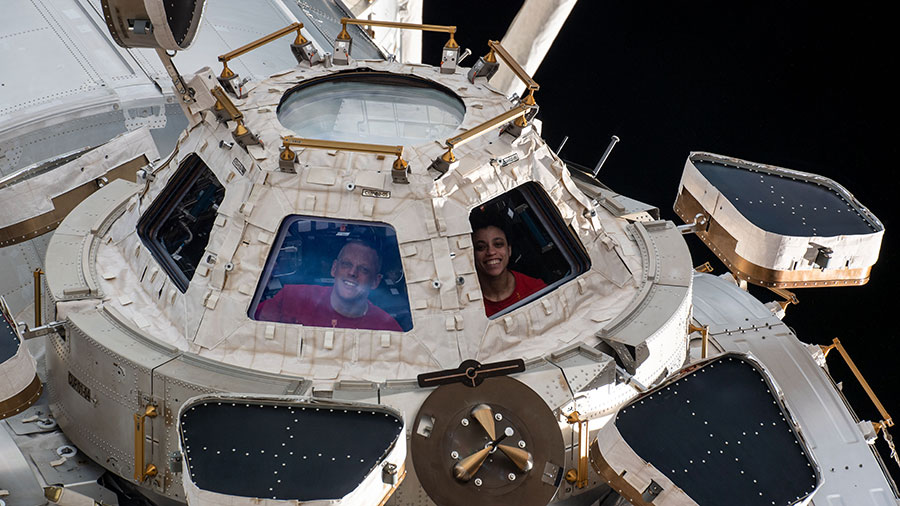
The Expedition 67 crew opened up BEAM, the International Space Station’s expandable module, today and conducted sensor checks and organized hardware. The orbital residents also continued their space botany and automated robotics research as well as ongoing cargo operations. NASA Flight Engineers Jessica Watkins and Bob Hines partnered together inside the BEAM module today for …