





















Launch week is underway at Vandenberg Air Force Base in California, where NASA's InSight spacecraft is being prepared for its upcoming flight to Mars. Mission and launch officials gathered Monday for the InSight flight readiness review. Teams are preparing to launch InSight on its United Launch Alliance Atlas V rocket Saturday, May 5, at 4:05 …
ISS Daily Summary Report – 4/30/2018
Japanese Small Satellite Orbital Deployer 8 (J-SSOD#8): Today the crew extended the Slide Table into the Japanese Experiment Module (JEM) from the JEM Airlock (JEMAL) and installed the Multipurpose Experiment Platform (MPEP). They then installed two J-SSOD#8 deployers on the MPEP. The J-SSODs are used to launch small satellites from the JEM Remote Manipulator System …
Faraday Cup Bests Sun Simulator
You don't get to swim in the Sun's atmosphere unless you can prove you belong there. And Parker Solar Probe's Faraday cup, a key sensor on the spacecraft, earned its stripes on April 19 by enduring testing in a homemade contraption designed to simulate the Sun.
What Does It Take to Keep the Station Stocked With Supplies?

The crew on board the International Space Station has been busy this month unloading the bounty of supplies and equipment brought up by the SpaceX Dragon and repacking it with cargo to be returned to Earth. If you’ve ever wondered what goes into a layover at the space station, check out chapter 14 of the …
Crew Packs Dragon With Science While Continuing More Space Research

The Expedition 55 crew members are packing up the SpaceX Dragon cargo craft today for its return to Earth on Wednesday. Meanwhile, the six International Space Station residents continue operating a multitude of space experiments while ensuring the orbital lab remains in tip-top shape. NASA astronauts Scott Tingle and Ricky Arnold transferred an array of …
More Than 1.1 Million Names Will Head to the Sun with Parker Solar Probe
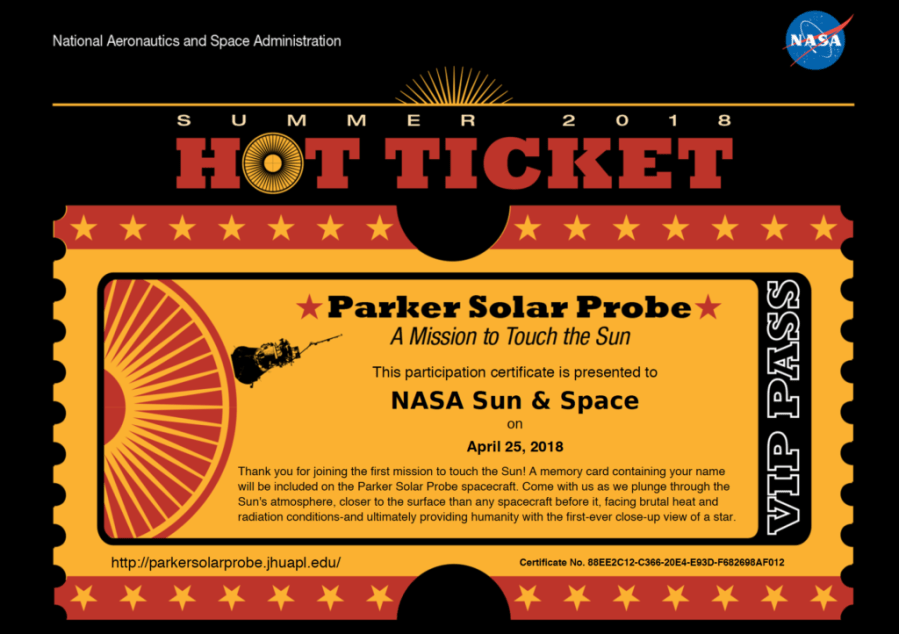
NASA's Parker Solar Probe will carry 1,137,202 submitted and confirmed names on its journey to the Sun. Submissions opened on March 6, 2018, and closed on April 27 at 11:59 p.m. EDT. A chip containing the names will be installed onto the spacecraft before launch.
NASA’s InSight Spacecraft Attached to Atlas V Rocket for Launch

NASA's next Mars lander is one significant step closer to beginning its journey. Secured inside its payload fairing, the agency's Interior Exploration using Seismic Investigations, Geodesy and Heat Transport (InSight) spacecraft was transported from the Astrotech facility to Space Launch Complex 3 at Vandenberg Air Force Base in California. The payload fairing was hoisted up …
ISS Daily Summary Report – 4/27/2018
Japanese Experiment Module (JEM) Airlock (JEMAL) Materials ISS Experiment – Flight Facility (MISSE-FF) Operations: The crew extended the JEMAL Slide Table into the JEM and removed the MISSE Transfer Tray (MTT) from the table. They also removed the JEM ORU Transfer Interface (JOTI), which was configured to support the MTT, from the table. Space Technology …
Safe in the Shadow: Making Sure Solar Probe’s Instruments Keep Cool

NASA's Parker Solar Probe is rotated down to a horizontal position during pre-launch processing and testing on April 10, 2018, at Astrotech Space Operations in Titusville, Florida, just outside Kennedy Space Center. Once horizontal, the integration and testing team will measure the alignment of the heat shield mounting points with respect to the spacecraft structure. This is done to assure that the umbra (or shadow) cast by the heat shield – called the Thermal Protection System – protects the spacecraft and instruments.