

















NASA’S PUNCH Releases Refined Images of Eruptions from the Sun
NASA’s PUNCH (Polarimeter to Unify the Corona and Heliosphere) mission has released processed images of huge eruptions from the Sun, known as coronal mass ejections (CMEs), that occurred from Oct. 21 to Nov. 12. This release marks the first time PUNCH observations can be used to continuously trace solar eruptions from the Sun’s outer atmosphere into interplanetary space.
To study the Sun’s outer atmosphere, or corona, each of the PUNCH mission spacecraft are outfitted with a camera that works with the others as a single “virtual instrument.” One PUNCH spacecraft hosts a Narrow Field Imager, which is a coronagraph designed to block out the bright radius of light from the Sun’s disk to reveal the faint, wispy details of the Sun’s corona, or outer atmosphere. The other three PUNCH spacecraft each carry a Wide Field Imager that captures images of the outermost portion of the solar corona and the solar wind. The mission then combines these individual views into a wide-field mosaic that allows PUNCH to track space weather events from the Sun all the way to Earth.
In the video, PUNCH captured several CMEs erupting from the Sun’s surface over several weeks. These ejections led to intense geomagnetic storms on Earth, with one particular storm in mid-November rated as G4, or severe. According to NOAA’s (National Oceanic and Atmospheric Administration) Space Weather Prediction Center, the G4 rank is the second highest level, indicating elevated risks of serious disturbances to Earth’s magnetic field and increased radiation exposure.
Such geomagnetic storms can have a significant impact on human society and technology, from sparking and intensifying auroras to interfering with satellites or triggering power outages. The storm on Nov. 11 resulted in widespread auroras seen as far south as Arizona, New Mexico, Texas, and Florida in the United States.
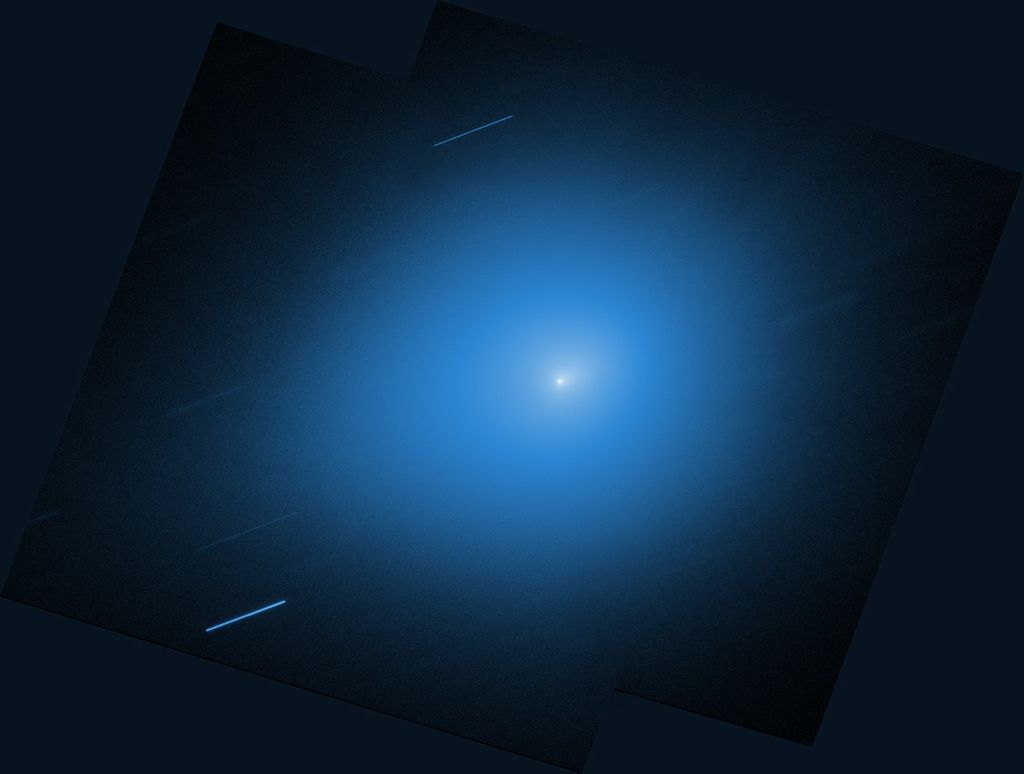
Though designed to observe CMEs, the PUNCH spacecraft tracks other objects journeying through our inner solar system. For example, the imagery also captured comet Lemmon (C/2025 A6), top portion of the video, making an appearance when the comet was passing close to Earth.
Delivering extra PUNCH with refined images
The PUNCH mission’s four suitcase-sized spacecraft are spread out along Earth’s day-night boundary, giving the mission a continuous, unobstructed view of the Sun and its surroundings. This allows the mission to study how the Sun’s corona turns into a constant outflow of material that travels across the solar system, called the solar wind.
The solar wind and energetic solar events like flares and CMEs can create space weather effects throughout the solar system. The measurements from PUNCH will provide scientists with new information about how these potentially disruptive events form and evolve. This could lead to more accurate predictions about the arrival of space weather events on Earth and related impacts on humanity’s robotic and human explorers in space.
To bring out details in the faint corona and solar wind, PUNCH images require multiple steps or “levels” of processing, from 0 (least processed) to 3 (fully processed). The PUNCH team is now releasing Level 3 data but continues to work on perfecting the imagery.
“The current data release is still preliminary, as we continue to refine the ground calibration to the exquisite level we need to reach our final sensitivity,” said Craig DeForest, PUNCH’s principal investigator at the Southwest Research Institute in Boulder, Colorado. “This release is a milestone because, although we still have work to do, these are the first data products that can be used directly to track CMEs and other events through the outer solar corona and inner heliosphere.”
With each iteration and release, the team is reprocessing prior images downlinked from the mission, so the quality of the PUNCH data products will continuously improve.
The PUNCH images are available for download from NASA’s Solar Data Analysis Center, and more information about the data is available at the Southwest Research Institute’s data access page. Scientists also use PUNCH’s observations of the corona and heliosphere in a project known as QuickPUNCH to support space weather forecasting operations.
The PUNCH mission complements observations from other NASA heliophysics missions — such as NASA’s Parker Solar Probe, STEREO, CODEX, and the recently launched IMAP, along with the NASA/ESA (European Space Agency) Solar Orbiter and SOHO missions — that examine the corona and solar wind at smaller scales and from different perspectives. Together, these missions provide a more complete picture of the corona and solar wind than we’ve ever had before.
Southwest Research Institute, based in San Antonio, leads the PUNCH mission and operates the four spacecraft from its facilities in Boulder, Colorado. The mission is managed by Space Science Mission Operations at NASA’s Goddard Space Flight Center in Greenbelt, Maryland, for the Science Mission Directorate at the agency’s headquarters in Washington.
By Desiree Apodaca
NASA’s Goddard Space Flight Center, Greenbelt, Md.
