
















Instruments on NASA’s Roman Space Telescope Get in Sync for Science
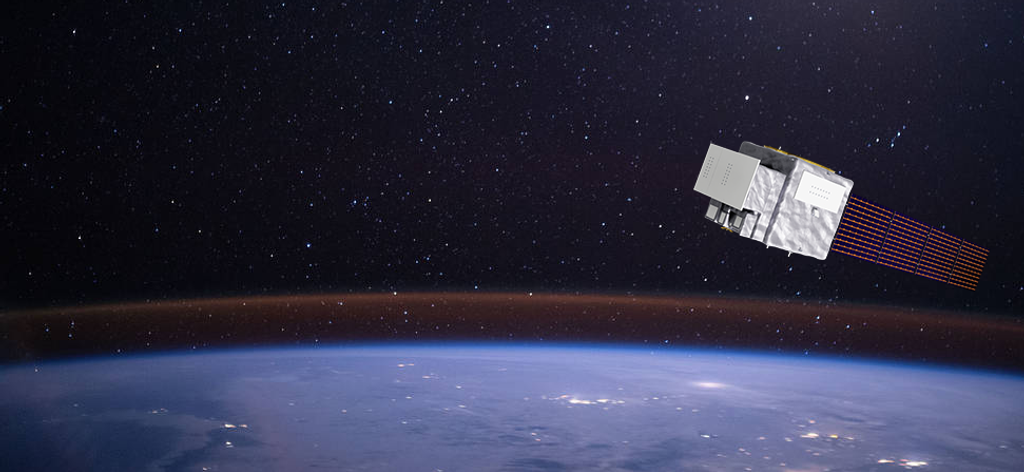
NASA’s Nancy Grace Roman Space Telescope has completed a key milestone, bringing its instruments into precise alignment and moving the observatory another step closer to science operations.
“Roman requires exquisite alignment because it has to be at least ten times more stable than our Hubble or Webb space telescopes to conduct the science it’s setting out to do,” said Dominic Benford, Roman’s program scientist at NASA Headquarters in Washington. “Roman’s power comes from two things: how big a view it gives us, and how small we can make the uncertainties in its measurements.”
The Roman team precisely lined up the observatory’s optics and instruments on the ground prior to launch. But launch vibrations, temperature changes, and the lack of gravity in space can cause little shifts. Scientists have been conducting a series of test observations to measure those shifts and update their notes on Roman’s anatomy, or “internal map.”
“The 18 detectors in the Wide Field Instrument are meant to work together when we’re locking onto guide stars,” said Tyler Desjardins, an astrophysicist working on Roman at the Space Telescope Science Institute in Baltimore. “If our map says a star should land here on one detector and another star should land there on another detector, but one of those positions is wrong, it starts presenting problems for guiding. We need to know the positions of our guide stars very precisely so we can accurately aim and correct tiny drifts.”
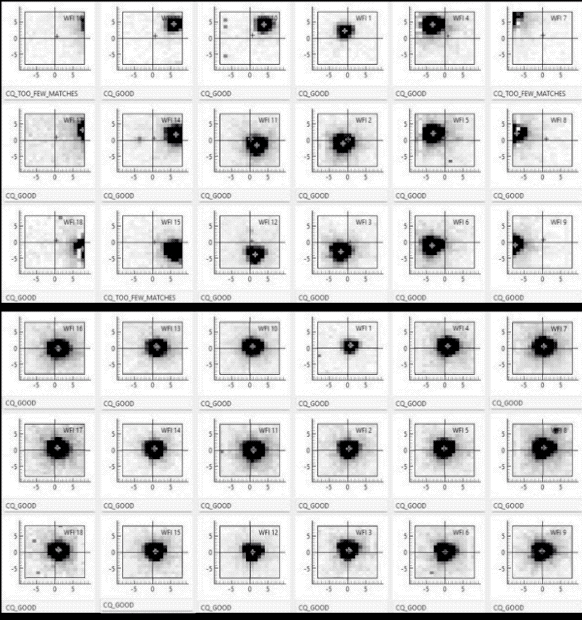
Scientists observed stars and compared where they were in Roman’s images with where they were expected. That told them how they need to adjust future observations so they will point exactly where they need to for light from the mission’s cosmic targets to fall onto the Wide Field Instrument’s detectors.
“Roman is now internally aligned to within a tiny fraction of a hair’s breadth of perfection,” said Tony Sohn, an astronomer working on Roman at the Space Telescope Science Institute. “This precision is essential both for pointing at the right place and for holding extremely still during each observation.”
Double agent
The Wide Field Instrument doubles as both Roman’s primary instrument and its guider, tracking stars to help the telescope point and hold steady during observations. Even while the Coronagraph Instrument is taking images of nearby stars in search of planets and dusty disks, the Wide Field Instrument will watch stars in a neighboring patch of sky to keep the observatory steady.
“The coronagraph will have to stare at a star for a long time to cancel out its light and collect very faint signals from orbiting planets, and we’ll get a random sampling of bonus deep fields alongside those observations for free,” Benford said. “It will be a very valuable additional bit of data that scientists will pore over, because those are largely going to be places where we have never had deep surveys.”
The Coronagraph Instrument uses a series of masks and other components to block a star’s glaring light. If any were placed incorrectly, the coronagraph wouldn’t be able to block unprecedented levels of starlight as it aims to do.
“The wave nature of light makes starlight spill when forming images, flowing into areas surrounding the star where planets could be found,” said Brian Kern, an optical engineer working on Roman at NASA’s Jet Propulsion Laboratory in Southern California. “A coronagraph uses carefully chosen masks to absorb and redirect that spilled starlight, removing enough to uncover the planets. We have precise alignment tolerances for positioning those masks individually, as a first step. That allows the next, more complex step to finish what alignment alone could not achieve.”
The Roman team adjusted the positions of the secondary mirror, along with a smaller mirror that connects the telescope to the Coronagraph Instrument and all the masks and optics within the instrument itself, to make its vision as clear as possible. Next, they’ll exercise more than 3,000 of the small, moving parts that make the instrument’s deformable mirrors move. “The deformable mirrors leverage the wave nature of light to redirect starlight while leaving planetary light, working step-by-step to reject more and more starlight,” Kern said. “That is how we will see such faint planets, so close to the stars that would otherwise smother our images with spilled starlight. We have demonstrated this in a lab using an artificial space environment, but the second stage of active starlight control in space, with real starlight and real planets, will be a record-breaking first-time accomplishment.”
To learn more about Roman’s commissioning process, visit:
science.nasa.gov/missions/roman-space-telescope/roman-commissioning
