













NASA’s Galileo Mission Points to Ammonia at Europa, Recent Study Shows
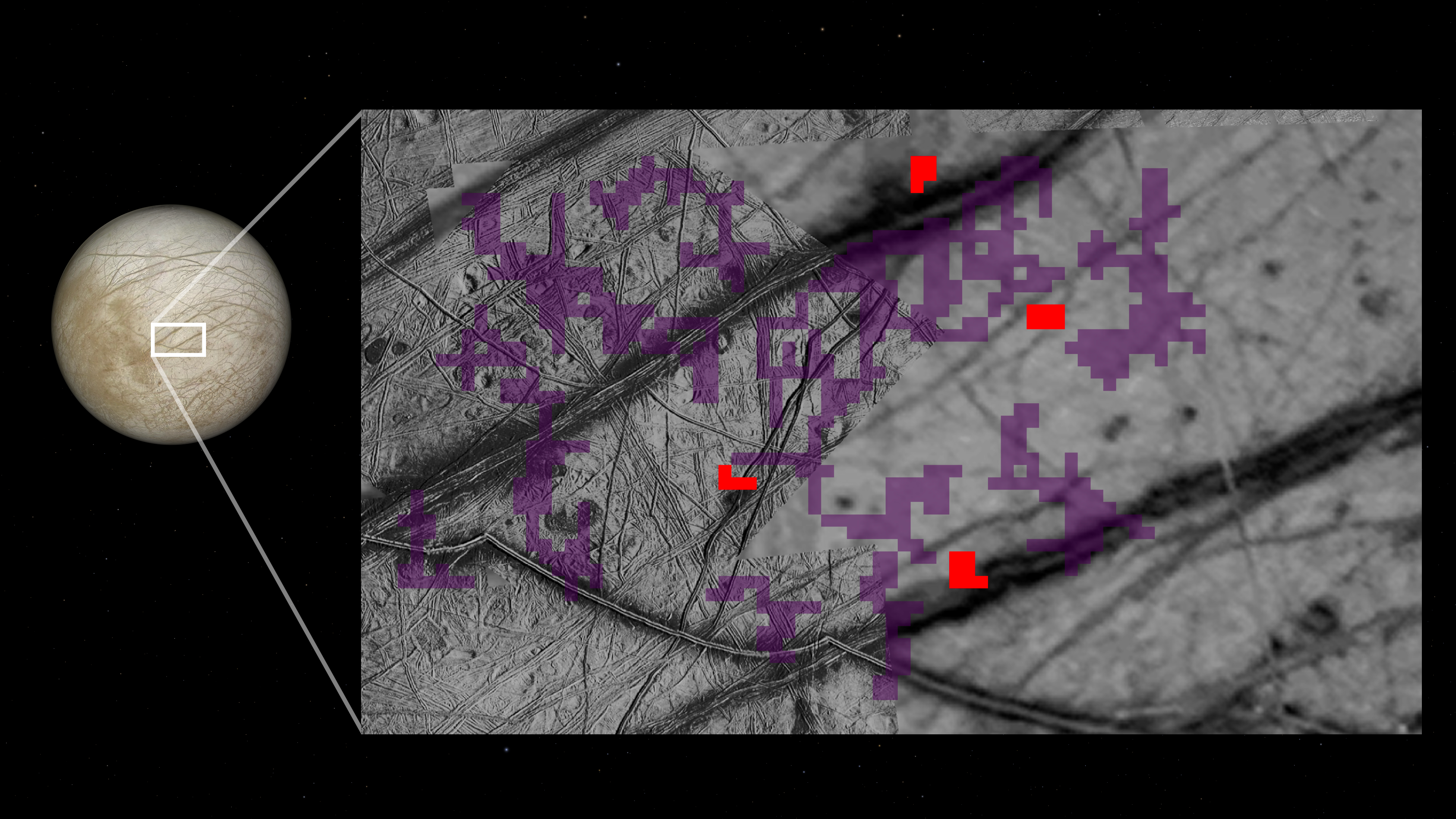
New analysis of decades-old data has turned up a significant result: the first discovery of ammonia-bearing compounds on the surface of Jupiter’s moon Europa. Ammonia is a nitrogen-bearing molecule, and nitrogen — like carbon, hydrogen, and oxygen — is key to life as we know it. As the first such detection at Europa, the finding has important implications for the geology and potential habitability of this icy world and its vast subsurface ocean.
Between 1995 and 2003, NASA’s Galileo spacecraft studied the Jupiter system, and a recent paper by researcher Al Emran of the agency’s Jet Propulsion Laboratory in Southern California re-examines data from the mission’s Near-Infrared Mapping Spectrometer. Hidden in the data were faint signals of ammonia near fractures on the moon’s frozen surface, through which liquid water containing dissolved ammonia compounds would be expected to rise. The compounds may have reached the surface through geologically recent cryo-volcanism.
That’s because ammonia significantly lowers the freezing point of water, acting as a sort of antifreeze. Ammonia also has a short lifespan in the space environment. These qualities, combined with the detection appearing near large fractures and pits on Europa’s surface, suggest active placement of ammonia-bearing compounds there, from either the moon’s subsurface ocean or its shallow subsurface.
The finding underscores the ongoing value of legacy datasets collected by previous space missions, which researchers can mine for new discoveries using modern analysis techniques. It also provides a tantalizing target for follow-up by the Europa Clipper mission, which arrives at the Jupiter system in April 2030.