Some Antarctic icebergs can persist for many years. A newborn child could go off to school, learn to drive, and become an adult all within the span of time it takes some of the largest icebergs to break up and melt away. Iceberg A-68A—now just a few months shy of its third birthday—is a youngster compared to some. But the mammoth berg has already had an impressive journey.
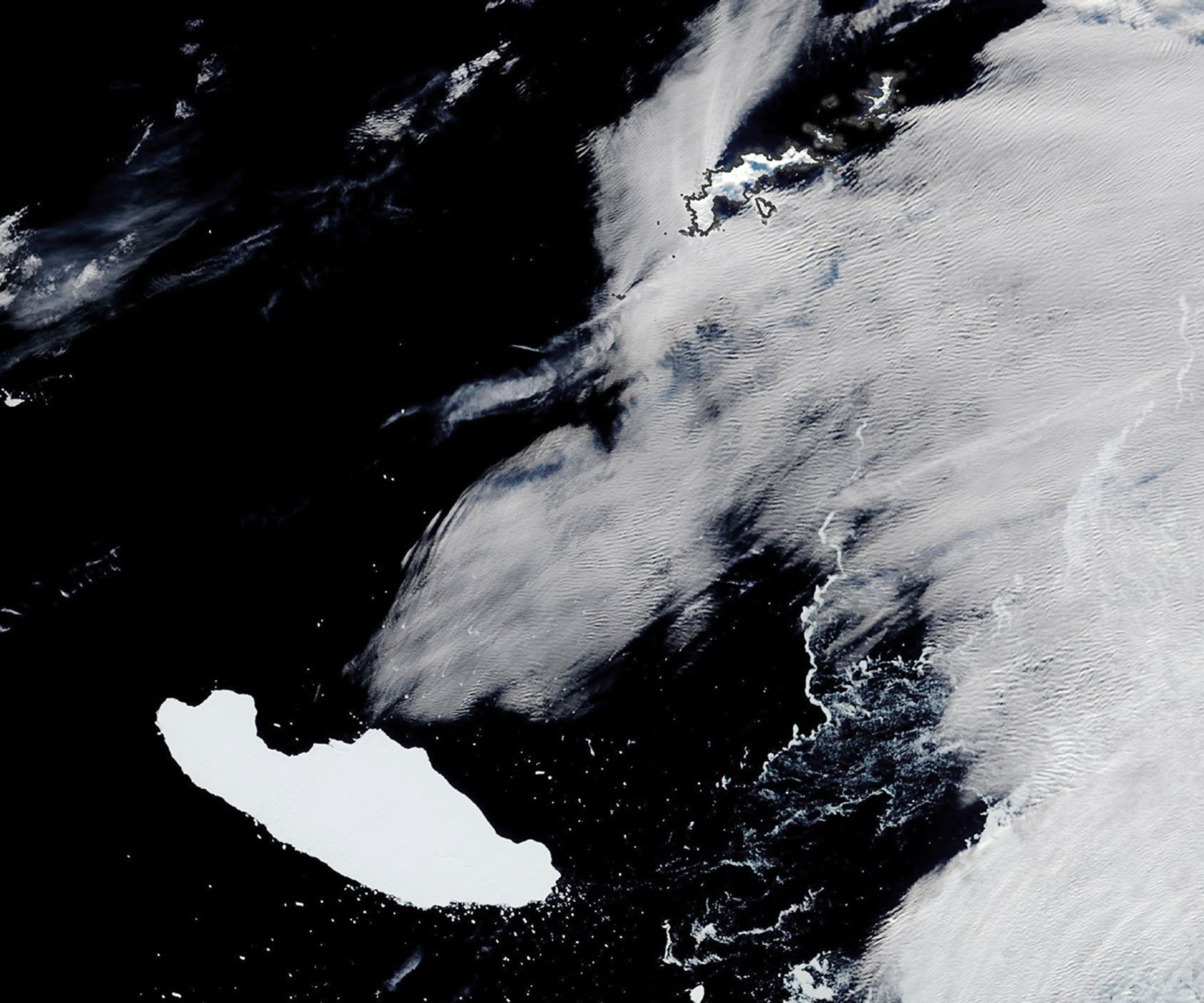
On April 9, 2020, the Moderate Resolution Imaging Spectroradiometer (MODIS) on NASA’s Terra satellite acquired this image of A-68A floating about 230 kilometers (140 miles) west-southwest of the South Orkney Islands. The 95-mile-long iceberg appears to dwarf the 80-mile-long island chain.
In this image, A-68A is about 500 miles from where it broke away from the Larsen C Ice Shelf in July 2017. The journey, however, was not exactly direct. In its first year, the iceberg moved just 45 kilometers (28 miles) as tides shuffled the Delaware-sized block of ice back and forth, occasionally smashing it against a rocky outcrop on the Antarctic Peninsula. The region’s powerful currents eventually won, and the iceberg has since been winding its way north through the Southern Ocean.
A-68A seems to have hit the brakes in recent weeks, rotating in place without moving far. NASA/UMBC glaciologist Christopher Shuman thinks the berg could be caught up in a circulating mass of water, or “gyre.” Christopher Readinger, a scientist at the U.S. National Ice Center (USNIC), agrees that a gyre or smaller-scale eddy could explain the berg’s motion. “This is behavior we’ve seen many times before with other bergs downstream of the peninsula,” Readinger said. “They just start circling for no apparent reason.”
Icebergs passing through this area eventually get kicked to the east when they encounter the powerful Antarctic Circumpolar Current, which funnels through the Drake Passage. From that point, the ice can whip north into the warmer waters of the South Atlantic—a region where icebergs melt, break down, and ultimately die. That has been the fate of many fragments of another iceberg, B-15. The Connecticut-sized berg was the largest ever measured by satellites, but 20 years after breaking from the Ross Ice Shelf, only one piece is still large enough to be tracked by the USNIC.
A-68A is not quite at that point. “I’m surprised at how well it’s sticking together,” Readinger said. “It’s been in warmer water for a few months now and it’s not exactly a very thick berg, so I expect it will break up sometime soon, but it’s showing no signs of that yet.”
References & Resources
- NASA Earth Observatory (2018, July 16) One Year Adrift, but Not Far.
- NASA Earth Observatory (2017, July 27) A Fracturing Berg in the Polar Night.
- U.S. National Ice Center (2020, April 10) Current Daily Ice Analysis. Accessed April 17, 2020.
NASA Earth Observatory image by Lauren Dauphin, using MODIS data from NASA EOSDIS/LANCE and GIBS/Worldview. Story by Kathryn Hansen.