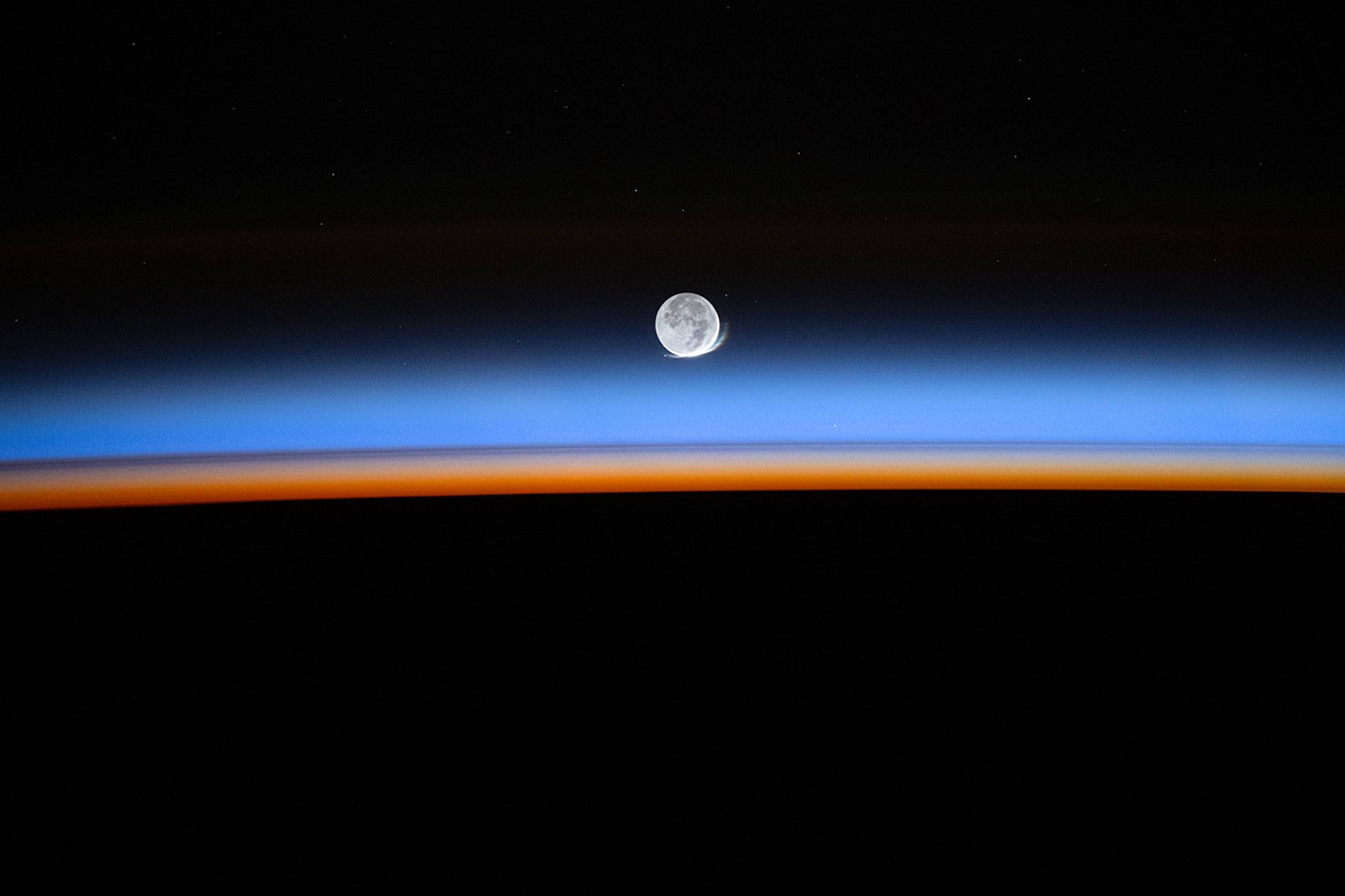



















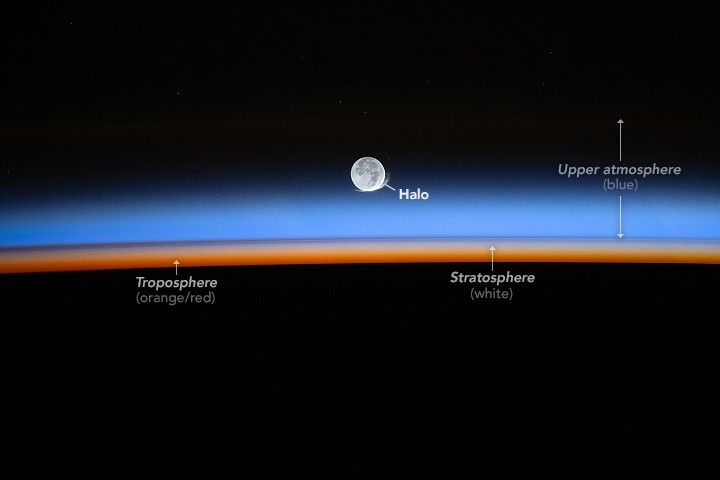
An astronaut aboard the International Space Station took this photo while orbiting over the Indian Ocean. The Earth appears black in the lower half of this image, mirroring the darkness of space above. Atmospheric layers span the image, displaying a range of hues. The troposphere generally appears orange and red, the stratosphere is mostly white, and the mesosphere is shades of blue. The Moon, with a shimmering streak-like feature below it, is visible near the top atmospheric layers.
When this photograph was captured on September 4, 2024, the Moon was in the waxing crescent phase. During this phase, only a sliver of the Moon is illuminated by reflected sunlight, visible as the extra-bright white crescent on the Moon’s lower-right edge. Camera settings such as exposure, shutter speed, and aperture increased the visibility of the Moon in this image, giving the impression of a full Moon. Another photo taken just before this one offers the same field of view, but different camera settings provide an image more similar to what human eyes would see.
At the time of this photo, the Moon was positioned behind Earth’s atmosphere relative to the space station. The atmosphere acts like a lens, bending light that passes through it and toward the astronaut’s camera, causing the Moon to appear non-uniform in shape.
The refraction or reflection of light through its interaction with various natural media—such as Earth’s atmosphere, standing and flowing water, or manufactured media like windows, mirrors, and camera lenses—can create fascinating optical phenomena. For example, ice crystals can form in the mesosphere around tiny dust particles, refracting light when it passes through to create arc-shaped features, like the Moon halos seen from Earth. A similar halo-like feature appears just below and to the right of the Moon in this photograph. However, based on established knowledge of imagery taken through space station windows, the observed “halo” is more likely the result of internal reflections from the layered panes of the cupola windows or internal lens reflections, rather than an atmospheric phenomenon.
Editor’s Note (December 2025): The final paragraph of this article has been revised to clarify that the precise cause of the observed halo feature remains uncertain.
Astronaut photograph ISS071-E-609044 was acquired on September 4, 2024, with a Nikon Z9 digital camera using a focal length of 200 millimeters. It is provided by the ISS Crew Earth Observations Facility and the Earth Science and Remote Sensing Unit, Johnson Space Center. The image was taken by a member of the Expedition 71 crew . The image has been cropped and enhanced to improve contrast, and lens artifacts have been removed. The International Space Station Program supports the laboratory as part of the ISS National Lab to help astronauts take pictures of Earth that will be of the greatest value to scientists and the public, and to make those images freely available on the Internet. Additional images taken by astronauts and cosmonauts can be viewed at the NASA/JSC Gateway to Astronaut Photography of Earth . Caption by Elysia N. Viengkham, Amentum-JETS II Contract at NASA-JSC.