
















June 6-July 6, 2021
A Longer-Lived Ice Arch
A natural seasonal structure known as an “ice arch” performs an important function as a temporary gatekeeper for sea ice in the Arctic Ocean. In most years, the structure takes shape in winter and spans either the southern or northern end of the Nares Strait between Greenland and Ellesmere Island. It works like a barrier to help keep sea ice penned up in the Arctic Ocean—at least until the arch crumbles away in late spring or summer.
A 2021 study led by Kent Moore of the University of Toronto Mississauga found that ice arches in the Nares Strait have been breaking up earlier than usual in recent years or have failed to form at all. The earliest known breakup occurred in 2017, when an ice arch on the northern end of the strait collapsed in early May. In 2018, an ice arch at the strait’s southern end didn’t even form until April. In both cases, the arches lasted for about 120 days.
There are still some years when the ice arch sticks around into summer. That was the case this year, as the ice arch lasted for about 200 days and persisted into July 2021. “There is a lot of variability,” Moore said, “and this year seems to have been a return to a longer-lived arch.”
The image pair above shows the ice arch on June 6, 2021 (left), and July 6, 2021 (right), before and after its collapse. Both images were acquired with the Moderate Resolution Imaging Spectroradiometer (MODIS) on NASA’s Terra satellite.
The arch formed in mid-December 2020 across the southern end of the strait and remained stable until early July 2021. The usual reason for the arch’s demise is the arrival of warmer temperatures in spring that begin to melt the ice, causing it to thin and weaken. Notice the ponds of melt water on the ice surface in the July image. Once the ice is weakened, winds can help to deliver the final blow.
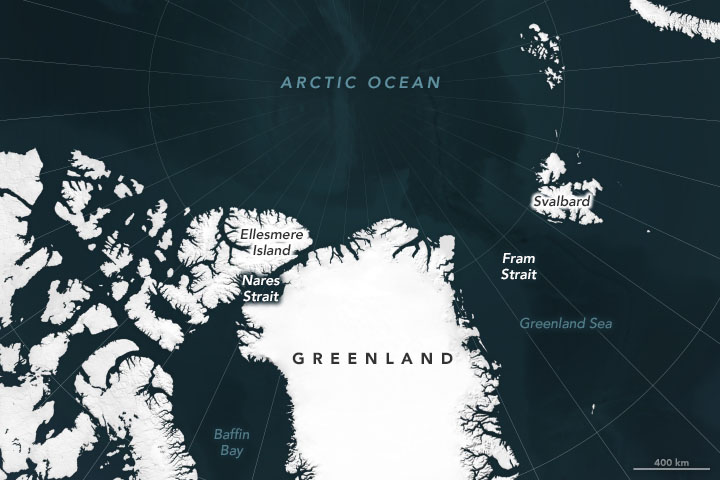
Despite the longer-lived ice arch this year, Moore notes that sea ice in the strait is generally becoming thinner. Thinner ice means less-stable arches. That could mean trouble for the older, thicker sea ice “upstream” of Nares Strait. Without an arch in place, this rarer type of multi-year ice north of Greenland and Ellesmere Island can more freely pass through the strait and leave the Arctic Ocean. In contrast, ice that leaves the Arctic Ocean via the Fram Strait east of Greenland is mostly younger and thinner.
“If the arches are less stable or don’t form, more multi-year ice leaves the Arctic,” Moore said. Indeed, Moore and colleagues reported that nearly double the volume of ice now passes through Nares Strait compared to the early 2000s.
References & Resources
- Moore, G. W. K. et al. (2021) Anomalous collapses of Nares Strait ice arches leads to enhanced export of Arctic sea ice. Nature Communications, 12 (1).
- NASA Earth Observatory (2017, May 20) Breakdown of an Ice Arch.
- National Snow & Ice Data Center (2017, July 7) Keeping pace with the record holder. Accessed July 13, 2021.
NASA Earth Observatory images by Lauren Dauphin and Joshua Stevens, using MODIS data from NASA EOSDIS LANCE and GIBS/Worldview . Story by Kathryn Hansen .