




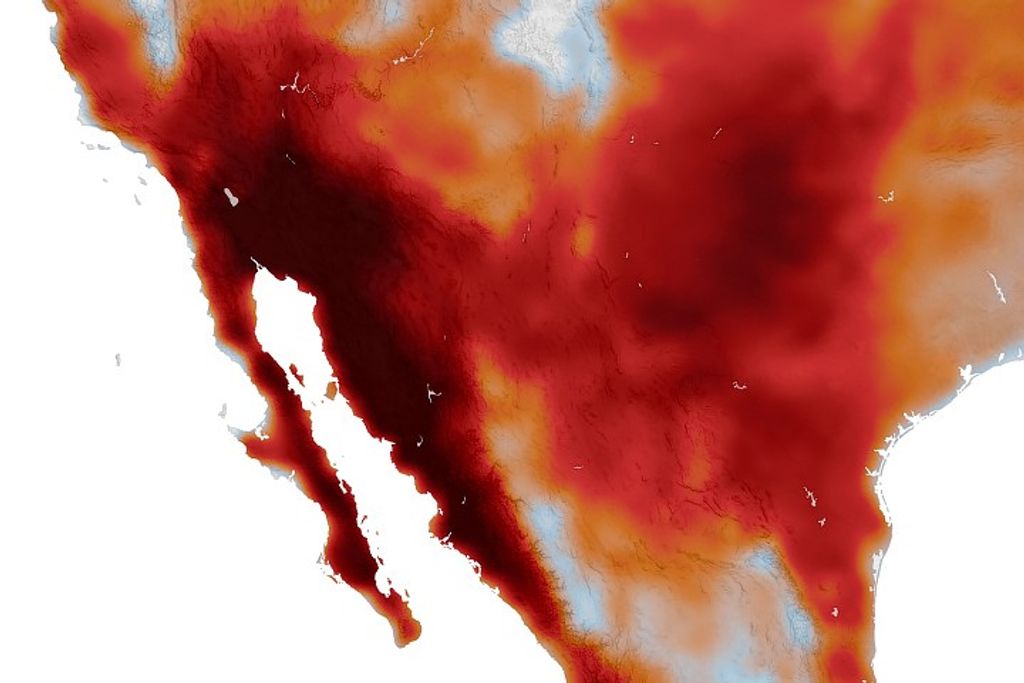

















While record-breaking heat scorched the Pacific Northwest in June 2021, parts of Europe and Siberia also saw early-summer temperatures climb.
The heatwaves are apparent in this map, which shows anomalies in air temperature at the surface from June 18-25, 2021. The anomalies indicate how much the daytime temperatures were above or below the average for the same period between 2003-2013. Red areas depict where the temperature was hotter than usual, and blue areas were cooler than usual. Data for the map are from the Atmospheric Infrared Sounder (AIRS) on NASA’s Aqua satellite.
One of the hot spots parked over central and eastern Europe. On June 23, ground stations in Moscow measured an air temperature of 34.8°C (94.6°F)—the city’s hottest June temperature on record. Helsinki, Finland, also saw its hottest June day on record (31.7°C/89.1°F), and national records for the month were set in Belarus (35.7°C/96.3°F) and Estonia (34.6°C/94.3°F).
According to Jennifer Francis, a scientist at Woodwell Climate Research Center, the heatwave is the result of a persistent northward bulge in the polar jet stream. “This is associated with a blocking pattern in the jet stream that has been prevalent over Scandinavia this year and contributed to unusually warm conditions there, especially in Finland,” Francis said.
A second region of warm surface temperatures is visible toward the east, along the Arctic coast in Siberia. According to James Overland, of NOAA’s Pacific Marine Environmental Laboratory, a low-pressure zone just west of the hot spot produced strong, warm winds from the south that kept away the colder Arctic air.
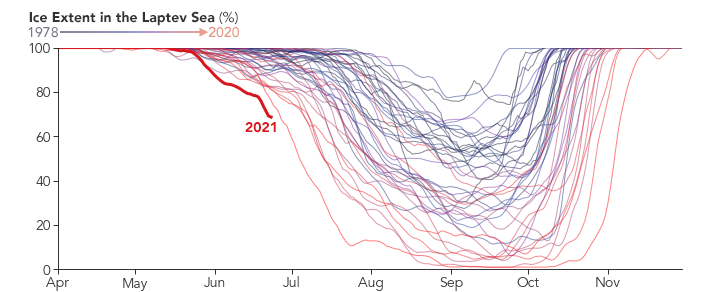
Both the offshore wind and the early heatwave helped to reduce the amount of sea ice in the Laptev Sea. As the chart above shows, sea ice coverage in this part of the Arctic Ocean reached a record low for the time of year.
So far, the record-low sea ice appears to be localized to the Laptev Sea. “I don’t think that the Arctic sea ice extent this summer will be as low as it was last summer,” said Judah Cohen a climatologist at Atmospheric and Environmental Research. Nor does the Siberian heatwave appear to be as widespread or anomalous as the 2020 heatwave.
Still, scientists are paying attention. “Western North America and northeast Asia are the two fastest-warming spots in summer,” Cohen said. “I’m not sure we know why Siberia is one of the regions that is warming the fastest in summer, but we can observe it.”
References & Resources
- Axios (2021, June 23) Arctic Heat Roasts Finland and Russia, Melts Sea Ice. Accessed June 30, 2021.
- NASA Earth Observatory (2020, June 24) Heat and Fire Scorches Siberia.
- Helsinki Times (2021, June 21) Heat Wave Continues with Temperatures Expected to Hit a Record High. Accessed June 30, 2021.
- The Washington Post (2021, June 24) Capital Weather Gang: Records Crumble in Europe, Russia Amid Scorching Heat Wave. Accessed June 30, 2021.
- World Meteorological Organization (2021, June 30) June Ends with Exceptional Heat. Accessed June 30, 2021.
NASA Earth Observatory images by Joshua Stevens , using AIRS data from the Goddard Earth Sciences Data and Information Services Center (GES DISC) and data from the National Snow and Ice Data Center . Story by Kathryn Hansen .