










![Request for Information – Potential [Placeholder for Prize]](https://assets.science.nasa.gov/dynamicimage/assets/science/missions/a-step/FFR_Earth_Background_20251120%20.png?w=1024)








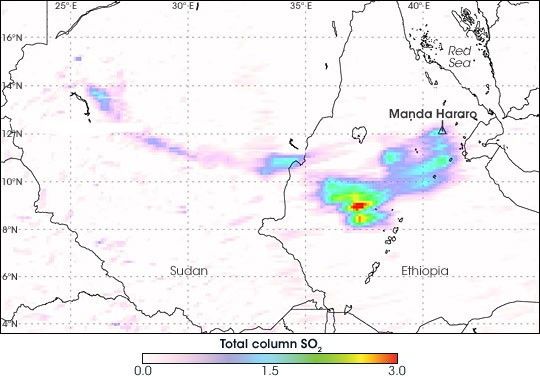
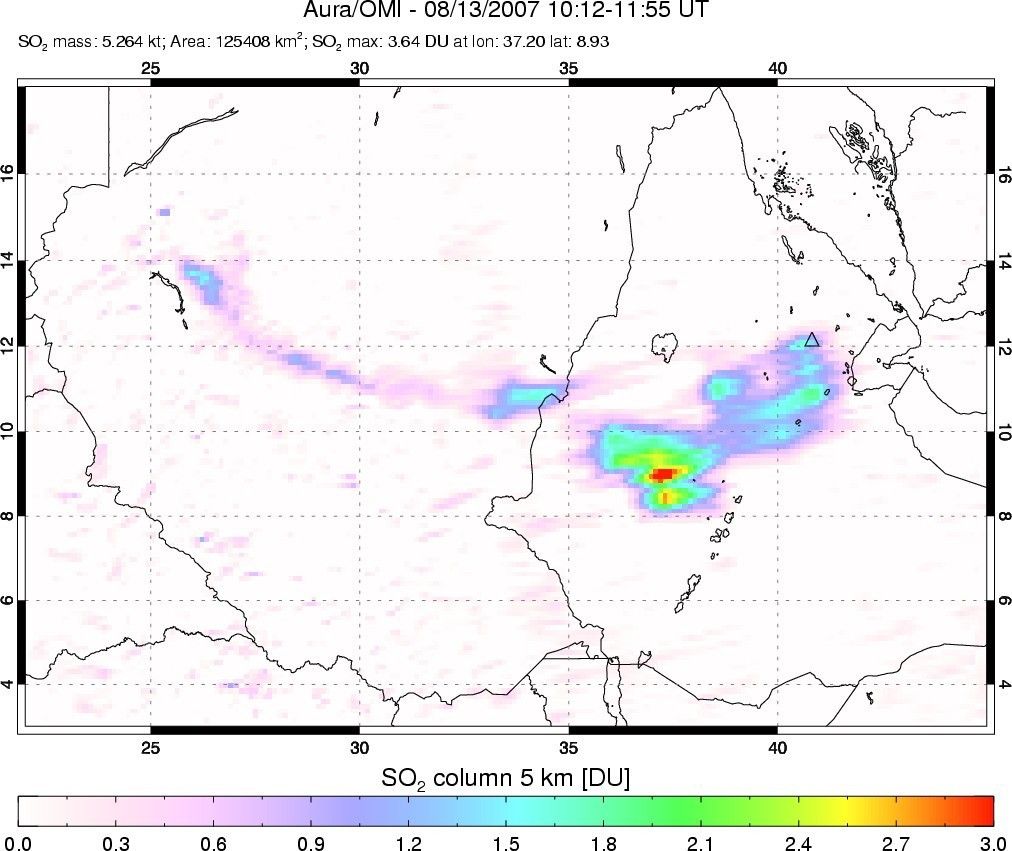
In western Afar, Ethiopia, sits a massive volcano complex, roughly 105 kilometers (65 miles) by 25 kilometers (15 miles). Known as Manda Hararo, the area had not been known for eruptive activity, but in August 2007, satellite, aerial, and ground-based observations showed the volcanic complex coming to life. According to a report from the Smithsonian Institution, an August 16 inspection of the site showed lava flows—including splattering and bubbling lava—from fissures in the complex, as well as sulfur deposits. On August 13, satellite observations detected gaseous emissions of sulfur dioxide.
This image shows the concentration of sulfur dioxide in the air column on August 13, 2007, as measured by the Ozone Monitoring Instrument (OMI) on NASA’s Aura satellite. The highest concentration appears just southwest of the volcano’s summit, and it intensifies near the southernmost portion of the sulfur dioxide plume. A fainter plume of sulfur dioxide moves to the west in a counter-clockwise direction. Because the greatest gas concentration has moved away from the summit, and another, dissipated plume has moved off to the west, this image may have captured the sulfur dioxide plume after the volcano had already been active for a few days.
The sulfur dioxide concentrations are measured in Dobson Units. If all sulfur dioxide in the air column the satellite observed were flattened into a thin layer at the surface of the Earth, one Dobson Unit would make a layer of pure sulfur dioxide 0.01 millimeters thick, assuming the temperature was 0 degrees Celsius. According to the U.S. Environmental Protection Agency, hazards posed by sulfur dioxide include breathing difficulties, visual impairment, and acid rain.
Manda Hararo is a complex of shield volcanoes. Composed of hardened lava flows, shield volcanoes resemble old warrior shields due to their flattened shape. In many shield volcanoes, lava erupts not from a central crater but from fissures on the volcano’s flanks. This was how lava erupted from Manda Hararo in August 2007.
References & Resources
NASA image courtesy Simon Carn, Joint Center for Earth Systems Technology (JCET), University of Maryland Baltimore County (UMBC)