












Located about 40 miles (70 km) southeast of Mexico City, Popocatépetl (pronounced poh-poh-kah-TEH-peh-til) is one of Mexico’s most active volcanoes. Popocatépetl has been erupting since January 2005, with near constant venting from fumaroles punctuated by minor steam, gas, and ash emissions.
Activity began to pick up significantly in mid-April. The volcano began emitting a substantial amount of ash on April 12, 2012, and an explosion on April 13 sent volcanic blocks as far as 500 meters (1,640 feet) away from the crater rim. On April 15, an ash plume rose 1.5 kilometers (0.9 miles feet) above the crater.
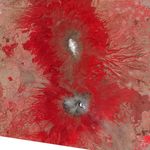
When the Advanced Spaceborne Thermal Emission and Reflection Radiometer (ASTER) instrument on NASA’s Terra satellite captured this false-color image of the volcano at 12:17 PM local time (17:17 UTC) on April 23, a plume of gas and steam was visible drifting east above the crater. The red depicts forests and vegetation surrounding the volcano.
The Mexican National Center for Disaster Prevention (CENAPRED) issued an update about the eruption on April 23, noting that seven small-to-moderate-sized ash emissions had occurred within an 11 hour period. When CENAPRED released its update, a continuous plume of steam and gas 100 meters (328 feet) above the crater was blowing south-southwest.
The last major eruption of Popocatépetl occurred in 800 A.D., in which vast amounts of lava and ash from the volcano completely filled many of the surrounding valleys. Since then, there have been at least five moderate eruptions, two of which occurred in the 1900s.
Further Reading
- NASA. (2012) NASA’s New Satellite Movie of One Week’s Ash Activity from Mexico’s Popocatépetl Volcano Accessed April 24, 2012.
References & Resources
- Global Volcanism Program. (2012) Popocatépetl Summary. Accessed April 24, 2012.
- CENAPRED. (2012) Popocatépetl: April 23. Accessed April 24, 2012.
NASA Earth Observatory image by Robert Simmon, using data from the NASA/GSFC/METI/ERSDAC/JAROS, and U.S./Japan ASTER Science Team. Caption by Adam Voiland.